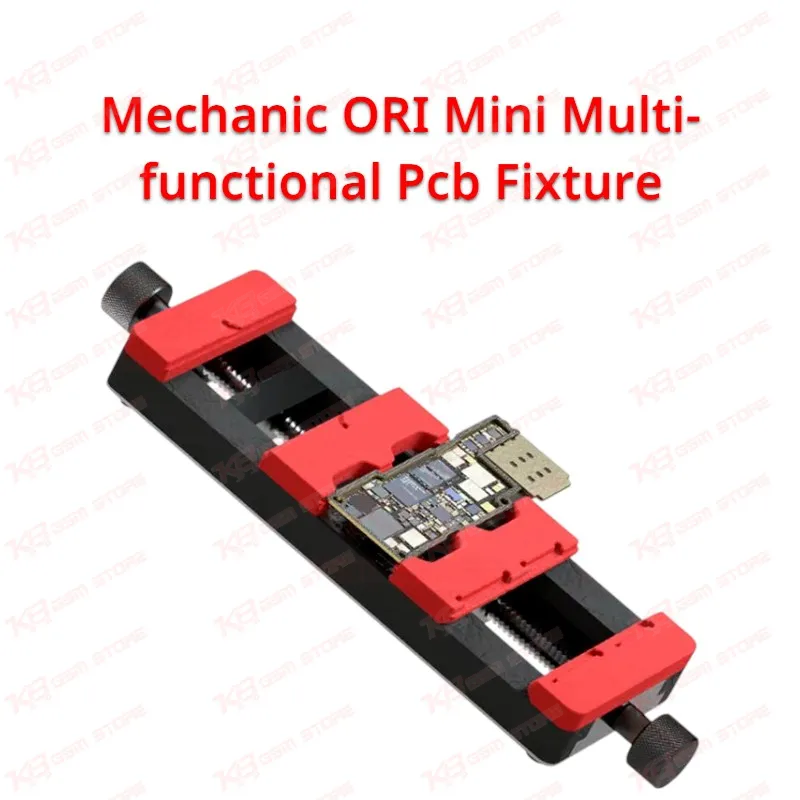
Every mobile repair workshop reaches a point where holding a motherboard steady by hand just does not cut it, and that is exactly the gap the Mechanic ORI Mini fills on the bench. This fixture uses a dual-axis screw clamping system, meaning the jaws move on two independent axes to grip boards of different shapes and sizes without you having to fight the clamp for alignment. The new jaw design keeps the board locked in one direction of operation, so once you set the clamping angle for a task, it stays put through the whole repair instead of drifting mid-job. That matters most when you are doing IC change karna on a dead phone board under the microscope, where even a slight shift in position can ruin the pads or shift a BGA chip out of alignment. The clamping surface itself is made from a high-temperature resistant synthetic stone, a material chosen specifically because it does not degrade or char when hit repeatedly with a hot air gun during reballing or IC removal. Anti-static and anti-corrosion properties in this panel mean flux residue, solder splashes, and daily handling will not eat into the surface the way a plain plastic or bare metal clamp would over time. Underneath, the alloy base gives the whole fixture the weight and grip it needs to stay planted on the workbench, so you are not chasing a sliding fixture around while trying to solder or probe test points. One of the more practical touches on the ORI Mini is dual-plate clamping, which lets you hold two boards or a board and a reference piece at once, useful when you are comparing a faulty motherboard against a known-good one for a boot loop issue or a hang on logo fault. Beyond phone motherboards, the fixture is built to hold CPU packages, hard disk drives, and other precision ICs that need de-glueing before removal, which makes it a reasonable stand-in for dedicated CPU jigs in a smaller workshop that cannot stock a separate fixture for every task. In a typical Pakistani repair shop, this fixture earns its place doing jobs like clamping a board during IC reballing, holding a chip steady while you jumper lagana on a damaged trace, fixing a motherboard in place while diagnosing a charging issue or network issue with a multimeter, and securing a board under the hot air station while chasing a dead after flash fault. Because the fixture is universal rather than tied to one phone brand or chipset, it sits well alongside your ISP box, UFS tools, and eMMC programmer as a shared piece of bench equipment rather than a single-purpose accessory. Technicians moving between Android and iPhone repair jobs get the same clamping behavior regardless of board layout, which keeps the workflow consistent whether you are working on a Samsung, Oppo, Vivo, Infinix, Tecno, or Apple board. Pair it with a soldering station and a set of tweezers and it becomes part of the core hardware setup for board-level repair, sitting between your desoldering work and your programming or flashing stage. For a repair shop investing in reballing kits, hot air stations, and microscopes, the ORI Mini is the low-cost fixture that ties that equipment together by giving every board a stable, repeatable clamping point on the bench.