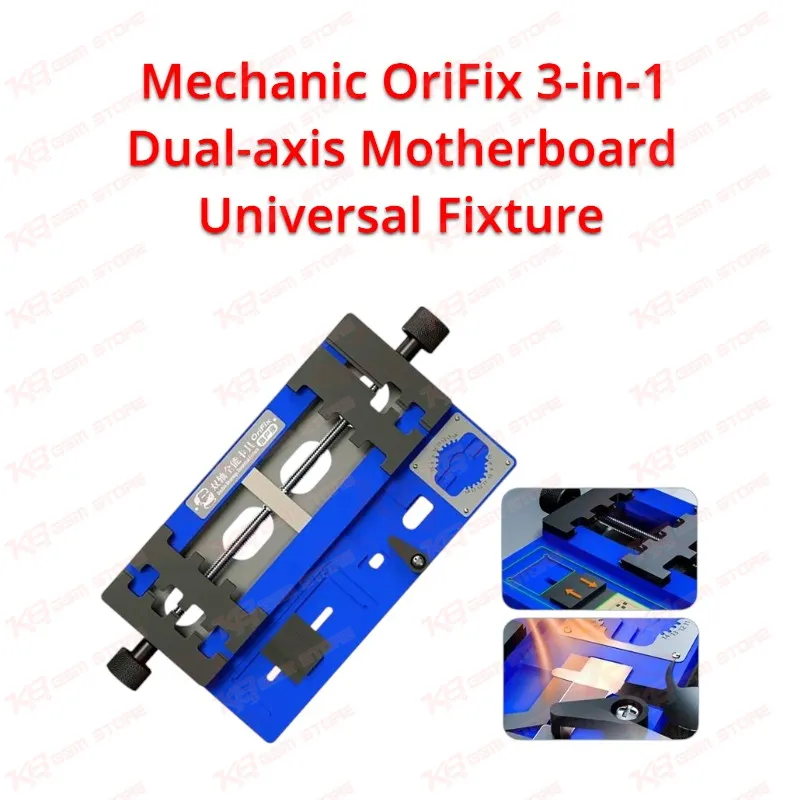
Every technician who has fought a shifting motherboard while running hot air over a CPU or NAND chip knows how much a bad clamp costs you in wasted boards. The Mechanic OriFix 3-in-1 Dual-Axis Motherboard Universal Fixture solves that exact problem on the workshop bench. It uses a double-axis linkage with a dislocation buckle, so the two clamping arms move independently and lock the board from both sides without twisting it out of position. That dual-axis action matters most when you are working on curved or uneven mainboards, where a single-axis clamp tends to let one corner lift while you apply heat to the other end. Under the clamping surface, Mechanic uses a V-groove structure alongside a trapezoidal card position, and together these two shapes bite into the board edge from different angles so it cannot slide sideways or pop out mid-repair. The clamping part itself is built from high-temperature resistant material that stays stable even as your hot air station runs hot enough to reflow BGA solder, and it holds up against corrosion from flux residue and cleaning solvents over repeated use. Underneath, a thickened double-layer bottom plate adds real weight to the base, so the whole fixture stays planted on the table instead of sliding around while you push, twist, or pry at a stuck chip. The handle is shaped for a firm grip, which helps when you need to reposition the board quickly between reballing, degluing, and testing steps without losing your clamp tension. Mechanic added several chip positioning slots and small storage compartments directly into the fixture body, so screws, jumpers, and tiny components you remove during a repair have somewhere to sit instead of rolling off the bench or getting lost. This is a genuine 3-in-1 tool in the sense that one fixture handles motherboard clamping, CPU and NAND chip fixation, and general precision IC holding for parts like hard disks that need controlled heat during degluing. It fits common mobile phone motherboard sizes found across current iPhone and Android models, and the clamping geometry is wide enough to match Apple boards from the A8 through A15 CPU generation as well as most mainstream Android chipsets. For iPhone X through 13 series repairs specifically, the fixture design accounts for the Face ID recognition module, letting you clamp the board for chip-level work without disturbing that module's position, which matters if you plan to reassemble Face ID function afterward. On the shop floor, this fixture earns its place during eMMC and NAND reballing, CPU reflow after a dead-after-flash board, network IC repair on a hang-on-logo unit, and general PCB stabilization while running diagnostics on a board with a charging issue or display problem. Because the clamp holds the board rigid, you get cleaner solder joints and fewer accidental pad lifts compared to holding a board by hand or resting it loosely on a mat. It is not a powered device and needs no calibration, so setup is just clamping the board and starting work. For a repair shop running multiple boards a day, having a fixture that holds motherboard, CPU, and precision ICs in one unit cuts down the number of separate jigs you need on the bench, which keeps the workflow faster between customer jobs.