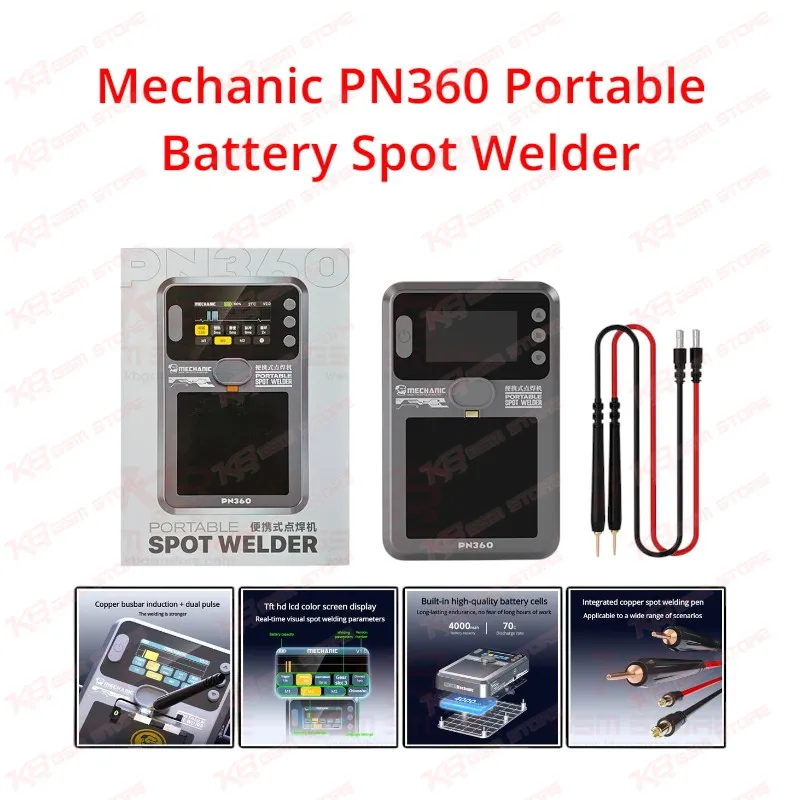
When a customer walks in with a phone that shuts down at 30%, keeps hanging on logo, shows a swollen back cover, or arrives as a dead phone that only powers on with the charger connected, the battery sits at the top of your suspect list, and the Mechanic PN360 Portable Battery Spot Welder gives you a clean way to fix it at cell level instead of hunting for a full replacement pack that may not exist in the local market. Many shops in Lahore, Karachi, and Islamabad now keep the original protection board and flex from the old battery and weld it onto a fresh cell, and that job needs a controlled, high-current pulse rather than a soldering iron. Heat from an iron travels straight into the lithium cell, stresses the internal layers, and can start the exact swelling problem you just removed, so a spot welder stays the safer choice for tab joints. The PN360 handles this job with a fully integrated body measuring 140 x 90 x 25mm, which means the power source, control circuit, display, and copper welding pen all live in one compact unit that sits comfortably beside your microscope and PCB holder. Its core is a built-in 4000mAh high-rate lithium battery rated at 70C discharge, and that high discharge rating lets the welder release a large current in a fraction of a second, reaching up to 650A peak at a maximum 4.2V output. Because the unit runs on its own internal battery, you never depend on a wall socket or a separate power supply during a weld, which matters in workshops where load-shedding or voltage drops can ruin a joint halfway through the job. When the charge runs low, you top it up through the USB Type-C port at 5V/2.1A maximum, using the same kind of charger already sitting on most repair counters. The PN360 routes its welding current through a copper busbar instead of thin internal wiring, and copper carries heavy current with less loss, so more of that output reaches the weld point rather than turning into heat inside the machine. Mechanic pairs this busbar with dual pulse output, a welding method where a short first pulse prepares the contact surface and the second pulse forms the actual weld, giving you a tab joint that holds under vibration and pulling instead of popping loose after a week in the customer's pocket. The integrated copper welding pen connects directly to the unit, so you avoid loose clip leads that shift during work, and you can position the tips precisely on small phone battery tabs or on a nickel strip joining two cells. A TFT colour display shows your welding parameters in real time, so you see the selected power level and mode before you press the tips down rather than guessing from a beep. You get adjustable output power, which lets you drop the energy for thin phone battery tabs and raise it for thicker nickel strip work, and the machine offers both automatic and manual welding modes. In auto mode, the PN360 fires the pulse once both pen tips make proper contact, which keeps your hands steady and your welds consistent across a batch, while manual mode gives you direct control when you want to time the weld yourself on an awkward tab. The workflow stays simple enough for a new apprentice to pick up quickly: place the battery cell and tab in position, set the output level on the screen, and press the pen tips down to complete the weld. For a typical cell swap, you separate the old cell from its protection board, dispose of the swollen or dead cell safely, prepare the new cell, lay a fresh nickel strip over the terminals, and weld the strip to both the cell and the protection board pads before insulating everything with Kapton tape. Check the rebuilt battery with a multimeter for correct voltage before refitting it, and watch the charging current with a USB tester once the phone boots, so you catch any weak joint before the customer leaves your counter. The PN360 fits naturally into your battery bench next to a soldering station for board pads, a hot air station for softening adhesive and removing stuck batteries, and a microscope for inspecting weld marks on tiny tabs, and it works alongside multimeters, test boxes, and PCB holders when a charging issue turns out to be a hardware fault on the board rather than a battery fault. The kit ships with the main unit, the welding pen, a charging cable, and nickel strips, so you can start practising welds on scrap cells the same day it arrives. Beyond phone batteries, the same high-current pulse suits lithium battery nickel plate welding for small packs, including power bank repairs and small 18650 or 21700 builds that technicians and hobbyists assemble for bench tools and portable devices. Keep the job matched to the tool: a portable, battery-powered welder at this output level suits thin nickel strips and phone battery tabs, not heavy industrial pack production, and within that range you get reliable joints every time. For repair shops, the practical gain shows up in turnover, because instead of telling a customer to wait days for a battery that may never arrive, you rebuild the pack with a quality cell and the original protection board and hand the phone back the same day. That service works especially well for older models and hard-to-find batteries where local markets only stock low-quality copies. Service centers handling bulk battery jobs benefit from the consistency of auto mode, since every weld hits the same energy level and your staff produce uniform results regardless of experience. Training institutes can use the PN360 to teach battery handling and spot welding basics without setting up a bulky mains-powered welder, and the compact size lets students practise at every seat. Treat lithium cells with respect during every job: work on a heat-resistant mat, never weld on a punctured or badly swollen cell, and keep a fire-safe container nearby for damaged batteries. If you want to add battery cell replacement to your shop's service menu, or you currently use a soldering iron for tab joints and want safer, stronger results, the PN360 gives you a portable, rechargeable, and simple battery welding setup, and you can order it from KB GSM Store with delivery across Pakistan.