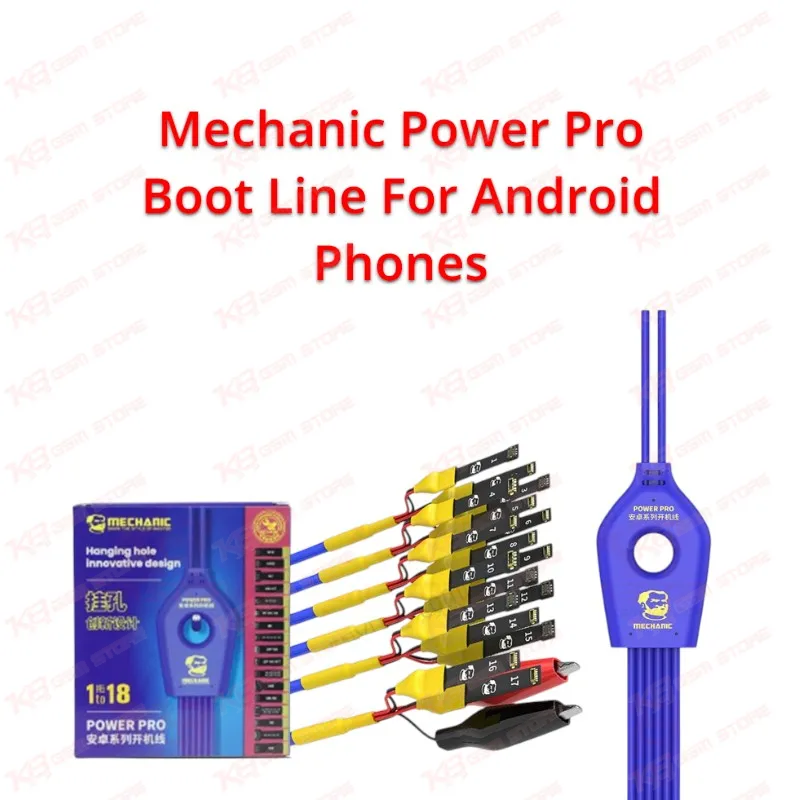
When a customer walks into your shop with a dead phone, the first question on the bench never changes: does the board take current or not? The Mechanic Power Pro Boot Line For Android Phones answers that question fast. Instead of trusting a weak or swollen battery, you feed the motherboard directly from your DC power supply through one flexible FPC line that fans out into 17 battery-connector heads, and your ammeter shows you what really happens on the board. A reading that jumps to full current the moment you connect points to a short on the main power line. Zero current tells you the board never wakes up, which sends you toward the power key path, the PMIC, or the battery connector itself. A reading that climbs, drops and repeats matches a boot loop issue or a phone that hangs on logo, and that pattern often separates a software fault from a hardware fault before you even pick up the flash box. Mechanic designed this line for the battery connectors found in Android and HarmonyOS phones, with support for more than 2000 models from Samsung, Xiaomi, Redmi, Huawei, Oppo, Vivo, OnePlus, Lenovo, LG, Meizu and ZTE, which covers most handsets that land on a Pakistani repair counter on any given day. The cable uses flexible FPC instead of a rigid hardboard PCB, so the head bends into tight spots and you get a clean contact without fighting the board. Inside, a thickened copper wire core widens the conduction area and keeps resistance low. That matters more than many technicians realise: a thin, high-resistance boot cable drops voltage under load, and the board can restart or refuse to power on even when nothing is wrong with it, so you end up chasing a fault that does not exist. With a low-resistance line, the current figure on your supply reflects the board, not the cable, and your diagnosis stays trustworthy. Precision welding at the joints keeps power delivery stable, and the high-density wire body resists cracking and wear from daily bending, plugging and unplugging, exactly the treatment a boot cable gets on a busy bench in Lahore, Karachi or Islamabad. The hook and hanging-hole design looks like a small detail, but it lets you hang the line beside your power supply instead of losing it under flux bottles and screws. In a real workflow, the Power Pro sits at the very start of board-level diagnosis. You open the phone, mount the board in a PCB holder, connect the matching head and switch on the supply. If the reading signals a short, you move to your multimeter, then confirm the hot component under a microscope before you lift it with a hot air station or rework it with a soldering station. If the board draws normal current but stays dead after flash or stuck on a corrupted boot, you know the hardware holds up and you can shift to your test box, ISP pinout tools, eMMC programmers or UFS adapters for the software and storage side of the job. The line earns its place after the repair too: once you replace a charging IC or finish a job with your reballing kit, you power the board through the boot line and confirm a clean start before you close the phone, which saves you from comebacks. For shop owners buying in Pakistan, one cable replaces a drawer of loose clip wires and spares customer batteries from risky tests on unknown boards. Pair it with a reliable DC power supply, and the Mechanic Power Pro Boot Line becomes the first tool you reach for on every Android board.