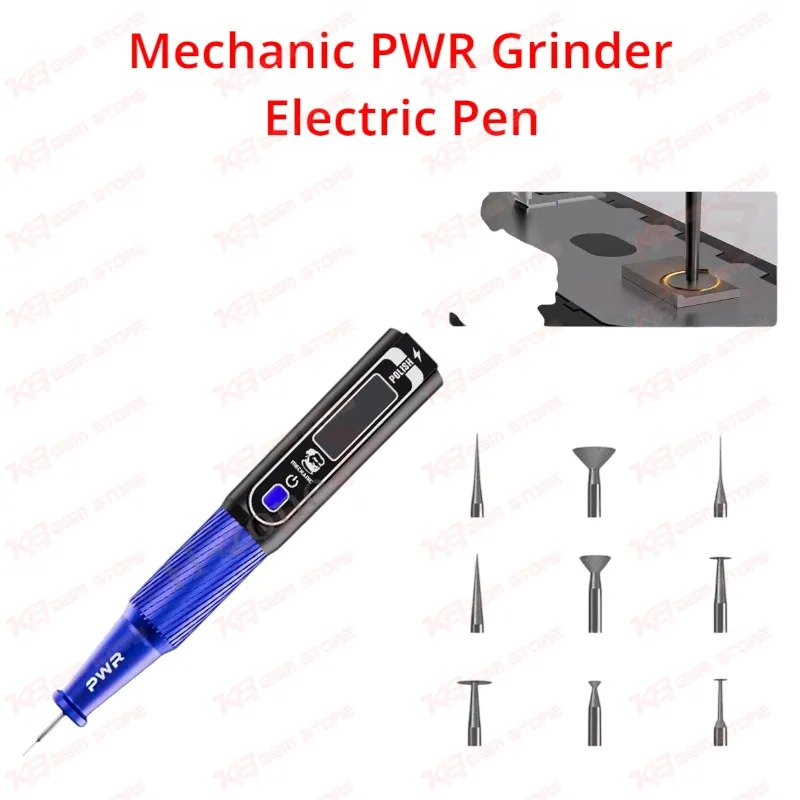
Every board-level technician knows the moment when a hot air station and flux alone cannot finish the job: a CPU sits under hardened underfill, a pad carries a stubborn oxide layer, or a bent bracket will not release the board. The Mechanic PWR Grinder Electric Pen fills that gap on a Pakistani repair bench. Mechanic built this cordless grinding pen around a 37000 RPM high-speed motor that holds its torque under continuous load, so the bit keeps cutting when you press into epoxy or aluminium instead of stalling halfway through the pass. The manufacturer rates its grinding efficiency at around 70 percent higher than traditional motors. In daily workshop use that means less time on sealant removal for each CPU, eMMC or UFS chip you prepare for IC replacement. Precision matters more than raw speed on a phone motherboard, and the PWR handles that through double ball bearings and an all-metal transmission structure that keeps runout within 0.01mm. Low runout means the emery head spins true on its axis instead of wobbling. That lets you skim BGA sealant around a processor, clean a pad's oxide layer before reballing, or level a chip surface without chewing into nearby capacitors, resistors or the solder mask. Pakistani distributors list three speed stages of 12000, 24000 and 37000 RPM. Use the low setting for polishing and pad cleaning, the middle setting for general underfill removal, and full speed for motherboard cutting or metal work on brackets and frames. A dot-matrix display on the body shows the working status in real time, so you know which speed stage you are running before you start a delicate pass on an expensive board. Power comes from a 1200mAh rechargeable battery with Type-C charging. The cordless design removes the cable drag that pulls your hand off line during fine grinding under a microscope. You charge it with the same Type-C cable you already use around the shop, keep it next to your soldering station, and pick it up whenever a job calls for it. At 150 × 26 × 24mm and about 100g net weight, the pen sits in your hand like a thick marker, which reduces fatigue when you spend a full evening clearing underfill from several boards. Mechanic ships the PWR with nine emery grinding heads for different tasks: fine tips for chip-edge sealant, wider heads for flattening and polishing, and cutting profiles for board and bracket work. That kit covers chip grinding, motherboard cutting, bracket removal, screw removal and frame correction, so one tool replaces several single-purpose gadgets on a busy repair counter. Think about the jobs that reach a typical Pakistani repair shop every week: a phone that goes dead after a failed flash and needs its eMMC or UFS chip lifted for direct programming, a boot loop or hang on logo fault that you trace to a cracked CPU joint, a charging issue that comes from a damaged PMIC, or a network issue that points to an RF IC under glue. In each of these cases, underfill removal decides whether the IC change succeeds or whether you lift pads and turn a repairable board into scrap. The PWR lets you remove the glue around the chip perimeter before you apply heat, so the component releases cleanly under your hot air station and the pads underneath survive for reballing. After removal, switch to a polishing head at a lower speed to clear leftover sealant and oxide from the pad field. Then move to your reballing kit, stencil and solder paste with a clean surface ready for new balls. The same workflow applies when you prepare a chip for data recovery or direct eMMC and UFS reading, where you need clean pads before the chip goes onto a UFS adapter or eMMC programmer socket. The metal-capable heads also earn their place away from the board. Stripped or seized frame screws, bent mid-frame edges that stop a new display from seating, and brackets that a previous technician glued in place all respond to controlled grinding, which avoids forced prying that can crack the motherboard. Mount the board in a stable PCB holder so it cannot shift during a pass, work under a stereo microscope for chip-level jobs, and keep light, even pressure so the motor's torque does the cutting. When you finish, check the repair with a multimeter and a DC power supply before you close the device. If the job continues into software work such as flashing or FRP lock removal, connect the phone to your test box or ISP pinout setup. For shops that still use a corded rotary tool or scrape by hand with a blade, the Mechanic PWR is a clear upgrade. You get cordless freedom, a speed range that suits electronics rather than woodwork, and runout precision that respects the tight component spacing on modern Samsung, Oppo, Vivo, Infinix, Tecno and iPhone boards. Technical training institutes benefit too, because students learn controlled underfill removal on a tool that forgives small mistakes better than a sharp blade. KB GSM Store stocks the Mechanic PWR Grinder Electric Pen for technicians, service centers and repair businesses across Lahore, Karachi, Islamabad and the rest of Pakistan, so you can add reliable grinding and cutting capability to your bench without waiting on international shipping.