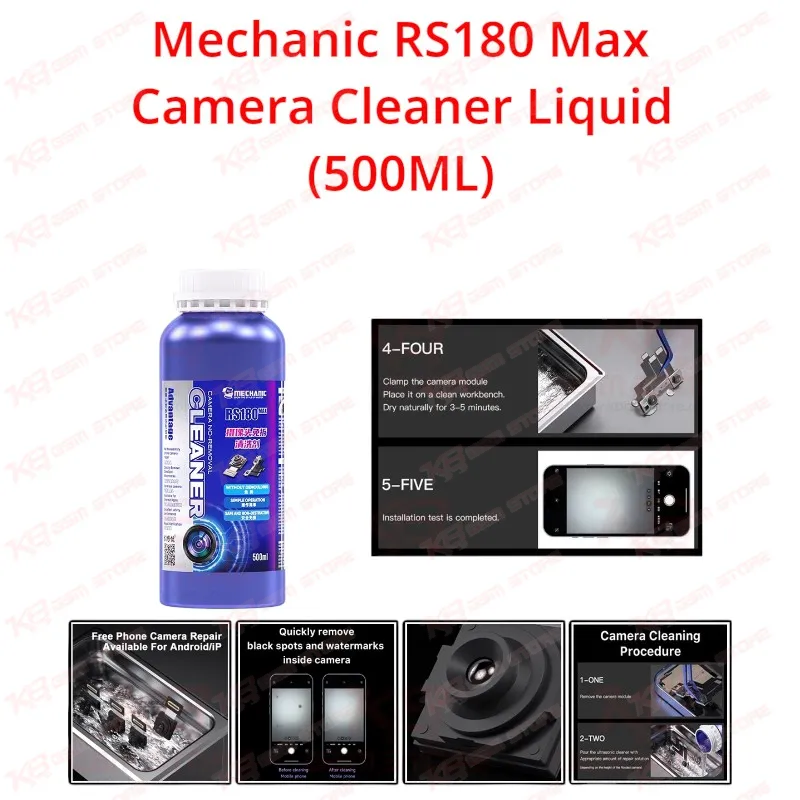
A phone lands on your bench with a clean outer lens, a working camera app, and photos that still come out hazy, spotted, or foggy at the edges, and the customer insists the camera is dead. In many of these jobs the fault sits behind the outer glass: moisture traces, watermarks, dust, and oily film settle on the camera module after water exposure, a cracked back glass, or a careless earlier repair. The Mechanic RS180 Max Camera Cleaner Liquid (500ML) targets exactly this problem. Mechanic, the Hong Kong repair consumables brand behind a wide range of fluxes, solder pastes, and maintenance agents, classifies the RS180 Max as a no-disassembly camera cleaning agent, which means you clean the camera module without opening the lens assembly. That matters because opening a modern lens stack usually ruins focus alignment, and a replacement camera for a flagship Samsung or iPhone costs far more than a proper cleaning job. The RS180 Max works with an ultrasonic cleaner, and that pairing drives the whole workflow: the ultrasonic bath creates cavitation in the liquid, and the solution carries that scrubbing action into gaps and edges no swab or brush can reach. You remove the camera module from the board, check the flex and connector for corrosion under your microscope, prepare the ultrasonic bath as the bottle label directs, run the cycle, and let the module dry fully before you refit it and test. The solution lifts dust, fingerprints, oil stains, and light adhesive residue, so it also earns its place after back glass replacement, when glue traces and fine glass powder end up on the camera cover and module housing. For water-damaged phones, this cleaner slots into your normal liquid damage routine: you clean the motherboard, trace the charging issue or network issue back to corroded points with your multimeter, and then treat the camera watermarks and black spots as a separate step instead of quoting a new module by default. Shops that handle camera blur complaints every week save both parts cost and turnaround time with a no-disassembly cleaning step, and you get a clear, lower-cost option to offer customers who do not want to pay for an original camera. The 500ML bottle gives a busy bench plenty of working stock for repeated cycles, and the cobalt blue Mechanic bottle stands out on a shelf crowded with IPA, flux cleaners, and glue removers. Keep in mind that this liquid addresses contamination, not hardware damage: a cracked internal lens, a scratched sensor, a failed autofocus motor, or a no-image fault from a damaged connector or flex line still needs proper diagnosis and possibly a replacement module. A good habit is to inspect the lens under a stereo microscope before and after cleaning, so you can show the customer the difference and confirm the black spots came from dirt rather than a sensor defect. On a complete KB GSM Store workbench, the RS180 Max sits alongside your hot air stations and soldering stations for connector and shield work, your PCB holders for keeping the board steady during module removal, and your microscopes for final inspection. Technicians who spend most of the day on software jobs with test boxes, ISP pinout tools, eMMC programmers, and UFS adapters still receive water-damaged phones and camera complaints, and a bottle of dedicated camera cleaning solution means those jobs never have to leave the shop. Reballing kits and board-level tools handle the hardware fault side, while the RS180 Max handles the optical side, so you deliver a complete liquid damage repair instead of a partial one. For Pakistani repair shops dealing with rainy-season water damage, dusty street conditions, and constant camera blur complaints across popular Android and iPhone models, the Mechanic RS180 Max gives you a purpose-built cleaning agent that turns a module replacement quote into a faster, lower-cost cleaning job.