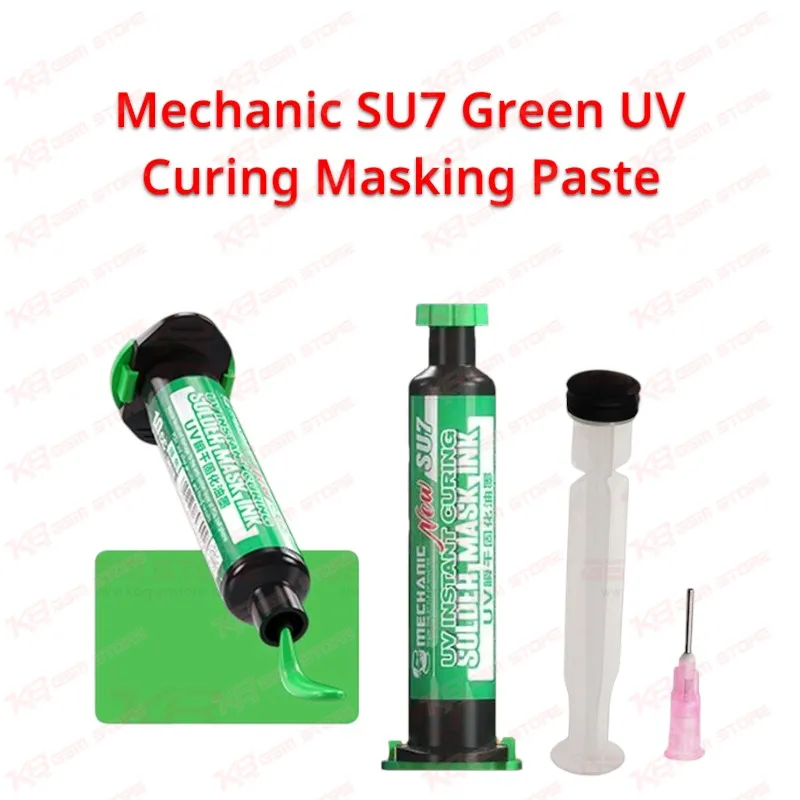
When you're doing motherboard-level repair, the last step after any jumper wire, IC reball, or trace repair is protecting that exposed copper again, and that's exactly where Mechanic SU7 Green UV Curing Masking Paste earns its spot in your toolbox. This is a UV-reactive solder mask ink, not a flux or adhesive, so its job is purely protective and insulating. You dab a thin layer over bare copper traces, repaired pads, or areas where you've scraped away the original mask to run a jumper, and once you hit it with a UV lamp it hardens in about 3 seconds into a tough, glossy coating that looks close to factory solder mask. That fast cure time matters on a busy repair bench because you're not waiting around for air-dry paste to set before you move to testing or reassembly. The green shade is the same one most Android and multi-brand motherboards use, so touch-ups blend in instead of standing out as an obvious repair. Functionally, the paste does three things a technician actually needs: it insulates so two nearby traces don't arc or short when the board flexes or gets touched by a tool, it seals copper against moisture and dust so corrosion doesn't creep back in weeks after your repair, and it physically masks off areas you don't want solder flowing into during rework, which cuts down on solder bridge issues when you're reflowing nearby components. You'll reach for it after IC change karna, after running a jumper on a dead-after-flash board, after reballing work near the CPU or power IC, or any time you've cleaned corrosion off a board and exposed bare copper in the process. It's also useful preventive maintenance on boards that came in with a charging issue or hardware fault traced back to corroded pads, since sealing that area again reduces the chance the same fault repeats. Application is straightforward: clean the board area with isopropyl alcohol first so the paste bonds properly, apply a thin even coat with a fine brush or applicator, then cure under UV light for the few seconds it needs. Avoid piling it on thick in one pass, since a thin layer cures more evenly and looks cleaner than a heavy blob. This isn't a tool that replaces your flux or your reballing paste, it's the finishing layer that comes after that hardware work is done, closing the loop between repair and long-term board reliability. For a repair shop handling volume, having a fast-curing mask ink on hand means fewer boards sitting around waiting to dry, which keeps your turnaround time down without cutting corners on protection quality. It's a small item, but it directly affects whether a repaired board holds up for months or comes back with the same corrosion or short problem in a few weeks. Keep the bottle sealed between uses and store it away from direct light, since UV-reactive formulas will start curing if left exposed for long periods, and a partially cured bottle won't apply smoothly the next time you need it on the bench.