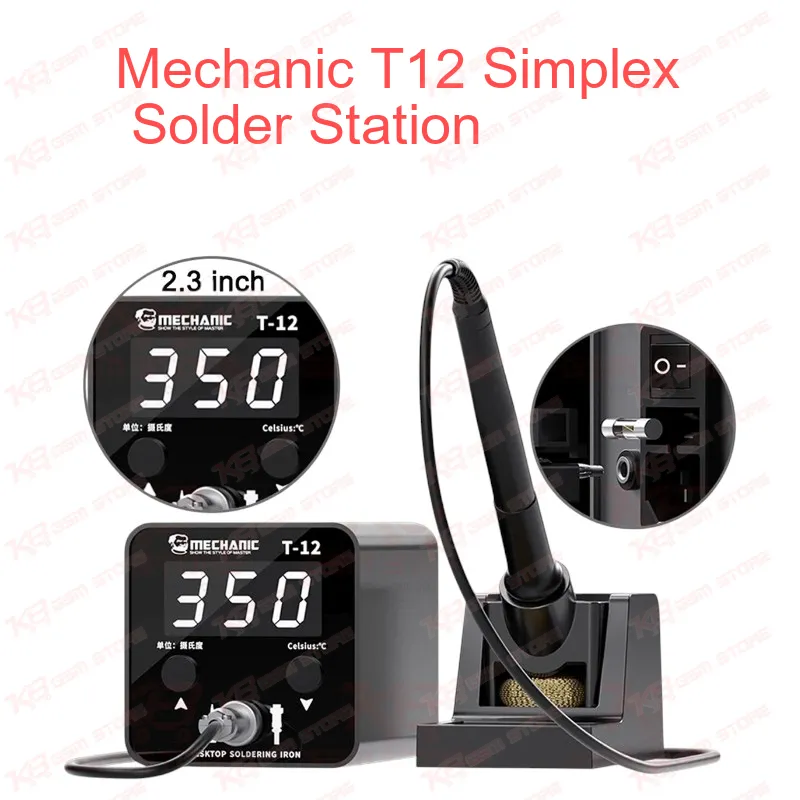
Every board-level repair follows the same rhythm: you open the phone, clean the area, lift the faulty part, prepare the pads, fit the replacement, and test the result, and the soldering iron touches nearly every one of those steps, which is why the Mechanic T12 Simplex Solder Station deserves a close look before you choose your next bench iron. Mechanic built this station around the universal T12 cartridge system, where the heating element and the tip form one piece, so heat travels straight from the core to the joint instead of passing through a separate sleeve and a loose tip like older 936-style irons. That direct heat path gives you steadier tip temperature when you work on ground planes, shielding frames, and thick copper areas that pull heat away fast, a common headache when you replace a charging connector or reattach a battery terminal on a multilayer smartphone motherboard. The station delivers 50W of power and runs on AC 110–240V input, so it works directly on standard Pakistani 220V mains in Lahore, Karachi, Islamabad, or any small-town repair shop without a step-down transformer. You control temperature from 180°C to 450°C, and the LED digital display shows the value at a glance, even while you glance up from a stereo microscope. The control logic shapes how fast you move through a job: the unit stores five quick temperature gears, a short tap switches between them, and a long press lets you fine-tune the value step by step. In practice you can keep a low preset for delicate flex connector pins and small passive components, a middle preset for general SMD work with leaded solder, a higher preset for lead-free joints, and a top preset for large ground pads, then jump between them without scrolling through the full range every time the job changes. Mechanic also lets you calibrate the temperature yourself: hold the up or down key while you power on and the station enters calibration mode, so when you pair it with a tip thermometer you can correct drift after months of heavy daily use or after you switch to a different tip style. A similar power-on key sequence opens the sleep time setting, which lets you decide how long the iron waits on its stand before it drops into standby, a small detail that protects tip plating, cuts oxidation, and saves you from replacing T12 cartridges every few weeks. The all-metal one-piece sleep stand sits heavy on the bench, holds the handle at a safe angle, and resists tipping when you reach across a crowded workspace full of screwdrivers, tweezers, and a PCB holder. The host uses an aluminium alloy body that sheds internal heat quickly and keeps the electronics stable during long repair sessions, and at roughly 85mm in height it stands shorter than most smartphones held upright, which matters in the narrow counter shops you find in most mobile markets. A 1.27-metre handle cable gives you enough reach to work on a board in a holder beside a hot air station without dragging the station across the bench. Inside, a built-in fuse blows instantly on a short circuit and shields the control board from damage, a real benefit in markets where voltage fluctuations and generator or UPS switching cause sudden power spikes. The universal T12 compatibility opens a large ecosystem of tip shapes: you can fit a fine conical tip for jumper wiring on broken traces, a knife tip for dragging solder across IC legs, a bevel tip for tinning pads and removing old solder with wick, or a chisel tip for shield cans and connector legs, and because the station accepts every T12 series tip you never lock yourself into a single supplier. Consider a typical charging issue on a budget Android phone: you remove the damaged charging port, clean the pads with flux and wick at a lead-free preset, tin the new port legs, and solder it in place, then switch to a lower preset to reflow a nearby capacitor you knocked loose, all without touching the fine adjustment once. On a phone that shows no network after water damage, you might trace a corroded path under the microscope, scrape the mask, and run a thin jumper wire from pad to pad, work that demands a fine tip and stable temperature more than raw power. Dead phone cases often end with a PMIC or charging IC change that starts with hot air removal, and the Mechanic T12 Simplex Solder Station then takes over to clean the pads flat, level the solder, and fix any lifted components around the chip before you move to a reballing kit or place the new IC. Display problems that come from damaged FPC connectors, hang on logo faults that start at bad component joints, and boot loop issues that trace back to cracked solder near power rails all pass through the same iron before you confirm the fix with a multimeter or a DC power supply. For new technicians and training institutes, the station offers a clean learning path because the five presets and clear display make good temperature habits easy to build, while experienced hardware engineers get a dependable T12 platform that fits beside ISP pinout tools, eMMC programmers, UFS adapters, and test boxes on a combined software and hardware bench where one technician handles both flashing and board repair. When your workload grows, you can pair this station with a hot air station for component removal, a stereo microscope for inspection, a reballing kit for BGA chips, and a sturdy PCB holder, building a complete rework setup around the same tip ecosystem. The box includes the soldering station, the soldering iron handle, one T12 soldering tip, the soldering iron holder, and the power cable, so you can unbox, insert the tip, plug in, and start working the same day. If you want a compact, affordable, and practical digital soldering station that respects bench space, protects your tips, and handles the everyday joints behind most mobile repair jobs in Pakistan, this station earns its place as your daily driver.