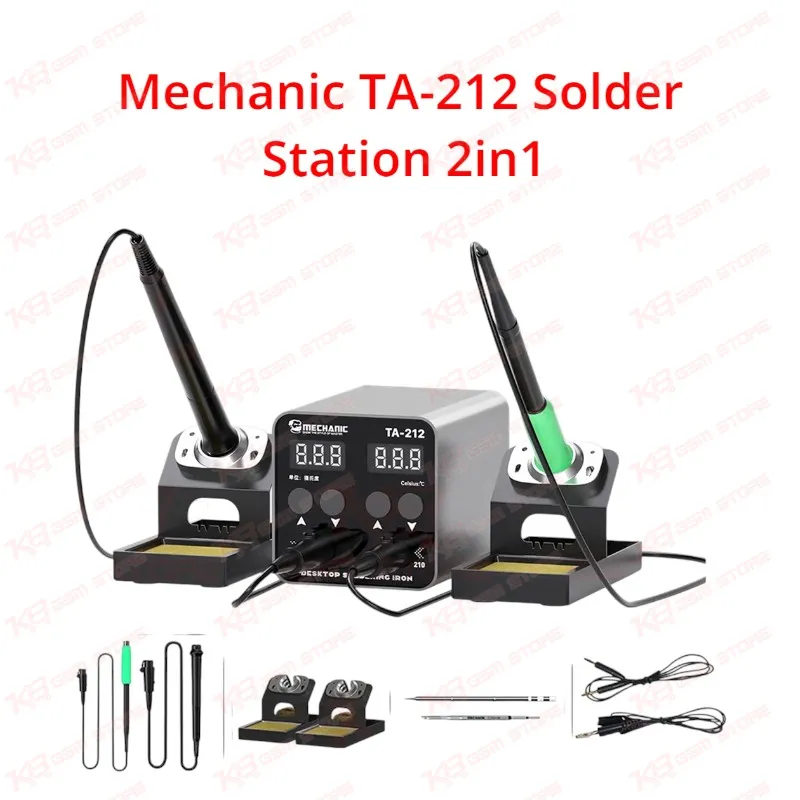
Every technician knows the moment: a customer puts a dead phone on your counter, you open it up, and the fault sits right next to the CPU, where one wrong move with a heavy iron lifts a pad and turns a simple job into a lost board. The Mechanic TA-212 Solder Station 2in1 gives you two independent soldering channels in one compact unit. You keep a C210 heating core ready for delicate micro-soldering on one side and a T12 tip ready for broader pad work on the other, without swapping cartridges every ten minutes. Each channel has its own LED digital display and its own temperature control, so you read both set points at a glance and adjust one handle without touching the other. For shops in Lahore, Karachi, Islamabad, Rawalpindi, and Peshawar that open twenty to fifty phones a day, that change alone removes a lot of dead time from the bench. The station covers a working range of 150°C to 450°C on 140W rated power, and it stores five quick-access presets at 250°C, 300°C, 350°C, 400°C, and 450°C. A short press jumps between presets and a long press sets the exact value, so you can drop low to tin a flex connector pad and climb back up for a stubborn ground-plane joint in seconds. Ground planes on modern smartphone boards pull heat away fast, and constant-temperature control decides whether your joint flows clean and shiny or turns cold and grainy. If you notice the displayed temperature drifting from the real tip temperature after heavy use or a tip change, turn the station on, press the up and down buttons together, and use temperature compensation to correct that channel instead of guessing. You can also switch the display between temperature units to match your thermometer or your training material. The T12 channel accepts the T12 series tip range, which matters in Pakistan because T12 tips are easy to find in almost every parts market, so a burnt tip never keeps you stuck waiting for a special cartridge. The C210 channel handles precision micro-soldering. That is the work you do when you replace a charging IC, rebuild a broken line under the microscope, or run a jumper wire to bypass a damaged track on a phone with a charging issue or a no-display problem. With both types live on the bench, you can move from cleaning old solder off a shield frame area with a broad T12 tip straight to a tiny SMD capacitor with a fine C210 tip, and nothing has to cool down in between. So where does the Mechanic TA-212 fit in a real repair workflow? A typical board-level job starts with diagnosis: a DC power supply and a multimeter to trace the short or the dead rail. Then a hot air station lifts the faulty IC, and the job comes back to the iron to clean and level the pads before the new chip goes down. After your hot air station and preheater do the heavy lifting on a CPU, PMIC, or eMMC chip, your iron cleans the pads and flattens the solder so the reballed chip sits level. This is where two handles earn their keep: one tip wicks and flattens while the other stays ready for touch-up around nearby components. The same station supports the software side of your shop too. When a phone comes in dead after flash, hangs on the logo, or stays stuck in a boot loop issue that software alone cannot fix, you often need to solder fine wires to ISP test points before connecting a test box or eMMC programmer. A fine C210 tip at a controlled lower temperature keeps those tiny pads from lifting. Build quality counts for a tool that runs long hours through a Pakistani summer. The main unit uses an aluminium-alloy body that helps dissipate heat, measures 110 × 84 × 84 mm, and weighs 963 g net. That leaves room on a crowded bench next to your microscope and PCB holder. A built-in fuse gives short-circuit protection and guards the station against sudden faults, which matters in shops that live with voltage swings and generator changeovers during load-shedding. Each handle cable measures 1.1 m, long enough to reach across a PCB holder under a trinocular microscope without dragging the station across the mat. A hibernation line connects the handle stand to the station to support its sleep function when you rest the handle between jobs. The TA-212 carries an AC 110–240V input rating and ships in 110V and 220V plug variants, so make sure your unit is the 220V version for standard Pakistani mains. If you still run a single-iron setup and keep swapping tips between jobs, this station gives you a clear upgrade path to a proper dual-channel workstation. It suits new shop owners building their first serious hardware bench and experienced board-level technicians who want a dedicated second iron. It also fits service centers with several technicians on shift, and training institutes where one channel handles student practice while the other stays set for demonstrations. Pair it with the rest of your hardware setup for a complete board-level bench from KB GSM Store: reballing kits for BGA chips, UFS adapters and eMMC programmers for memory work, ISP pinout tools for dead-boot recovery, test boxes, multimeters, microscopes, PCB holders, and a hot air station for rework. If you are checking the Mechanic TA-212 price in Pakistan and need a dual soldering station that keeps up with real workshop volume rather than hobby use, this unit deserves a spot on your repair bench.