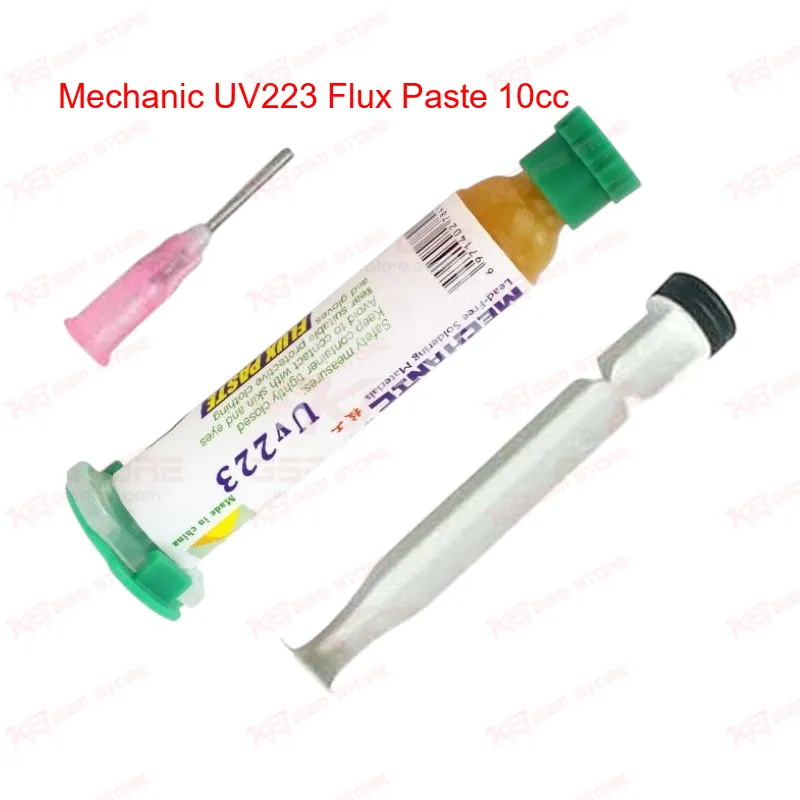
Every repair bench that handles board-level work eventually runs into the same problem: bad flux ruins good soldering. Mechanic UV223 solves this by giving technicians a no-clean, lead-free flux paste formulated specifically for the fine-pitch work mobile repair demands — BGA reballing, CPU and PMIC reflow, IC change, and SMD component replacement. The paste itself is a mixture of alloyed powder and resinic flux compound, designed to spread evenly across pads without pooling or running under adjacent components. When you apply UV223 to a chip pad or PCB trace before reflow, it breaks down surface oxidation instantly, which is what gives you that clean, bright solder joint instead of a dull, weak one. This matters most on dense boards where pad spacing leaves no room for sloppy work — think CPU, PMIC, and NAND packages on modern smartphone motherboards. What separates a no-clean flux from a standard rosin paste is what happens after reflow. UV223 leaves behind a light, non-conductive residue that does not need alcohol wiping or ultrasonic cleaning to remove. That residue carries a high SIR (surface insulation resistance) value, so it will not cause shorts or leakage current between closely packed pads. For technicians running high board volume — service centers doing dead phone repair, boot loop fixes, or charging IC replacement all day — skipping the cleaning step saves real time without risking board reliability. The lead-free, RoHS-compliant formula also means the paste is safer to work with on a daily basis compared to older acid-core or halide-heavy fluxes. It does not corrode copper pads, gold-plated connectors, or bronze contacts, so you can reuse it across different repair jobs — screen connector resoldering, charging port repair, and NAND/eMMC chip removal — without worrying about long-term pad damage. In a typical reballing workflow, UV223 gets applied at two stages: first to prep the pad before old solder removal, and again after placing new BGA balls to help them seat evenly during reflow. The paste's tackiness holds solder balls in position on the stencil, which reduces misalignment and bridging — two of the most common causes of a failed reball job. For IC change work, a thin layer under the hot air nozzle helps the chip lift cleanly without dragging solder across neighboring pads. Packaging comes in a 10cc syringe format with a needle tip, giving you precise control over how much paste you dispense per joint. This matters on smaller boards where excess flux can bridge closely spaced pins, particularly around PMIC and RF sections where trace spacing is minimal. A little goes a long way — most technicians report that a single 10cc unit lasts through dozens of board repairs when applied correctly. UV223 fits into nearly every stage of the mobile repair workflow: diagnostics-driven IC change, board-level hardware fault repair, chip-level reballing, and general SMD rework. Whether you are running a Qualcomm or MediaTek board, the flux performs the same job — clean oxidation removal and reliable wetting — regardless of chipset brand, which makes it a practical addition to any repair bench handling mixed-brand devices. For repair shops and service centers in Pakistan working through high volumes of dead phone, hang on logo, and charging issue cases, having a dependable no-clean flux on hand cuts rework time and reduces the chance of re-visits caused by weak solder joints. UV223 is built to hold up under that kind of repeated daily use.