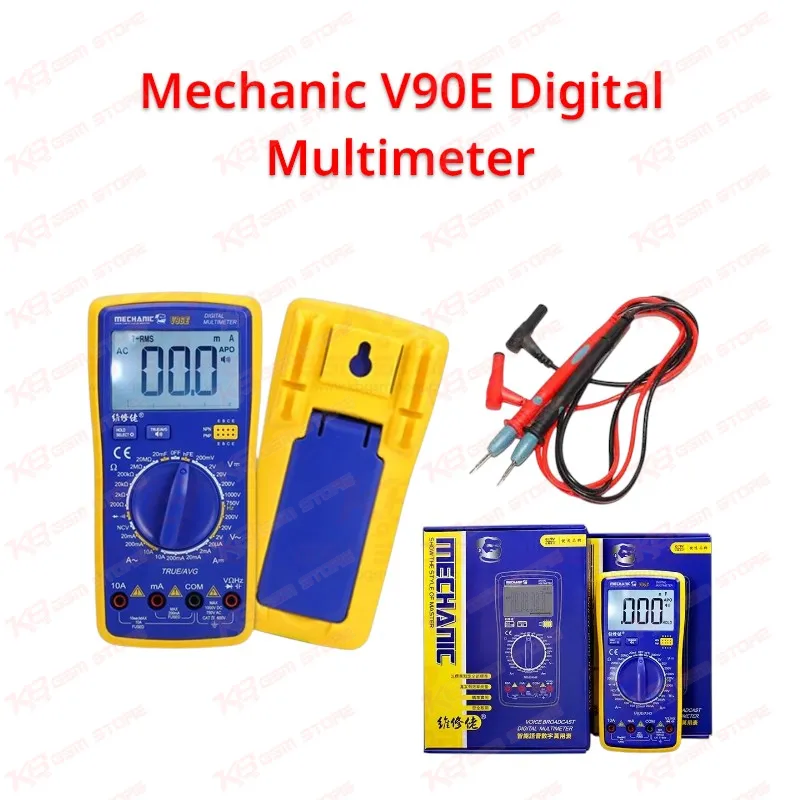
Every board-level fault on your bench starts with one question: where is the short? The Mechanic V90E Digital Multimeter answers it while your eyes stay on the PCB instead of the meter screen. Mechanic built the V90E as a fully automatic meter with English voice broadcast. When you probe a capacitor line on a dead phone under the microscope, the meter speaks the reading out loud, so you never lose your probe position on a tiny pad. On a normal meter you look at the board, look at the display, then look back and hunt for the same test point. On a crowded logic board that habit costs time, and sometimes a slipped probe bridges two components. With the V90E you keep the tips steady, listen to the value and move to the next point. The meter switches between diode and continuity on its own, and that matters most during diode-mode readings across a board. You check VBAT, the main power line, PMIC outputs and charging IC pins. Then you compare each value against a known-good board and spot the line that reads too low or beeps as a dead short. For a phone that will not power on, that comparison usually points you to a shorted capacitor, a failed charging IC or a leaky PMIC before you pick up the hot air gun. Mechanic also gave the V90E a high-voltage diode output that delivers about 1V more than a traditional diode test. That extra voltage lets you light and check LEDs directly, including display backlight LEDs, flash LEDs and indicator LEDs that a standard diode range struggles to drive. When a customer walks in with a display problem where the panel shows a faint image but no light, you can confirm or rule out the backlight circuit in seconds. On the measurement side, the V90E covers DC voltage from 200mV up to 1000V and DC current from 20µA up to 10A. The same meter handles a battery voltage check, a charger output test and a microamp-level reading on a board that drains the battery overnight. That low current range gives you a practical way to chase standby leakage on phones that come back with a "battery finishes in a few hours" complaint. AC current runs from 20mA up to 10A, and the meter reads both RMS and average values on AC and DC signals. Resistance spans 200 Ohm to 2M Ohm and capacitance covers 10nF to 20mF. Frequency, temperature and transistor testing sit in the same housing. Resistance mode helps when you check flex cables, battery connector pins and charging port contacts for an open line behind a charging issue. Continuity mode helps you trace antenna lines and RF paths when you chase a network issue after a drop or water damage. Capacitance mode lets you confirm a suspect capacitor after you lift it off the board, so you stop guessing during component replacement. When a phone sits in a boot loop or hangs on logo after a flash, a quick voltage check on the battery and main rails tells you whether you face a hardware fault or a software job for your test box. Mechanic fitted the V90E with a 26mm backlit display, so you read values clearly even in a dim corner of the workshop or late at night. The meter shows a 3½-digit reading with a maximum of 1999 and automatic polarity. It uses double-integral A/D conversion and samples about three times per second, which keeps readings stable without making you wait. When a value goes out of range, the display shows "OL". When the 9V battery runs low, a low-battery symbol appears, so a weak cell never feeds you a false short reading. The V90E runs on a single 9V battery, which Mechanic does not include in the box, so keep one ready when you order. Safety matters on any shared repair bench where trainees and senior technicians use the same tools. The V90E carries double fuse protection and overload protection, and Mechanic shaped the probe jacks so the test leads seat firmly. That protection helps when someone accidentally probes a charger output on the wrong range or leaves the leads in the 10A socket. At around 358g, the meter stays light enough to move between benches yet sits solidly beside your DC power supply. Rated for 0 to 40°C at under 80% relative humidity, it suits a typical Pakistani shop environment with a fan or AC running. On a full repair bench, the V90E sits at the centre of the diagnostic stage. A trinocular or stereo microscope shows you the pad, a PCB holder keeps the board steady, and the V90E tells you which line carries the fault. Your hot air station and soldering station then take care of the component swap, and a reballing kit handles any BGA chip that needs fresh solder balls. When the hardware checks out clean, the job moves to your test box or eMMC and UFS tools for software work. If you currently use a basic manual-range meter, the V90E offers a clear upgrade path. Automatic mode selection, voice output and the high-voltage diode function remove the most common slowdowns in daily short hunting. For repair shops in Lahore, Karachi, Islamabad and smaller cities, the V90E brings a professional diagnostic workflow at a workshop-friendly price. It suits trainee technicians learning diode-mode readings and senior hardware engineers who handle dozens of dead phones every week.