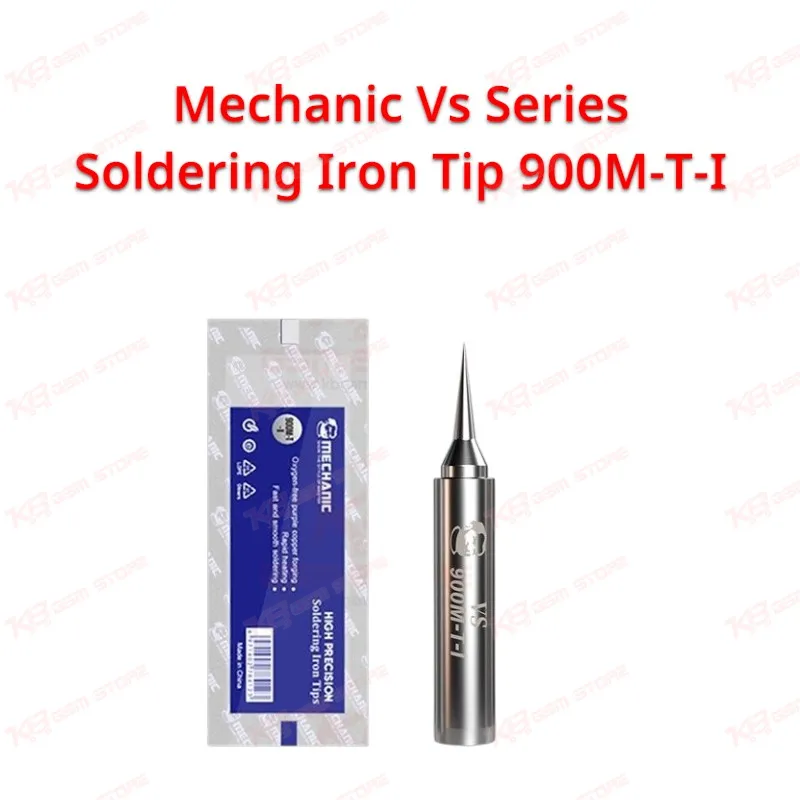
Fine-pitch board repair depends on the tip you put on your iron, and the Mechanic VS Series 900M-T-I is built specifically for that kind of detail work. It carries a sharply tapered, pointed geometry that reaches into tight spaces on a crowded PCB — fine pads, jumper points, and closely spaced component leads that a chunkier tip simply cannot access cleanly. The core is pure copper, chosen for its natural thermal conductivity, so heat travels from the base of the tip to the point quickly and stays consistent even during long repair sessions.That copper core carries a multi-layer electroplated surface, which is where the tip's durability really comes from. Bare copper oxidizes fast under repeated heating and flux exposure, and once oxidation sets in, tinning becomes inconsistent and solder starts to bead instead of flowing. The plating on the 900M-T-I resists that oxidation and corrosion, which means the tip keeps a clean, tinnable surface through many more cleaning cycles than an unplated equivalent. For a technician running dozens of repairs a day, that translates directly into fewer tip changes and steadier results.The 900M-T-I is a lead-free tip, built to meet current environmental soldering standards without giving up performance. Lead-free solder typically runs at a slightly higher working temperature than leaded solder, and tips designed for it need to handle that heat load without breaking down early. This tip is built with that in mind, so you get fast heat-up and stable performance whether you're working with lead-free or leaded solder on your bench.Fit is standardized around the 900M-T body, which slots into 936 and 937/937D soldering iron handles and stations — the same platform used across a huge share of repair shops in Pakistan. If your station already runs 900M-T series tips, this one drops straight in with no adapter or modification needed. The base diameter is sized to match the standard heater block on these irons, so seating is snug and heat transfer from the block to the tip stays efficient.In actual repair work, this tip earns its place doing disassembly welding when you're pulling components off a board, dragging tin across pads during reballing or IC prep, cleaning old solder and flux residue off pads before a new component goes down, and back welding when reattaching components after cleanup. The fine point also makes it a solid choice for jumper wire work, where you're soldering thin wire onto a small trace or via and need precise control without disturbing nearby components.For mobile repair technicians specifically, this tip fits naturally into everyday bench work — reworking a board after an IC change, cleaning up pads before jumper lagana on a damaged trace, or handling detailed touch-up soldering after a charging port or connector repair. It's not a specialty tool for one narrow task; it's a general-purpose precision tip that covers a wide range of the fine soldering work that comes up on a repair bench day to day.Because it's a direct-fit replacement tip, there's no learning curve involved — swap it into your existing 900M-T compatible iron, let it heat, tin it as usual, and it performs the way you'd expect from a standard pointed tip built for board-level work.Compatible Devices: Compatible with 900M-T series soldering iron handles, and 936 / 937 / 937D soldering stations. Not device-specific — this is a soldering iron tip, not a phone-model-specific tool.Common Repair Uses: Disassembly welding, dragging tin during IC and reballing prep, pad and flux residue cleaning, back welding after component reattachment, jumper wire soldering, and general fine-pitch PCB rework on mobile phone boards.