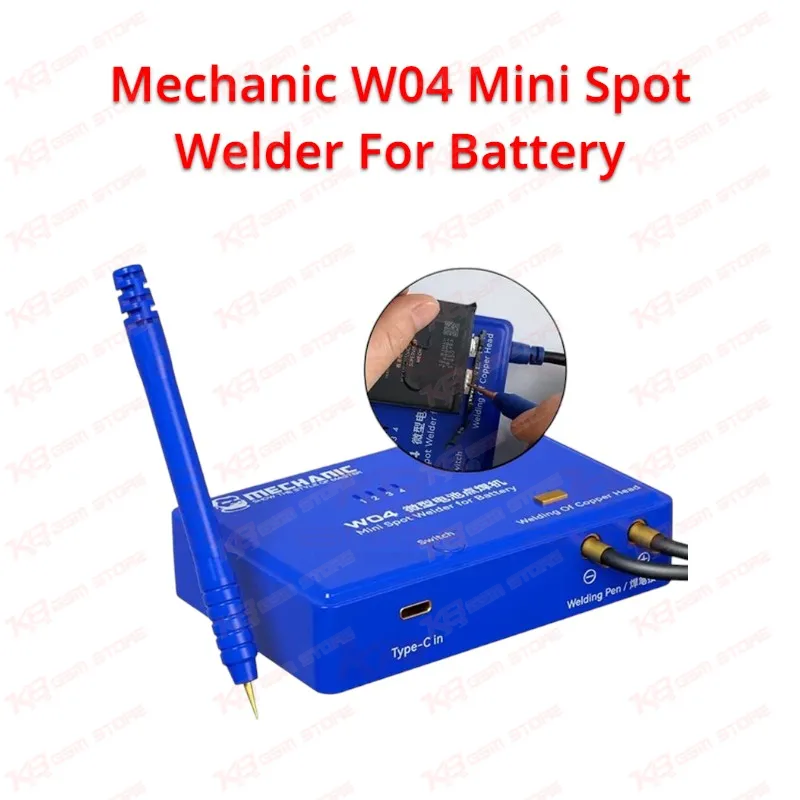
Every GSM technician eventually runs into a swollen, dead, or physically damaged phone battery where the nickel strip connecting the cell to the flex or PCB has lifted, corroded, or snapped off during disassembly, and reaching for a soldering iron in that situation risks overheating the cell, breaking down the internal chemistry, or triggering a thermal event, which is exactly the gap the Mechanic W04 Mini Spot Welder closes on a Pakistani repair bench. Instead of applying sustained heat the way a soldering pencil does, the W04 uses micro-resistance spot welding, sending a short, high-current pulse (up to 650A at a maximum 4.2V) through a 0.5mm tip directly into the nickel strip, fusing it to the cell terminal in a fraction of a second so the battery itself never absorbs damaging heat. That output voltage sits well within mobile phone industry safety limits, so you avoid the cell breakdown that happens when a standard iron sits too long on a lithium pouch or 18650 can. The unit runs from a built-in 3850mAh battery, which means you're not tethered to a bench power supply every time you need to reattach a tab or rebuild a small battery pack, and that same 3850mAh cell lets the W04 double as a basic USB power bank (5V/2.4A output) between repair jobs. Four gear settings give you control over weld strength: lighter gears suit thinner nickel strips and delicate flex-mounted cells, while higher gears push through thicker 0.1–0.2mm strips on larger packs, so you're not stuck applying one fixed power level to every battery that comes across your bench. Charging the tool back up takes a standard Micro USB input at 5V/2A, and the device includes a Micro/IN output interface for the welding probe itself, keeping the whole setup compact at 112 x 85 x 25mm — small enough to sit next to your hot air station without eating desk space. A 5-minute standby auto power-off protects the internal battery from unnecessary drain if you forget to switch it off between jobs, a small detail that matters when the tool is running all day in a busy service center. Within the wider mobile repair workflow, the W04 sits at the intersection of battery repair and PCB-level board repair: technicians use it to reattach lifted nickel tabs on iPhone, Samsung, Xiaomi, Oppo, Vivo, and generic Android batteries, rebuild small battery boards where the connector or fuel gauge flex has separated, and assemble or repair custom battery packs built from 18650 or pouch cells for POS terminals, handheld scanners, and other battery-powered devices common in local repair shops. It's a practical fit for the "charging issue" and "dead battery" complaints that walk through the door daily — cases where the phone won't power on because the battery connection itself has failed rather than the charging IC or PMIC, so the fix is mechanical reattachment rather than a board-level hardware fault. Because the weld happens instantly and locally, there's minimal risk of disturbing nearby SMD components or adhesive on the battery cell, which matters when you're working inside a tight phone chassis where a slip with a hot iron could damage the flex cable or board trace next to the battery connector. For repair shop owners scaling up battery replacement or refurbishment services, having a dedicated spot welder also cuts rework: a properly fused nickel strip holds up under vibration and daily handling far better than a strip that's been tacked on with excess solder, which tends to crack loose again after a few weeks of use. The W04 isn't a full rework station or a UFS/ISP programming tool, and it doesn't replace your hot air station or your microscope, but for the specific job of joining metal to a lithium cell safely, it fills a slot that most general-purpose soldering equipment simply isn't built for. Technicians who do regular battery work — replacing degraded cells, rebuilding packs, or repairing the small board that sits between the cell and the main connector — get a tool sized for the bench, powered independently, and tuned specifically for the voltage and current limits that lithium battery chemistry demands.