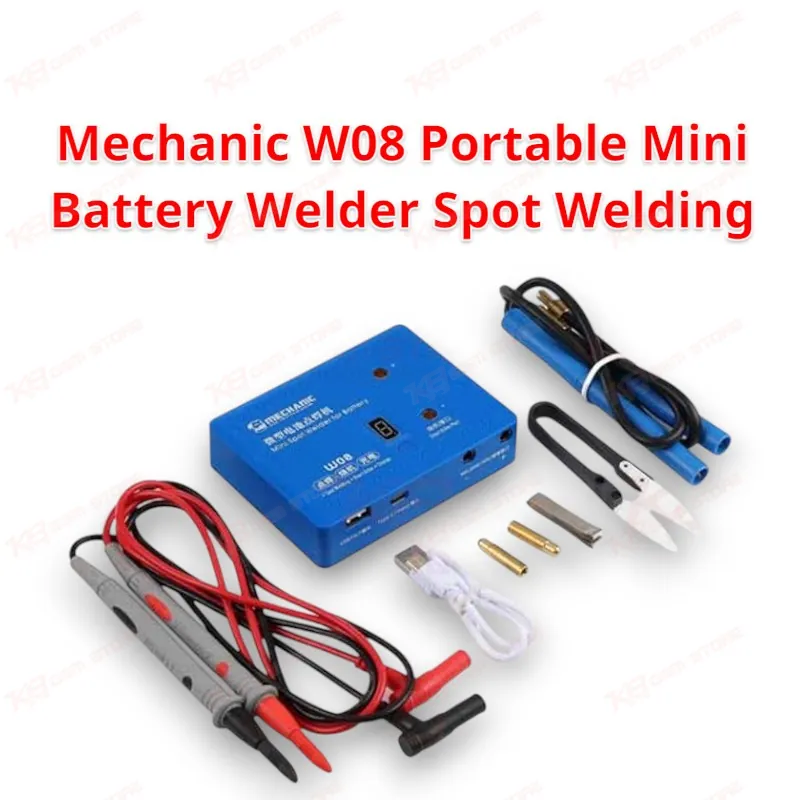
Battery repair work on mobile phones and small lithium packs demands a different kind of heat control than general soldering, and the Mechanic W08 Portable Mini Battery Spot Welder addresses that gap directly. Instead of applying continuous heat like a soldering iron, this handheld spot welder fires a controlled current pulse through a fine-tipped pen, fusing nickel sheets to battery terminals in a fraction of a second. This matters because lithium cells break down fast under sustained heat, and a technician working on a swollen or aging battery pack doesn't get a second chance if the cell overheats mid-repair. The W08 solves this by putting welding output on 8 adjustable gears, so you move from light, fast tacks on delicate protection board pads up to firmer joints on thicker nickel strips without swapping tools or guessing at settings. Every repair shop that handles battery plate replacement, custom battery pack building, or protection board (BMS) swaps runs into cases where a standard soldering iron either can't reach the joint cleanly or applies too much heat for too long, and that's exactly where a dedicated spot welder like this earns its place on the bench. The welding pen itself is built around a 0.5mm tip, fine enough to land precise spot welds on cramped board layouts without bridging adjacent pads, which becomes critical when you're reworking small-format cells used in phones, TWS earbuds, and compact power banks. Because the unit runs off its own built-in rechargeable battery rather than requiring a mains power supply, you can move it anywhere on the bench or take it into the field for on-site battery repair jobs, cutting down the cable clutter that comes with bulkier bench-mounted welders. Temperature control protection is built in, and the machine automatically powers off after 5 minutes of standby, a safety layer that matters given the unit sits directly beside live lithium cells during operation. In day-to-day repair work, this tool covers nickel sheet welding on cylindrical and pouch cells, reattaching torn or lifted nickel strips during battery plate replacement, and soldering battery protection boards back onto cell terminals after a swap — jobs where dead phone battery issues trace back to a failed weld point rather than the cell itself. Technicians running an ISP or UFS repair bench often deal with battery-adjacent failures too, since a phone that won't charge or holds no charge sometimes needs a fresh nickel strip weld rather than a full battery replacement, and having a dedicated spot welder on hand shortens that repair instead of forcing a full battery swap every time. The compact footprint also means the W08 slots into a mobile repair kit alongside your hot air station, multimeter, and screwdriver set without eating up bench real estate the way a full-size industrial spot welder would. Setup is straightforward: select the gear appropriate to the nickel sheet thickness you're working with, position the pen tip lightly against the weld point, and let the pulse do the work rather than pressing down hard, since excessive pressure on a spot welder tip tends to produce uneven joints or scorch marks on thin nickel. For technicians new to spot welding, starting on a lower gear and testing on scrap nickel sheet before committing to the actual battery board helps dial in the right setting without risking a damaged cell. This approach to Pakistan market repair work, where fast turnaround on charging issue and dead-after-flash cases is standard, makes a tool like the W08 practical rather than a luxury add-on — it directly shortens the time between diagnosing a bad nickel weld and handing a working phone back to the customer. Repair shop owners running higher-volume battery replacement services will also find that consistent weld quality across every job reduces callbacks tied to loose or cold-jointed nickel strips, a common issue when technicians rely on manual soldering for battery terminal work instead of a dedicated welding pulse. Overall, the Mechanic W08 fits into the diagnostics-to-repair workflow as a specialized station for cell-level and board-level battery work, sitting alongside your reballing and rework tools as part of a complete mobile repair setup rather than replacing your primary soldering station.