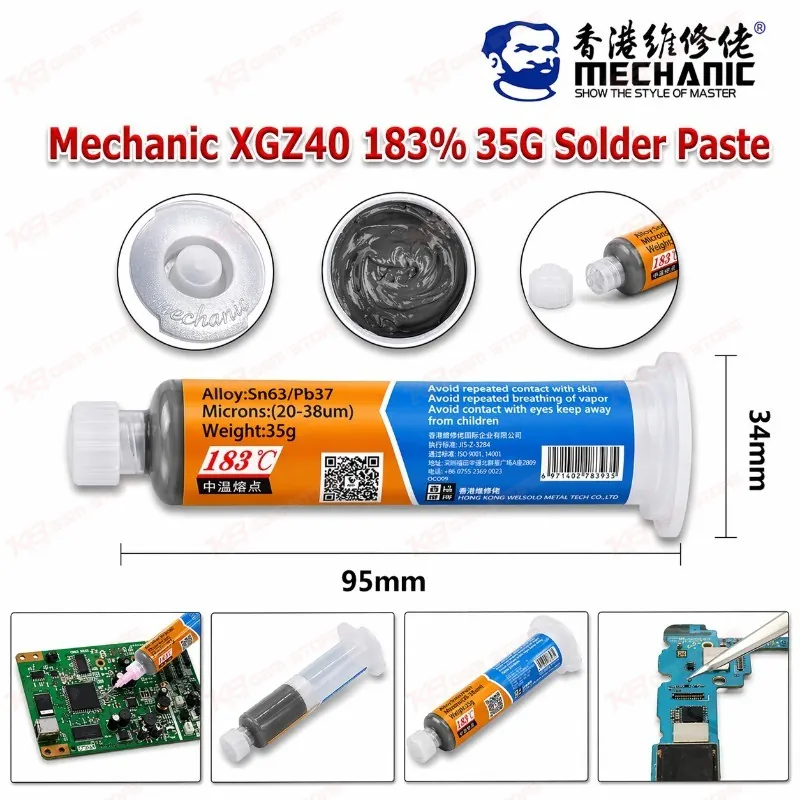
When a board comes in dead after flash or with a hardware fault traced to a lifted IC, the solder paste you reach for decides whether the joint holds or fails a week later. Mechanic XGZ40 is built around a 183°C melting point using a Sn63/Pb37 alloy — the same ratio most technicians already trust for board-level work because it flows predictably under hot air and doesn't require exotic reflow profiles.The paste ships in a 35g syringe, so you apply it directly onto pads without transferring it into a separate dispenser first. That matters when you're working fast on a busy bench — less prep time between jobs means more boards through the day. The no-clean flux formulation is the other half of what makes XGZ40 practical for daily repair use. Once the joint reflows, the flux residue stays minimal and doesn't demand a full alcohol wash before you move to the next step. You still get a cleaner board if you wipe it down, but the paste doesn't leave the sticky, corrosive residue that older leaded pastes are known for.For IC reballing, the paste's particle consistency matters as much as the alloy. XGZ40 holds its shape on the pad instead of spreading into neighboring balls, which keeps pitch spacing intact on tight BGA packages. That's the difference between a clean reball under the microscope and a bridge you have to rework twice. The same property helps on CPU and PMIC rework, where solder bridging between closely spaced balls is the most common cause of a board coming back dead after flash or stuck on hang on logo.Technicians running ISP or eMMC-related board work also use XGZ40 for secondary repairs on the same board — reattaching a lifted connector, re-tinning a damaged pad, or fixing a charging port that's lost its solder joint. Because the paste reflows cleanly at a known temperature, it fits into a normal repair workflow: diagnose the fault, isolate the component, apply paste, reflow with a hot air station, then test. You're not adjusting your station's temperature curve to accommodate an unpredictable paste, which keeps the whole repair process consistent from job to job.Storage and handling are straightforward. Keep the syringe capped between uses and store it away from direct heat, since solder paste flux is temperature-sensitive and can dry out or separate if left open on the bench. A fresh syringe applies smoothly straight out of the pack, without needing to be worked or thinned before use.For a repair shop doing volume board work — screen problem repairs, charging issue diagnostics, network issue fixes tied to RF shield rework, or straightforward IC change karna jobs — XGZ40 earns its place as a consumable you keep stocked rather than reorder only when you run out mid-repair. It pairs naturally with a hot air rework station and a set of BGA stencils, covering most PCB-level repair scenarios a mobile service center handles day to day.