


Brand:
MECHANIC
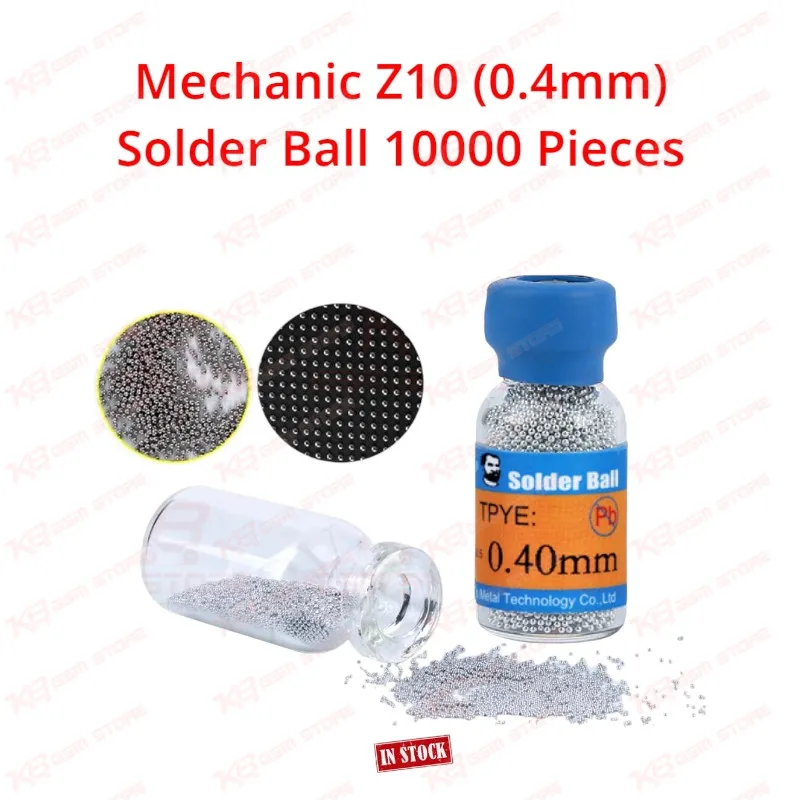
Mechanic Z10 (0.4mm) Solder Ball 10000 Pieces
Mechanic Z10 (0.4mm) Solder Ball 10000 Pieces
Regular price
Rs.1.00 PKR
Regular price
Sale price
Rs.1.00 PKR
Shipping calculated at checkout.
Quantity
Couldn't load pickup availability
Mechanic Z10 (0.4mm) Solder Ball 10000 Pieces gives your repair bench a full bottle of leaded Sn63/Pb37 balls sized for BGA and CSP reballing work. Technicians across Pakistan reach for these balls when a CPU, eMMC, UFS, or power IC comes off the board and needs fresh joints before it goes back down. High sphericity keeps the balls rolling evenly into a 0.4mm stencil, and the eutectic alloy melts at a low 183°C, so you protect nearby components during rework. One bottle covers a long run of chip jobs, making it a practical stock item for any shop handling dead phones and no-power faults.
SKU:MST-SOLDERING-ACCESSORIES-815
⚖️ Weight: 0.03 kg
- Safe & Secure Payment
- Fast Delivery
- WhatsApp Support


Description
FAQ
What is the product name?
The product name is Mechanic Z10 (0.4mm) Solder Ball 10000 Pieces.
What is the brand of this product?
The brand of this product is Mechanic.
What is the model of this product?
The model of this product is Mechanic XZ10 (0.4mm).
What is this product used for?
This product is used for BGA and CSP chip reballing during mobile phone board repair, including CPU, eMMC, UFS, and power IC rework.
Which devices are compatible with this product?
This product is compatible with any BGA or CSP chip that uses 0.4mm solder balls and a 0.4mm reballing stencil; it is not device-specific.
Who should use this product?
This product is suitable for mobile repair technicians, repair shops, service centers, and professional users.
Is the Mechanic XZ10 0.4mm solder ball leaded or lead-free?
The XZ10 is a leaded solder ball made from Sn63/Pb37 alloy. Mechanic sells the lead-free version separately under the XZW10 code.
At what temperature do Sn63/Pb37 solder balls melt during reballing?
Sn63/Pb37 is a eutectic alloy that melts at 183°C, lower than common lead-free alloys, which lets you reball with less heat on the chip and surrounding components.