Skip to product information
1 of 4
Brand: MECHANIC

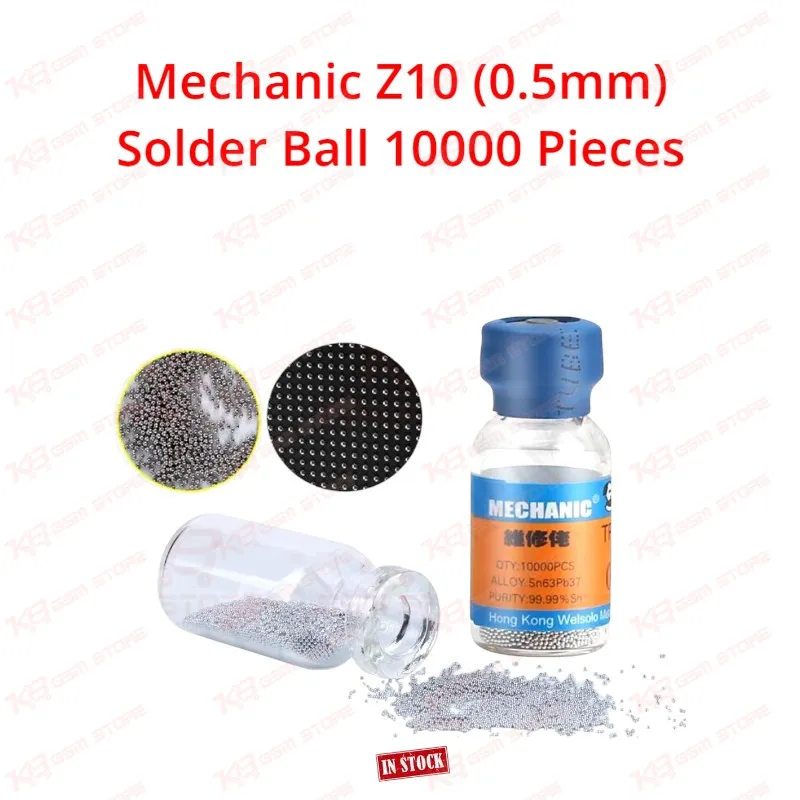
Mechanic Z10 (0.5mm) Solder Ball 10000 Pieces

Mechanic Z10 (0.5mm) Solder Ball 10000 Pieces

Regular price Rs.1.00 PKR
Regular price Sale price Rs.1.00 PKR
Sale Sold out
Shipping calculated at checkout.
Quantity

The Mechanic Z10 (0.5mm) Solder Ball 10000 Pieces bottle gives your repair bench a full stock of leaded Sn63/Pb37 balls for BGA reballing on mobile phone and motherboard chips. Every ball measures 0.5mm, so you fill a matching stencil in one pass and get even joints across the whole IC. The eutectic tin-lead alloy melts at a lower temperature than lead-free balls, which means less heat on the board and on nearby components. Pick up this Mechanic XZ10 series bottle at the best price in Pakistan from KB GSM Store and stop running short of balls in the middle of a CPU or eMMC job.

SKU:MST-SOLDERING-ACCESSORIES-814

⚖️ Weight: 0.1 kg

  • Safe & Secure Payment
  • Fast Delivery
  • WhatsApp Support
View full details

Description

When a phone lands on your bench as a dead phone, stuck on the logo, or showing a network issue after a drop, the fault often hides under a BGA chip where one or two joints have cracked, and no amount of flashing will bring it back. That is a hardware fault, and the fix starts with lifting the IC and reballing it properly. The Mechanic Z10 (0.5mm) Solder Ball 10000 Pieces bottle handles the ball side of that job. Mechanic packs 10,000 leaded balls in one bottle under its XZ10 series, and every ball follows the Sn63/Pb37 composition, meaning 63% tin and 37% lead. Technicians call this the eutectic alloy because it turns from solid to liquid at a single point, 183°C, instead of passing through a soft, pasty range. On the bench, that means the balls collapse and wet the pads together, you run your hot air station at a lower setting than lead-free work demands, and the board around the chip takes less punishment. Size matching decides whether a reball holds. You pick ball diameter by the chip and the stencil, never by guesswork: if the original balls on the IC and the stencil apertures call for 0.5mm, this bottle drops straight into your workflow. A ball that is too small leaves weak, starved joints, while a ball that is too large bridges neighbouring pads and turns a simple repair into a short. Keep the 0.5mm bottle beside your other sizes so the right diameter sits within reach whenever a chip comes off the board. The routine stays the same whatever the chip: remove the IC with hot air, clean old solder from both the chip and the board with wick and a soldering station, apply a thin, even layer of flux, lock the IC in a PCB holder or reballing platform, set the stencil on top, and pour a few balls across it. Roll them into the holes with a brush or tweezers, tip the extra back into the bottle, then heat until every ball reflows into a clean, shiny dome. Check the result under a microscope before you place the chip back, because one missing ball on a CPU or eMMC sends the phone back to you dead after flash or with random restarts. A full count of 10,000 balls matters for a busy shop. A single CPU or memory chip can take hundreds of balls, and spills happen on every bench, so a large bottle lets you pour generously, refill a stencil when the first pass goes wrong, and still have stock for the next customer. Leaded balls also forgive a technician who is still learning reballing, since the lower melting point gives more working time and reduces the risk of lifting pads on an older board that has already seen several repairs. The round, uniform shape helps the balls roll cleanly into stencil holes without jamming, which saves you minutes on every chip. After reballing, the chip goes back on the board with flux and hot air, and then the real testing starts: power the board through a DC supply, watch the current, check lines with a multimeter, and if the job involved a memory chip, confirm it on your eMMC programmer, UFS adapter, or through ISP pinout tools before you run the box to flash firmware. That sequence catches a bad joint before the phone goes back to the customer. Keep the bottle tightly closed in a dry spot, away from flux residue and dust, because moisture and dirt on the ball surface cause poor wetting. Pour out only what the current job needs and keep your fingers off the balls. If your shop already runs a reballing kit with stencils, tweezers and flux, this bottle keeps it stocked; if you are building a board-level bench from scratch, pair it with a hot air station, a temperature-controlled soldering station, a microscope and a solid PCB holder. KB GSM Store stocks the Mechanic XZ10 series 0.5mm bottle for technicians in Lahore, Karachi, Islamabad and across Pakistan, alongside the stencils, flux and rework equipment you need to finish the job right.

Key Features

  • 10,000 solder balls per bottle for repeated reballing jobs on a busy repair bench
  • Uniform 0.5mm ball diameter for stencils and BGA pads that call for this size
  • Sn63/Pb37 leaded composition (63% tin, 37% lead) from the Mechanic XZ10 series
  • Eutectic alloy with a single 183°C melting point for clean, even reflow
  • Lower reflow heat than lead-free balls, reducing stress on the board and nearby components
  • High sphericity so balls roll cleanly into stencil apertures without jamming
  • Suits BGA and CSP packages found in phones, motherboards and storage chips
  • Bottle packaging lets you pour only what the job needs and tip the extra back

Specifications

Brand Entity Mechanic
Product Entity Mechanic XZ10 0.5mm Solder Ball, 10000 pieces per bottle
Technology Entity Sn63/Pb37 leaded eutectic BGA solder balls
Compatible Device Entities BGA and CSP packages on mobile phone boards, motherboards and storage chips
Repair Process Entity BGA reballing, IC rework, stencil reballing, hot air reflow
Industry Entity Mobile phone repair, PCB board-level repair

Compatible Devices

  • Universal — not device-specific
  • Any BGA or CSP chip whose original balls and reballing stencil call for a 0.5mm diameter
  • Mobile phone, motherboard, hard disk and baseband chips where 0.5mm balls match the package

Common Repair Uses

  • Reballing CPU, eMMC, power and baseband ICs after removal with hot air
  • Restoring cracked or missing BGA joints behind dead phone and no-network faults
  • Replacing balls on donor chips before transplanting them to another board
  • Stencil-based reballing on a PCB holder or reballing platform
  • Motherboard and storage chip BGA rework

FAQ

What is the product name?
The product name is Mechanic Z10 (0.5mm) Solder Ball 10000 Pieces.
What is the brand of this product?
The brand of this product is Mechanic.
What is the model of this product?
The model of this product is Mechanic XZ10 series, 0.5mm size.
What is this product used for?
This product is used for BGA reballing of mobile phone and motherboard ICs.
Which devices are compatible with this product?
This product is compatible with any BGA or CSP chip that uses 0.5mm solder balls; it is universal, not device-specific.
Who should use this product?
This product is suitable for mobile repair technicians, repair shops, service centers, and professional users.
Are Mechanic Z10 0.5mm solder balls leaded or lead-free?
These balls use leaded Sn63/Pb37 alloy. Mechanic sells its lead-free balls under the separate XZW10 series.
What hot air temperature do Sn63/Pb37 solder balls need?
Sn63/Pb37 is a eutectic alloy that melts at 183°C, so it reflows at a lower hot air setting than lead-free balls. Your actual station setting depends on airflow, nozzle and board size.
How do I know if 0.5mm is the right ball size for my chip?
Match the diameter of the original balls on the IC and the aperture size of your reballing stencil. Use 0.5mm only when both call for it.