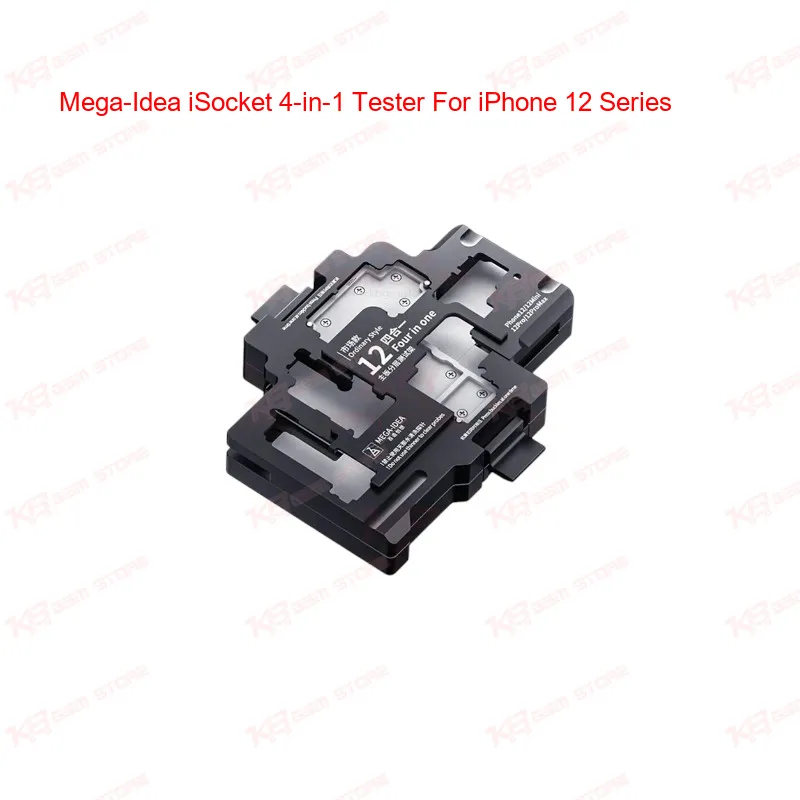
Working on an iPhone 12 series logic board without an iSocket fixture means repeatedly reflowing the upper and lower board layers just to confirm whether a repair actually fixed the fault. The Mega-Idea iSocket 4-in-1 test fixture removes that risk entirely for iPhone 12, 12 mini, 12 Pro, and 12 Pro Max boards, all of which use a split two-layer motherboard design joined by board-to-board connectors under the shielding. When you separate the layers to reach a PMIC, baseband IC, or CPU-area fault, the board loses its electrical path between the top and bottom sections. Normally you would need to solder both halves back together before you could power the phone on and check your work. If the fault persists, you disassemble again, repeat the soldering, and test again. Each cycle raises the chance of CPU tin damage, cold joints, and virtual welding on fine-pitch components — problems that turn a simple repair into a board write-off. The iSocket fixes this by clamping both board layers into a needle-plate socket that recreates the original board-to-board connection through spring-loaded pins. You place the upper and lower layers into the fixture, close it, and the pins make contact across every pad the original connector used. Connect your DC power supply and a working display, and you get a live, functional readout of the board exactly as if it were fully assembled — without a single solder joint. If the phone still shows a fault, you open the fixture, go back into the board, and test again in seconds instead of another 20-30 minute reflow cycle. This test-before-you-solder workflow changes how technicians approach dead phone and board-level repairs on iPhone 12 series units. Instead of gambling on whether a PMIC reflow or IC change actually resolved a no-power or dead-after-flash issue, you confirm the fix while the board is still open. That means fewer wasted reballing attempts, fewer damaged pads from repeated heat exposure, and a faster turnaround on service center jobs where technicians need to test, adjust, and retest without waiting on flux cleanup and cooldown between attempts. The fixture uses premium needle-plate construction designed for precise, consistent contact across the iPhone 12 series board layout. Poor-quality pogo pins lose contact under repeated use or fail to seat evenly across all board points, giving false negatives that send technicians chasing faults that do not exist. Mega-Idea builds the iSocket with a preferred needle-plate quality specifically to hold this alignment through daily bench use. Its mini, compact footprint fits easily into a tool drawer or repair kit bag, and technicians running mobile repair services or moving between service center benches will find it easy to carry without added bulk. At roughly 100 grams, it adds negligible weight to a repair toolkit while removing one of the most time-consuming and risky steps in iPhone 12 series board diagnostics. For any workshop handling dead phone, hang-on-logo, boot loop, or no-power complaints on iPhone 12 series units, this iSocket becomes part of the standard diagnostic sequence: disassemble, identify the suspect IC or connector, test in the fixture before committing to a final solder, then reassemble only once the fix is confirmed. It pairs naturally with your DC power supply, hot air rework station, and microscope as part of a complete board-level repair setup, cutting down the trial-and-error soldering that damages boards and eats technician time.