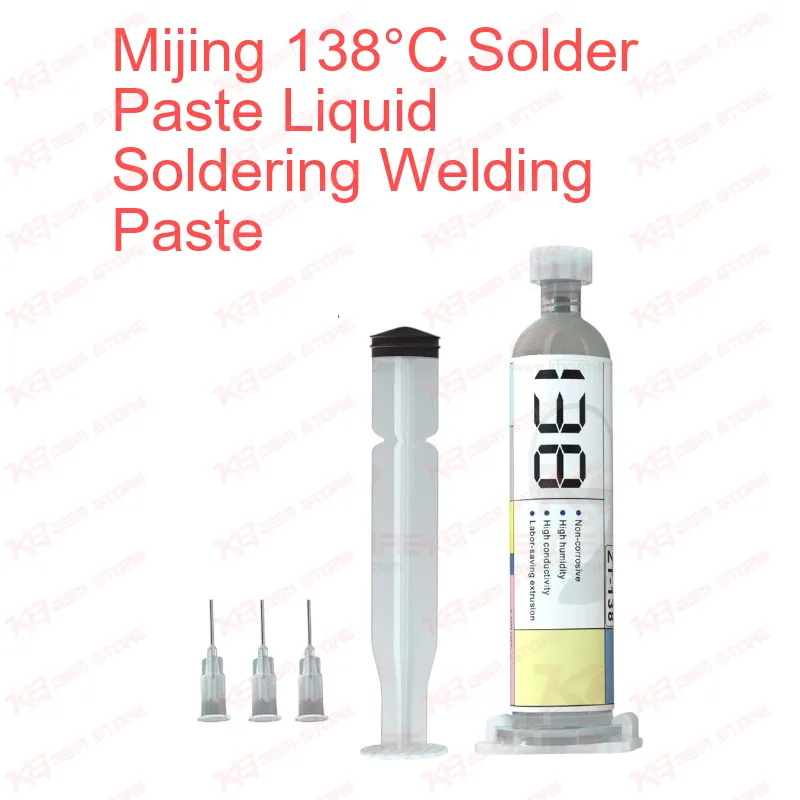
Working on a modern smartphone motherboard means dealing with tightly packed ICs, thin copper traces, and components that can't handle high heat for long. Mijing 138°C Solder Paste solves that exact problem on your repair bench. Its low melting point sits well below standard leaded and lead-free alloys, which normally reflow between 183°C and 217°C, so you get full joint formation at a fraction of the thermal stress. That matters most when you're reworking a board that already has a hardware fault, since extra heat cycles can turn one bad IC into three. Technicians dealing with a dead phone after a failed flash, or a board stuck on hang on logo because of a cracked BGA joint, need a paste that reflows fast without cooking the plastic connectors or LCD flex cables sitting a few millimeters away. This paste handles that by melting evenly at 138°C, giving you a narrow, predictable reflow window instead of guessing when the solder has actually gone liquid. The lead-free formulation also means you're not dealing with the fumes and disposal concerns that come with older leaded pastes, which matters in a workshop where you're soldering for hours at a stretch. In terms of workflow, this paste fits directly into the steps a GSM technician already knows. For IC change karna on power management chips, audio ICs, or charging ICs, you apply the paste to the pads, seat the IC or a fresh ball grid, and reflow at a controlled low temperature instead of pushing the hot air station past 300°C. For jumper lagana on lifted pads or broken traces, the paste's fine texture spreads evenly across small contact points, giving a stronger bond than trying to tack a wire with bare solder wire alone. It also works well in BGA reballing, where the goal is round, uniform balls without bridging — the paste's flow characteristics reduce the chance of solder balls merging into one blob under the microscope. Boot loop issues traced back to a cold solder joint on the CPU or eMMC often get resolved the same way: reflow the affected pads with this paste rather than a full chip swap, saving both time and the cost of a replacement IC. Because the paste stays workable a bit longer before drying compared to high-temperature pastes, you get more time to align BGA stencils or reposition a chip before it sets, which is useful when you're doing continuous board work rather than a single quick job. It's equally relevant for network issue repairs where a baseband IC or PA module needs reflowing, and for charging issue diagnosis where a lifted charging IC pad is the actual root cause rather than the port itself. Store it away from direct sunlight and extreme heat to keep the paste from drying out in the syringe, and give it a shake before use if it's been sitting for a while. For a repair shop handling daily board-level work — screen problem boards, network issue units, charging issue phones — having a dedicated low-temperature paste on the bench cuts down on collateral damage to nearby components, which directly affects how many boards you can save instead of scrapping. It's a straightforward addition to a soldering station setup, working alongside your existing hot air gun, microscope, and PCB holder without needing any special equipment changes.