Skip to product information
1 of 4
Brand: MIJING

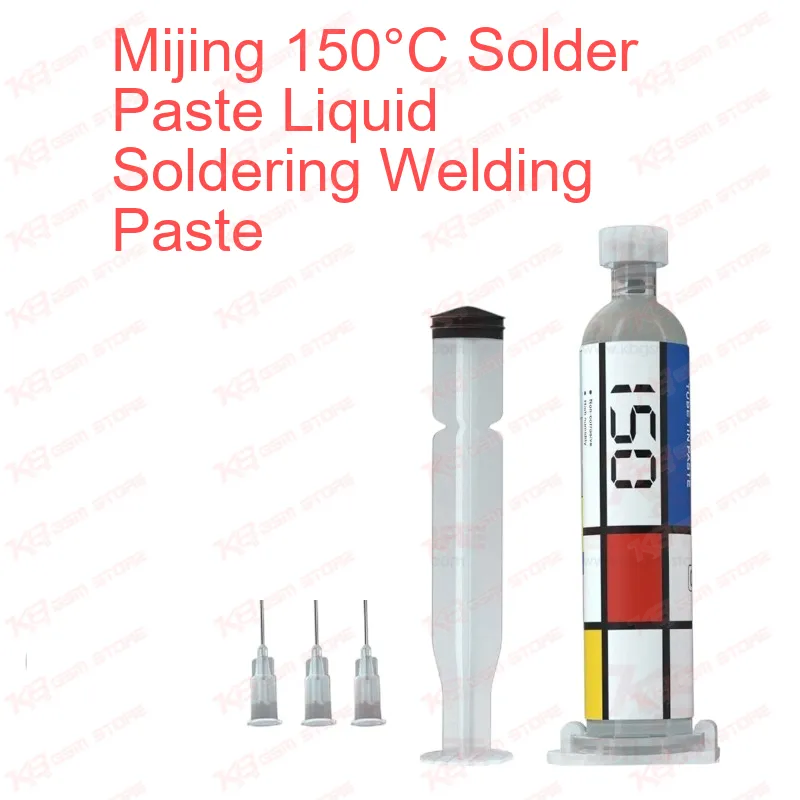
Mijing 150°C Solder Paste Liquid Soldering Welding Paste

Mijing 150°C Solder Paste Liquid Soldering Welding Paste

Regular price Rs.800.00 PKR
Regular price Sale price Rs.800.00 PKR
Sale Sold out
Shipping calculated at checkout.
Quantity

Mijing 150°C Solder Paste is a low melting point soldering compound built for mobile phone motherboard repair, IC rework, and BGA reballing on the workbench. The 150°C melting range lets you desolder charging ports, FPC connectors, and small ICs without pushing excess heat into nearby components, cutting the risk of pad lifting on dead phone boards. Its liquid, syringe-friendly paste form spreads evenly over pads, wets quickly under a hot air station, and leaves a clean, low-residue joint after reflow. Pakistani technicians handling charging issue, hardware fault, or IC change karna tasks get a paste that mixes easily with existing solder without disturbing surrounding SMD parts.

SKU:MST-SOLDERING-ACCESSORIES-548

⚖️ Weight: 0.03 kg

  • Safe & Secure Payment
  • Fast Delivery
  • WhatsApp Support
View full details

Description


A repair bench sees boards in every condition, from a phone that's dead after flash to one stuck on hang on logo, and the tin already on those pads rarely cooperates with a normal high-temperature iron. Mijing 150°C Solder Paste solves that by melting at a much lower point than standard Sn63/Pb37 paste, so you get full liquidus flow on the pad while the plastic connectors, FPC cables, and nearby capacitors on the board stay well below their damage threshold. That gap matters most during charging port swaps, FPC connector reflow, and small IC removal where one accidental overheat turns a five-minute charging issue fix into a full board recap. The paste ships in a liquid, syringe-ready form, which means you control the amount you lay down instead of fighting with a solid bar or wire that needs constant re-melting. A light bead across the pad is enough for most charging port and connector jobs, and the paste stays workable under the tip long enough to reposition a component before it sets, which is the difference between a clean joint and a cold solder joint on a busy bench. Technicians running box chalana sessions or working through a stack of dead phone boards benefit from the shorter dwell time each joint needs, since the lower melting point cuts the seconds the iron or hot air nozzle sits on one spot. That directly reduces the chance of lifting a pad on boards that have already been reworked once or twice, which is common on older Android and budget devices coming in with a hardware fault. Because the paste is a soldering aid rather than a fixed alloy, it blends into the tin already present on the board rather than fighting it, so mixed old-and-new solder joints still flow smoothly instead of forming a grainy, dull joint that fails re-testing. After reflow, residue stays minimal, which keeps continuity testing and multimeter probing accurate without a separate cleaning pass before you move to the next diagnostic step. This fits naturally into a standard PCB repair workflow: clean the pad, apply a thin layer of Mijing 150°C paste, reflow with a hot air station or fine-tip iron, let the joint set, then move straight into functional testing without extra flux cleanup delaying the bench. For technicians handling network issue or display problem boards where a connector or filter needs reflow rather than full IC replacement, this low-temperature approach keeps the repair contained to the exact component instead of risking collateral damage to the chipset area. It also pairs well in a UFS or eMMC-focused workshop, where board-level rework around the storage IC demands controlled heat, and any excess thermal stress risks corrupting a chip that's already being read for data recovery. Stored correctly in a cool, dry spot away from direct sunlight, the paste keeps its consistency and doesn't dry out between jobs, so a single tube covers a meaningful number of repairs before it needs replacing. For a repair shop running through daily charging port, connector, and small-IC jobs, this kind of low-temperature paste becomes a standard consumable sitting next to the flux and reballing kits on the bench, not a specialty item pulled out only for rare cases.

Key Features

150°C low melting point reduces heat stress on nearby SMD components

Liquid paste form works directly from a syringe for controlled application

Suitable for charging port, FPC connector, and small IC rework

Blends smoothly with existing board solder for mixed-joint repairs

Minimal residue after reflow, reducing cleanup before continuity testing

Fast wetting action shortens iron or hot air dwell time per joint

Helps prevent pad lifting on previously reworked motherboards

Compact tube size fits easily into a technician's daily toolkit

Specifications

Brand Entity Mijing
Product Entity Low Temperature Solder Paste
Technology Entity 150°C Low Melting Point Soldering Compound
Compatible Device Entities Smartphone Motherboards, PCB Boards
Repair Process Entity Soldering, Desoldering, BGA Reballing, IC Rework
Industry Entity Mobile Phone Repair Industry

Compatible Devices


Universal — not device-specific; suitable for use on smartphone and tablet PCB motherboards across major brands during component-level repair, regardless of chipset platform.

Common Repair Uses


Charging port replacement, FPC connector reflow, small IC removal and reattachment, BGA reballing support, cold solder joint rework, and general SMD touch-up during motherboard repair.

FAQ

What is the product name?
The product name is Mijing 150°C Solder Paste.
What is the brand of this product?
The brand of this product is Mijing.
What is the model of this product?
The model of this product is the 150°C Low Temperature Solder Paste.
What is this product used for?
This product is used for low-temperature soldering and desoldering during mobile phone motherboard repair, including charging port swaps and IC rework.
Which devices are compatible with this product?
This product is compatible with smartphone and tablet PCB motherboards generally, since it is a soldering compound rather than a device-specific part.
Who should use this product?
This product is suitable for mobile repair technicians, repair shops, service centers, and professional users.
Does this paste work with a normal soldering iron or does it need hot air?
It works with both a fine-tip soldering iron and a hot air station, since 150°C is low enough for either heat source to reach reflow without extra thermal buildup.
Can this paste be mixed with the solder already on a used pad?
Yes, since it functions as a low-temperature soldering aid, it blends into existing board solder instead of requiring the old solder to be fully removed first.