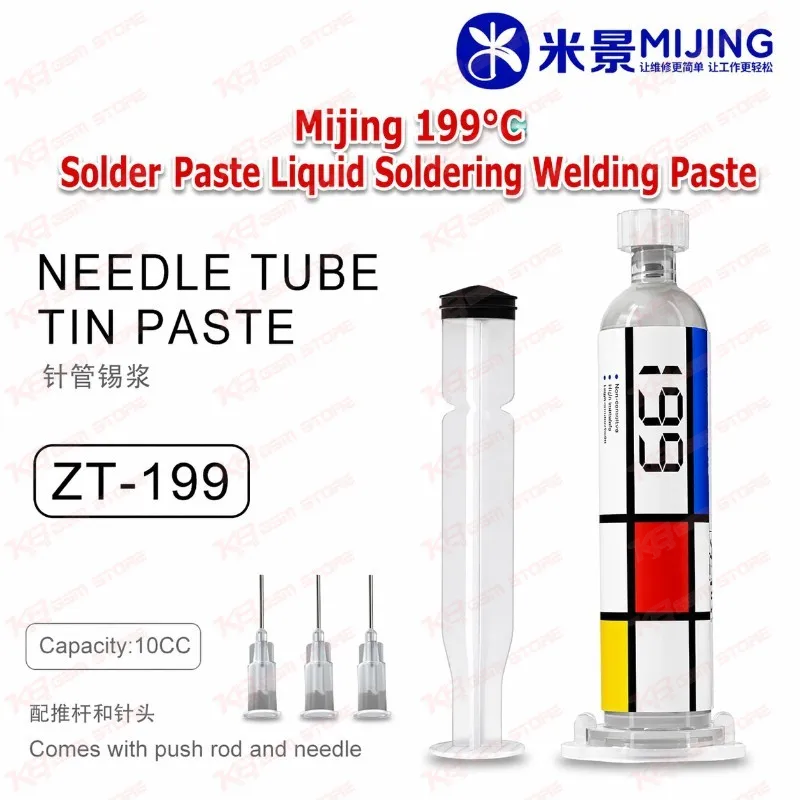
Every mobile repair bench runs into the same problem sooner or later: a joint that keeps failing after reflow because the paste used was too soft for the job. Mijing 199°C Liquid Solder Paste is built around a higher melting threshold than the entry-level 138°C and 158°C pastes most technicians already have lying around, which means it holds its bond better on components that go through repeated heating during diagnosis and rework. You apply it the same way you would any syringe or bottle-dispensed paste — a thin, even layer over the pad or IC leg before you bring your hot air station or soldering iron in. The liquid form spreads without clumping, so you're not fighting the paste to get full coverage on tight-pitch pads or small BGA balls. On a typical dead phone that's already been through two or three failed repair attempts by another shop, weak old solder joints are usually part of the problem. Reflowing with a paste that melts at 199°C gives you a joint that resists the next round of heat stress better than a low-temperature paste would, which matters when a board goes through several diagnostic passes before the actual fault gets isolated. This paste works well for IC change karna jobs where you're pulling and reseating power ICs, charging ICs, or small signal ICs, since a stronger joint means less risk of the same fault returning after a week. It also holds up for charging port pin repair, camera connector soldering, and flex cable pad rebuilding — repair categories where a weak solder point often causes intermittent charging issue or camera not detected complaints days after the phone leaves your shop. For jumper lagana work, where you're bridging a cut track or a missing component footprint with a fine wire, this paste gives the wire enough grip on the pad without needing multiple reflow passes. Boot loop issue boards where you suspect a cracked solder ball under the CPU or power management IC also benefit from a higher-temperature paste during the reball or reflow stage, since it reduces the chance of a repeat cold joint. The paste stays workable long enough for you to position small components accurately before it sets, which matters on hang on logo cases where you're working under a microscope and can't afford the paste drying out mid-placement. Technicians running a busy service center bench appreciate that this paste doesn't need constant temperature babysitting the way ultra-low-melting pastes do — you get a wider margin before under-heating or overheating becomes a problem. It fits naturally into an ISP, UFS, or eMMC repair workflow too, since board-level soldering is often the first step before you move on to box chalana and software marna stages of a dead-after-flash recovery. Pair this paste with a decent hot air station and a stable soldering iron tip, and you'll notice fewer callbacks on repairs that involve IC reseating or pad rebuilding. It's a straightforward, no-frills consumable that earns its place on the bench by simply holding joints together through the kind of repeated rework mobile repair actually demands.