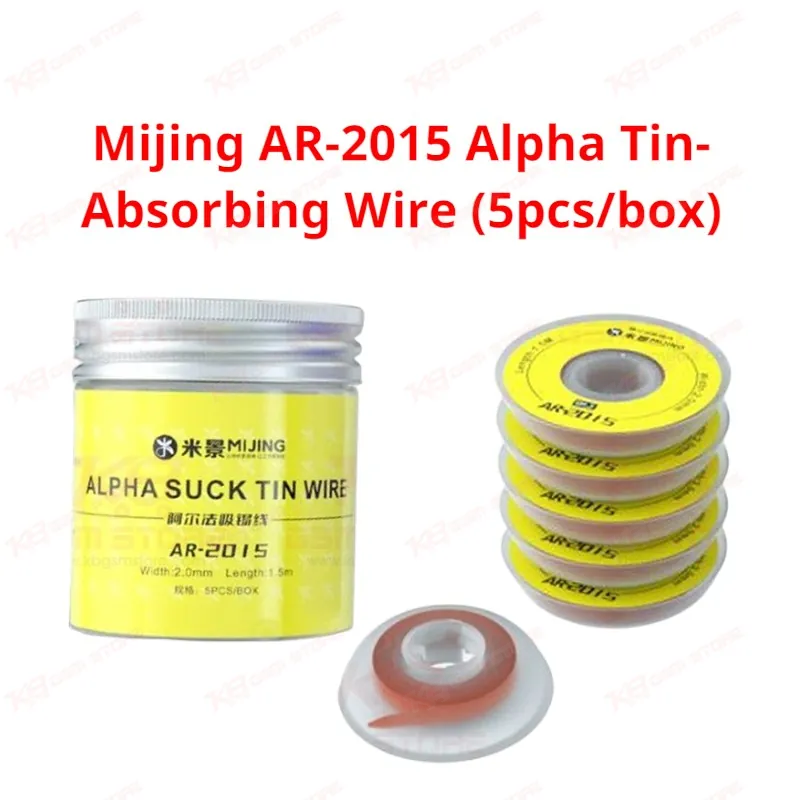
When you are lifting a damaged IC off a phone motherboard or cleaning up a pad after removing an old chip, the wick you use directly affects how clean and safe the job turns out, and the Mijing AR-2015 Alpha Tin-Absorbing Wire is built specifically for that kind of fine-pitch mobile repair work rather than general electronics soldering. The braid uses high-purity copper strands woven tightly enough to pull molten solder off small pads without lifting traces, which matters when you are working close to BGA footprints or tiny SMD components on a crowded board. A specially adjusted flux formula is baked into the wire itself, and Mijing states this raises tin absorption capacity by around 60% compared to standard wick, so you spend less time re-running the iron over the same spot and more time moving on to the next pad. That efficiency gain shows up on your repair bench as fewer passes per joint, which also means less heat exposure for nearby components during board cleaning karna. The antioxidant treatment applied to the copper keeps the braid from tarnishing while it sits in your toolbox, so a spool that has been open for weeks still performs the way it did on day one instead of oxidizing and losing its wicking action. Once the tin absorption karna is done, the flux leaves minimal residue behind, so you are not stuck scrubbing boards with isopropyl alcohol for several extra minutes before you move to reballing or reflow. This model, the AR-2015, runs 1.5 meters in length and 2.0mm in width, a size that suits detail work like IC pad cleanup, jumper site prep, and connector desoldering rather than bulk solder removal on larger through-hole boards. The 2.0mm width gives you enough surface area to pull solder efficiently while still staying manageable in tight spaces around camera modules, charging ports, and small chip clusters. Each box contains 5 pieces, which is a practical quantity for a shop doing regular chip-level repairs, since desoldering wick gets used up steadily on jobs involving dead phone boards, IC change karna, or hardware fault diagnosis. In a typical repair workflow, this wire fits in after you have applied hot air or heated a joint with your soldering iron, working alongside flux paste to lift solder cleanly off pads before you place a new IC, run a jumper lagana job, or prep a board for reballing with a BGA stencil. Technicians handling boot loop issue diagnostics that trace back to a damaged component, or working through hang on logo faults that require chip reflow or replacement, will find this wire useful during the pad cleaning stage that comes before any new part goes down. It also pairs naturally with flux paste and solder paste already in your kit, since the flux core in the wire works best when the joint is pre-fluxed and heated evenly rather than approached cold. Because the wire ships as a coil rather than pre-cut lengths, you control how much wick you use per joint, cutting off small sections for delicate pad work and longer sections when clearing solder across a wider trace run. This kind of control matters on repair benches handling a mix of iPhone, Samsung, Oppo, Vivo, and other Android motherboards, where pad sizes and component density vary significantly from one board to the next. The combination of copper purity, flux formulation, and antioxidant coating is what separates a wick built for GSM repair from generic hardware-store solder wick, and it is why many mobile repair technicians keep this specific type stocked rather than substituting general electronics desoldering braid. For a shop running through multiple boards per day, having a reliable 5-piece box on hand reduces downtime between jobs and keeps pad prep consistent across your repair team.