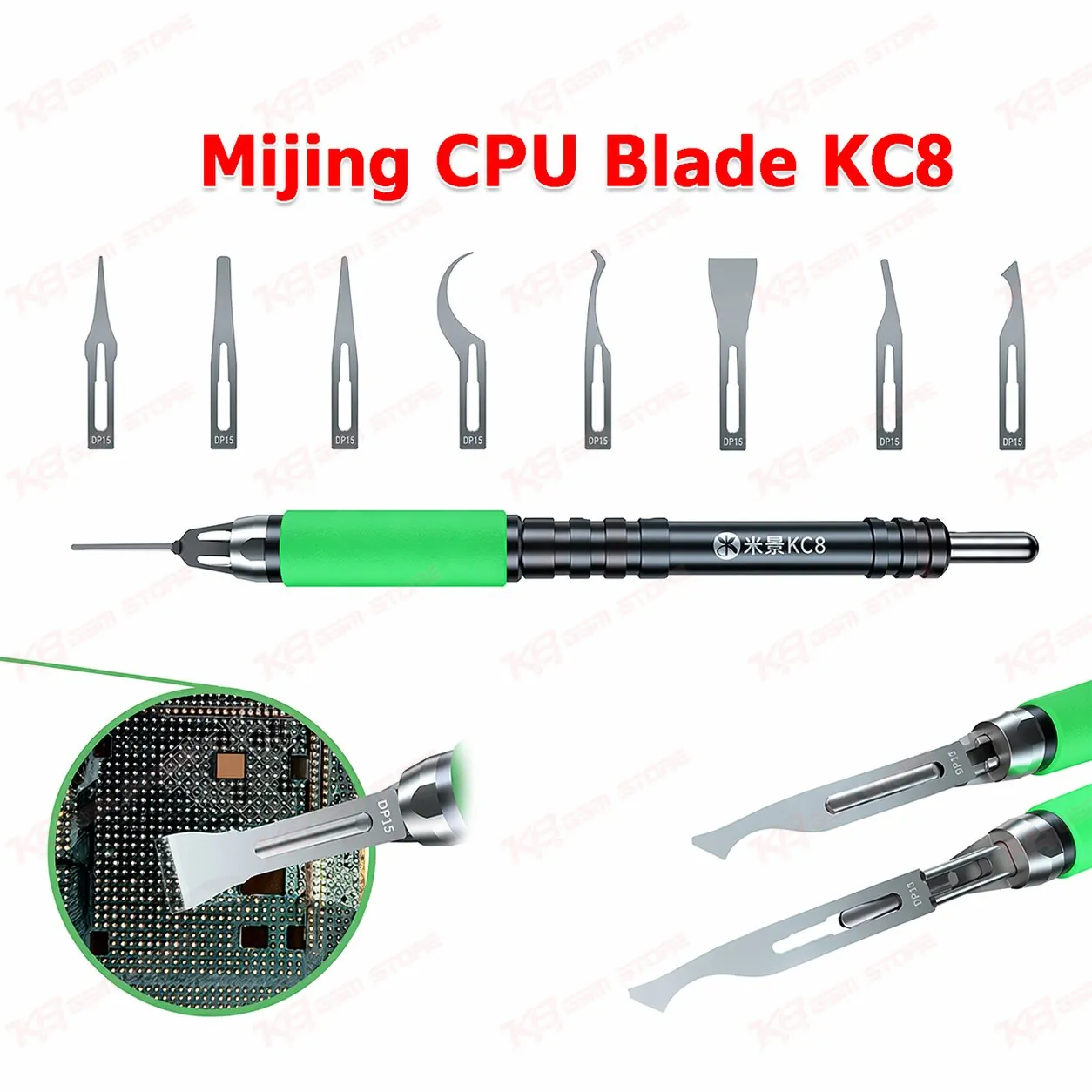
Every GSM technician reaches for a glue removal knife more often than almost any other hand tool on the bench, and the blade you pick decides whether that CPU comes off clean or the pad lifts with it. The Mijing KC8 solves that problem with a set of 8 interchangeable blades made from fine high-carbon elastic steel. The steel goes through a grinding and hand-polishing process that keeps the edge thin enough for precision work while the spine stays thick enough to survive daily prying without snapping or bending out of shape. Vacuum plating covers each blade after grinding, which gives the KC8 real resistance against corrosion, moisture, and the flux residue that builds up during rework. Technicians running hot air stations near their glue removal knife know how fast an unplated blade discolors and dulls. The KC8 holds its edge and its finish through repeated heat exposure, so you're not replacing blades every few weeks. The handle uses a press-rebound release, so changing a blade takes one motion. You press the release point, the spent or wrong-angle blade pops free, and you slot in the next one from the set of 8. No screws, no separate tool, no fumbling mid-repair when a customer's dead phone is sitting open on your mat. The grip itself is shaped for extended sessions — you're not white-knuckling it through an hour of glue removal on a batch of boards. On the bench, the KC8 covers the jobs that come up every single day. Cutting black glue off a CPU or NAND chip before reballing, separating side glue on connectors, prying a stuck rear glass panel, cleaning motherboard glue residue after a liquid-damage board comes in, and gently lifting small ICs during a hardware fault diagnosis. Because the blade set includes multiple shapes and angles, you're not forced into one edge profile for every task — a flatter blade suits wide glue removal across a board, while a finer edge works better for tight spaces around WiFi and power management ICs. This tool sits early in the PCB repair workflow. Before any IC change karna job, before reballing, before you even get the board under the microscope, someone needs to strip the glue and separate the chip without damaging the pads underneath. A blade that's too rigid chips the board; one that's too soft skates across the surface and doesn't cut. The KC8's elastic steel construction is built to hold that middle ground, which is exactly why it shows up on the benches of service centers running high volumes of dead-after-flash and hang-on-logo repairs where board-level work is unavoidable. For shops handling both iPhone and Android boards, a universal glue removal blade like the KC8 means you're not stocking separate knives for separate platforms. It works wherever there's adhesive, an IC to lift, or a glass panel to separate — the blade doesn't care about the chipset underneath, only about the glue and the pad you're trying to protect. Durability matters here because a soldering and rework bench chews through cheap tools fast. The laser-cut blade material keeps every piece in the set consistent, so blade number one performs the same as blade number eight, repair after repair. For a technician charging by the job, that consistency translates directly into fewer redone boards and fewer damaged pads passed on to the next repair step.