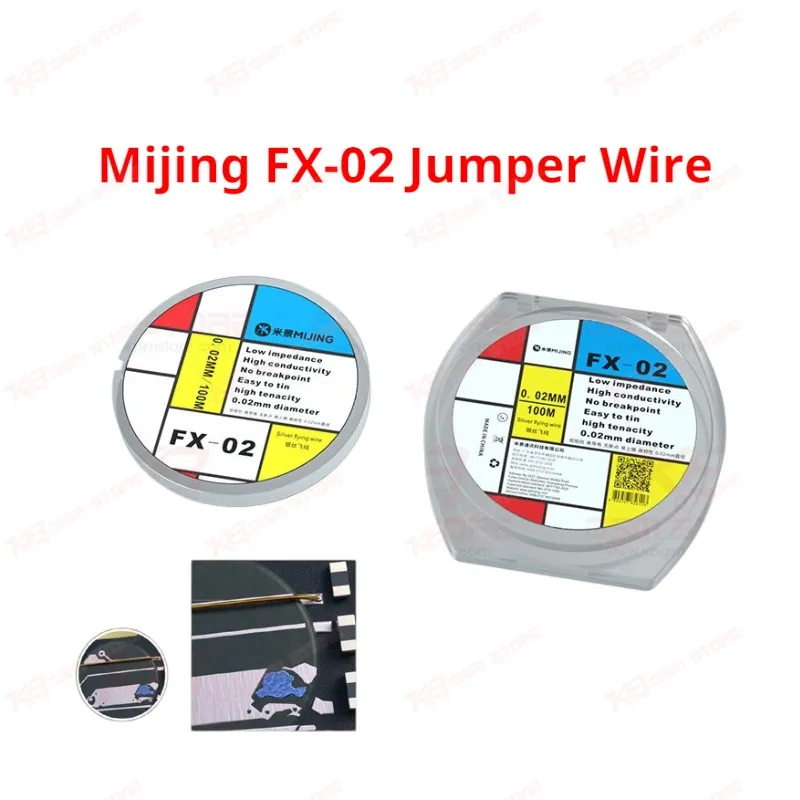
Every mobile repair bench eventually needs a flying wire that won't fight you under the microscope, and the Mijing FX-02 is built for exactly that job. This is a 0.02mm silver jumper wire supplied on a 100-meter spool, sized for the kind of micro-soldering work Pakistani technicians handle daily — lifted pads, snapped board traces, dead-after-flash boards, and fingerprint line repairs where the original copper track has broken away from the IC or connector. Silver conductor wire takes solder fast, which matters when you're working under time pressure on a customer's device and can't afford repeated reflow attempts that stress the board further. At 0.02mm, the FX-02 is fine enough to route between BGA balls and dense FFC connector pads without bridging adjacent points, so you can repair boot loop issues caused by broken pads or hang-on-logo faults tied to a snapped power rail without cutting a new pad site or reflowing the whole IC. Technicians commonly reach for this wire when a motherboard pad has lifted during IC change, when the fingerprint FFC connector trace has torn during disassembly, or when a charging issue traces back to a broken track near the charging IC. Because the wire is uninsulated silver rather than enamel-coated copper, it solders cleanly on the first pass, which shortens the time a board spends under heat and keeps surrounding components safer during rework. The 100-meter length means one spool covers a large volume of repair jobs before it runs out, so it's a practical bulk buy for a service center rather than a single-use consumable. On the workshop floor this wire sits alongside your hot air station, microscope, and fine-tip soldering iron as one of the basics you reach for constantly rather than occasionally — it belongs in the same drawer as your flux, solder paste, and BGA stencils. For diagnostics work, a broken trace is often the difference between a phone that's genuinely dead and one that just needs a bridge run under the scope, so having a reliable spool on hand directly affects how many boards you can save instead of writing off as "hardware fault, unrepairable." The FX-02 fits naturally into standard PCB repair workflow: isolate the fault with a multimeter or test box, identify the broken trace or lifted pad under the microscope, clean the area, then bridge the gap with a short length of FX-02 before reflowing and retesting. It pairs well with your existing ISP, eMMC, and UFS tool setup since board-level repair often precedes or follows a flash or programming step — a technician doing dead phone recovery will frequently need both a working data connection from a programmer and a solid physical bridge from a jumper wire like this one. Whether you're running a busy service center in Saddar or working solo repairs from a home bench, keeping the FX-02 stocked means you're never stuck waiting on a wire spool mid-job. It's a small, low-cost accessory, but it's one of the tools that decides whether a board repair gets finished the same day or gets shelved.