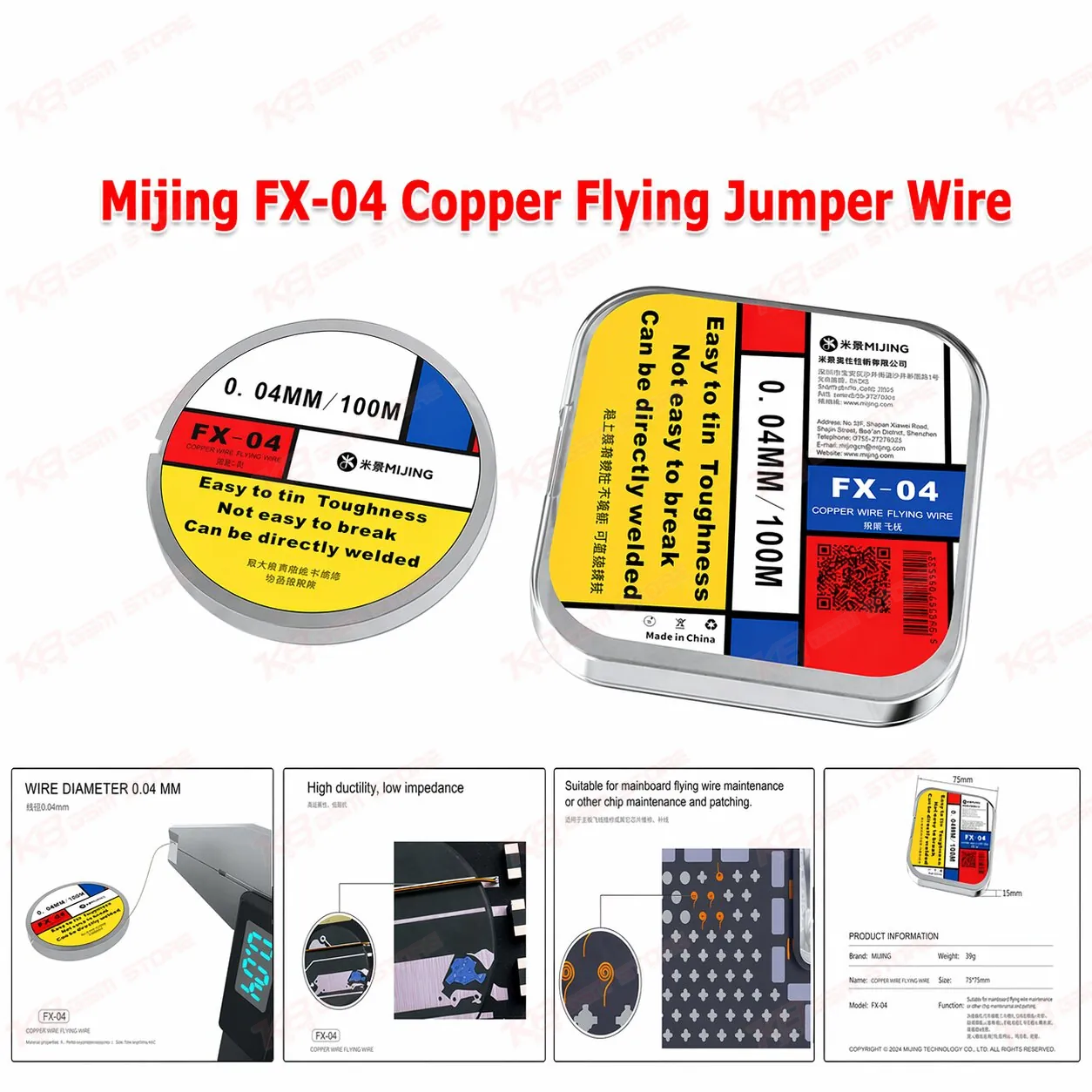
Board-level repair on modern phones depends on wire thin enough to route between BGA pads without bridging neighboring points, and the Mijing FX-04 is built exactly for that job. At 0.04mm diameter, this pure copper wire is fine enough to run jumpers under a chip, patch a lifted trace, or rebuild a fingerprint flying wire without disturbing surrounding components on a crowded board. Technicians working dead phone cases, hang on logo faults, or dead after flash boards rely on this kind of jumper wire to bridge a broken connection once the original trace has lifted during rework, so having a reliable spool on the bench directly affects how many jobs get closed instead of returned to the customer unfixed. The copper core is drawn for consistent gauge across the full spool, which matters when a technician is working under a microscope and needs the wire to sit flat against a pad rather than kink or vary in thickness mid-run. Pure copper also means the wire tins quickly under a soldering iron or hot air without heavy pre-cleaning, which keeps repair time down on jobs where the customer is waiting. This is a meaningful difference from lower-grade alloy wire that oxidizes faster and needs extra flux and scraping before it holds solder cleanly, adding time to every jumper on a board that may already need several. The FX-04 is most commonly reached for during CPU and IC patching, where a jumper needs to be built off a chip pin to a nearby test point or capacitor pad after a trace has failed. Fingerprint and Touch ID flying wire repairs are another core use, since these repairs often route the jumper along a very short, tight path directly to a sensor connector, where wire diameter has to stay minimal to avoid shorting adjacent pins. Battery FPC repair and general board patching after liquid damage or physical trace damage round out the wire's regular use cases, along with general PCB repair where a broken copper trace on the board itself needs to be bridged with an external jumper. Because the spool holds 100 meters, a repair shop doing regular board work can go through weeks or months of daily jumper repairs before needing a replacement, which keeps per-repair material cost low compared to buying short pre-cut lengths. The wire is flexible enough to route around components without work-hardening and snapping, a common frustration technicians run into with cheaper, stiffer copper wire during multi-point jumper work. For a Pakistani repair shop handling a steady mix of dead phone, charging issue, and board-level customer complaints, this wire fits into daily workflow rather than being a specialty item pulled out occasionally — most technicians doing IC change or jumper lagana work will use it on a regular basis. Storage is simple since the spool format keeps the wire protected from kinking or tangling between uses, and a fresh cut end is always available without needing to straighten a coiled length first. Overall, the FX-04 fills a specific gap in a repair kit: general hookup wire is too thick for BGA-level work, and improvised alternatives rarely match dedicated copper flying wire for consistency or solder response, making this spool a standard stock item rather than an occasional purchase for any bench doing regular motherboard repair.