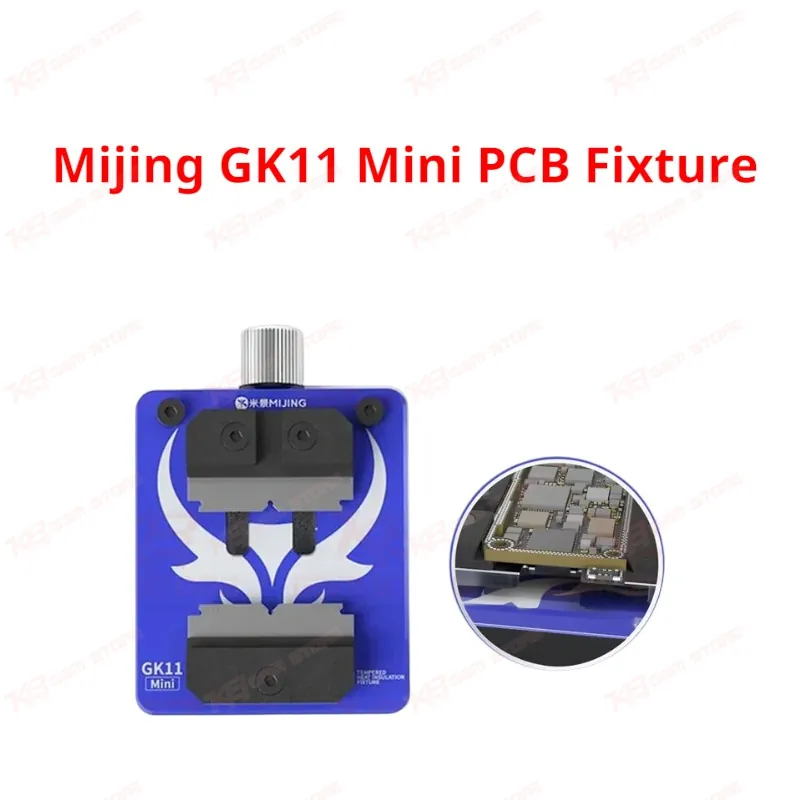
When you're working a dead phone that needs an IC change karna or a full chip reball, the first problem you hit is keeping the board still while you apply heat from an angle. The Mijing GK11 Mini solves exactly that problem. You clamp the motherboard into the toughened glass frame, lock the threaded rod, and get a fixed, level surface that doesn't shift when your hot air gun hits it at 30-40 degrees, which is the angle most technicians use to drive heat under a chip without scorching the surrounding components. The glass panel itself is high-temperature resistant, so repeated exposure to hot air rework doesn't yellow, warp, or crack the surface the way cheaper acrylic fixtures do over time. That matters on a busy bench where the same fixture holds ten or fifteen boards a day. The concealed threaded connecting rod is a small design detail that saves you real cleanup time. On open-thread fixtures, solder oil and rosin creep into the screw mechanism and turn the adjustment knob gummy within weeks. The GK11 Mini keeps that rod shielded, so the clamp keeps turning smoothly even after months of flux exposure. You get a mainboard fixing slot that adjusts across a wide range, and a separate, smaller chip fixing slot built for holding individual ICs during removal or reballing prep, so you're not trying to balance a loose chip with tweezers while running a hot air gun in your other hand. This makes it a natural fit for eMMC and CPU reballing work, where the IC has to stay perfectly flat under the stencil while you apply solder balls. The fixture works across board types, not just one brand. You'll use it clamping an iPhone logic board for a charging issue or display problem, then switch straight to an Android mainboard with a network issue or hang on logo fault, without changing tools. The "Mini" designation isn't a compromise on grip strength, it's a footprint choice, this size sits comfortably next to a soldering station or under a microscope stand without eating your whole bench. If you're doing board-level work under magnification, the flat glass base gives you a stable platform that doesn't wobble when you're threading flying wire or placing a jumper lagana on a tight-pitch trace. For shops that box chalana on a daily basis, running box software after hardware repair, a fixture like this sits upstream of that process. Before software marna even becomes relevant, the board has to survive the hardware fix, and that starts with a fixture that holds it steady through soldering, reballing, and IC replacement. Technicians running eMMC or UFS chip swaps also lean on this type of fixture heavily, since precise chip placement depends on the board staying exactly where you clamped it. The GK11 Mini fits into that workflow as a bench essential rather than a specialty tool, useful for general PCB repair, BGA rework, chip-level diagnostics, and reballing prep across most phone and tablet mainboards you'll see in a Pakistani repair shop.