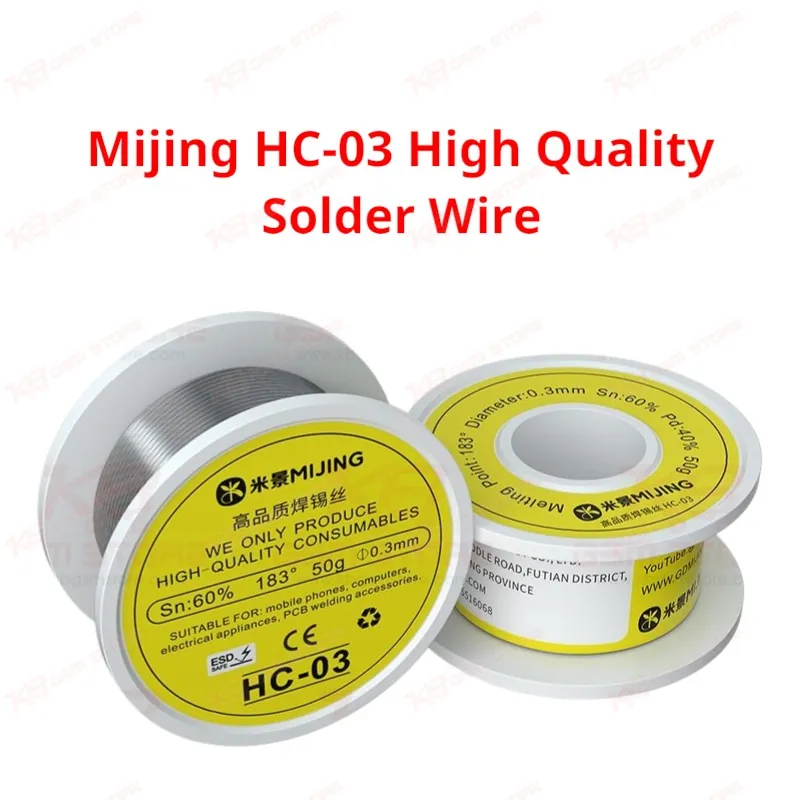
Precision soldering on modern phone boards demands a wire that flows cleanly, wets fast, and doesn't leave behind residue that interferes with diagnostics later. The Mijing HC-03 solves this with a 0.3mm Sn60/Pb40 alloy formulated specifically for fine-pitch repair work. At 60% tin and 40% lead, the alloy strikes a practical balance between melting point, joint strength, and workability that technicians rely on for everyday board-level repairs. The 183°C melting point sits in a comfortable range for hand soldering with a standard iron, letting you work quickly without overheating sensitive components nearby. On a busy repair bench, this can be the difference between finishing a job in one pass and having to touch up joints because the solder didn't flow evenly the first time. Low impedance and high conductivity are built into the alloy composition, so joints made with this wire carry current cleanly and resist the intermittent connection issues that show up months later as charging problems, network drops, or random reboots. High purity matters here because impurities in cheaper solder wire cause weak joints, dull surfaces, and poor wetting on aged pads. The rosin core running through the center of the wire is organic and environmentally friendly, activating on contact with heat to clean oxidation off the pad surface before the solder bonds. This active flux improves wetting on boards that have already been through diagnostic work, previous repairs, or general wear, where pads often carry a light oxide layer that resists fresh solder. Cleanup after soldering stays simple since the rosin residue wipes away with standard flux cleaner or isopropyl alcohol, leaving the board ready for continuity testing or further work without extra scrubbing. Smoke output stays low during soldering, which matters in enclosed workshop spaces where multiple technicians work close together for extended hours. The 0.3mm diameter is the key spec that separates this wire from general-purpose solder. Board-level phone repair regularly involves IC legs, BGA pad touch-ups, connector pins, and SMD components spaced tightly enough that a thicker wire either bridges adjacent pads or deposits more solder than the joint needs. A 0.3mm profile lets you feed exactly the amount required, keeping joints neat and reducing the cleanup and rework that comes from excess solder. This makes the HC-03 a natural fit for jumper wire installation, IC reballing touch-ups, charging port pin repair, and general motherboard component-level work where pad spacing is small. Oxidation resistance in the wire itself means a spool sitting on the bench for weeks still solders the same way it did on day one, without a dull, hard-to-melt surface forming from air exposure. Each spool carries 50g of wire, giving enough length for sustained daily use across multiple repair jobs before a replacement is needed, which keeps consumable costs predictable for repair shops running through solder regularly. Whether the job is IC change, jumper lagana on a dead board, charging port repair, or general PCB welding during a board-level diagnostic, the HC-03 handles the fine-pitch soldering demands that phone repair work requires. It pairs naturally with a temperature-controlled soldering iron, flux paste, and a PCB holder for stable board positioning during detailed work. For technicians running through multiple boards a day, consistent alloy quality and clean flow reduce the small frustrations that add up — cold joints, bridging, and rework — letting you move through diagnostic and repair queues with less friction on the soldering step itself.