


Brand:
MIJING
Mijing HM-11 Nano Cleaning Sponge
Mijing HM-11 Nano Cleaning Sponge
Regular price
Rs.1.00 PKR
Regular price
Sale price
Rs.1.00 PKR
Shipping calculated at checkout.
Quantity
Couldn't load pickup availability
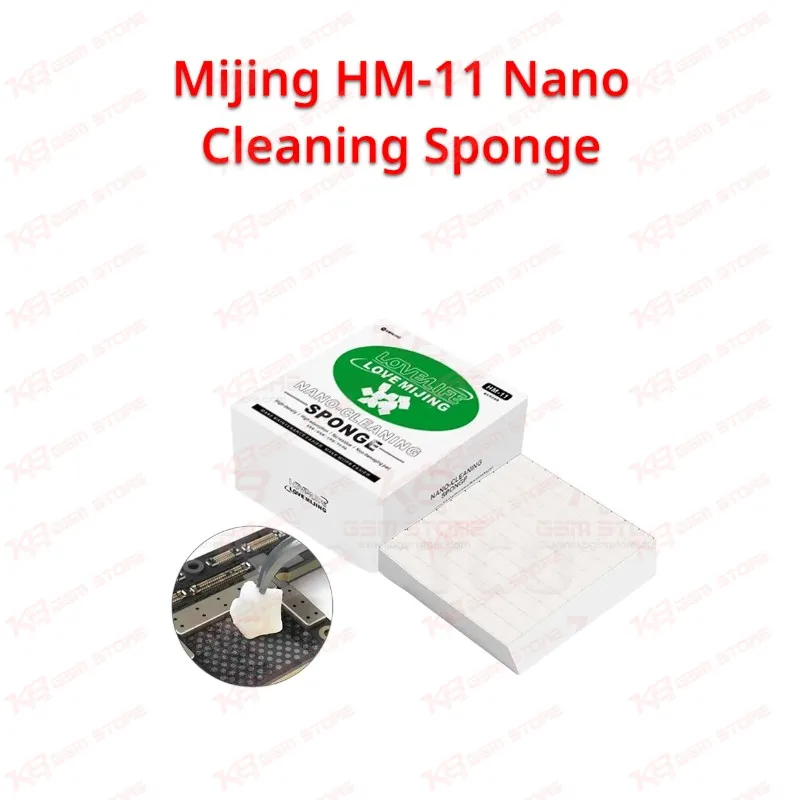
The Mijing HM-11 Nano Cleaning Sponge tackles flux residue, solder grease, and dust on mobile phone motherboards without leaving floc or streaks behind. You get a high-density nano-porous material that lifts dirt through pure adsorption, so it works with water or your usual PCB cleaning agent and never scratches sensitive components. Technicians use it on motherboards, CPU chips, back glass, LCD screens, frames, and camera lens modules during board-level repair. Each box holds 500 pieces cut to a convenient size for bench work, making it a practical consumable for busy repair shops that clean multiple boards daily.
SKU:MST-SOLDERING-ACCESSORIES-306
⚖️ Weight: 0.2 kg
- Safe & Secure Payment
- Fast Delivery
- WhatsApp Support


Description
FAQ
What is the product name?
The product name is the Mijing HM-11 Nano Cleaning Sponge.
What is the brand of this product?
The brand of this product is MIJING.
What is the model of this product?
The model of this product is HM-11.
What is this product used for?
This product is used for cleaning flux residue, solder grease, and dust from mobile phone motherboards, PCBs, screens, frames, and camera modules.
Which devices are compatible with this product?
This product is universal and works on mobile phone motherboards, PCBs, screens, frames, and camera lens modules across all brands, since compatibility depends on surface type rather than a specific device model.
Who should use this product?
This product is suitable for mobile repair technicians, repair shops, service centers, and professional users.
Does this sponge leave any residue on the motherboard after cleaning?
No, the nano-porous material adsorbs dirt and grease directly, so it does not leave floc, lint, or residue on the board.
Can this sponge be used together with a PCB cleaner or isopropyl alcohol?
Yes, technicians commonly pair it with PCB cleaning agents or isopropyl alcohol for tougher flux and grease buildup, though it also works dry for light dust and residue.