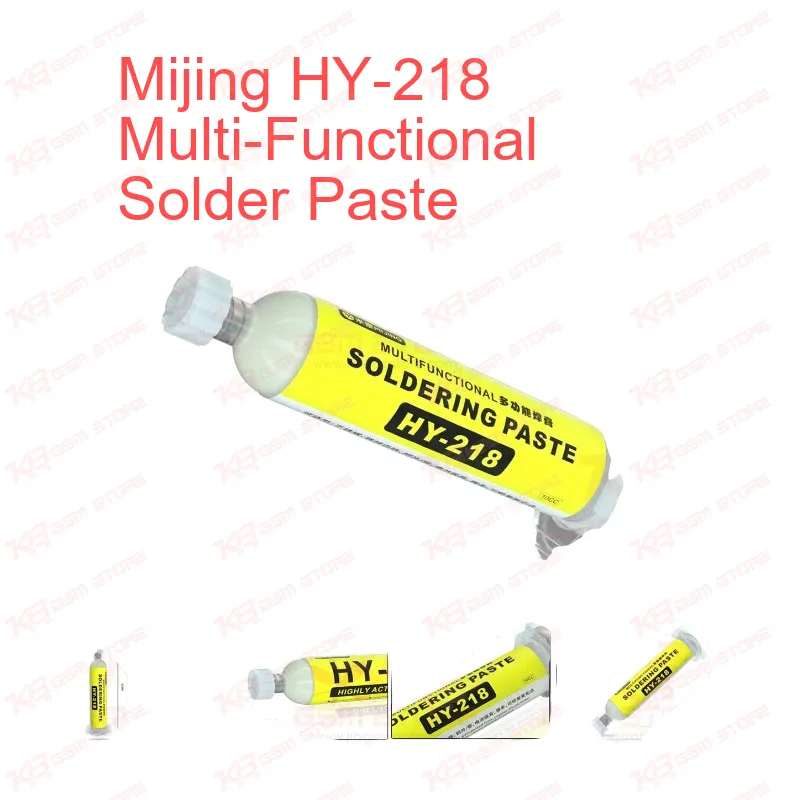
Every GSM bench runs into the same problem sooner or later: a board comes in with a dead battery flex, a corroded charging point, or a pad that's oxidized after months of moisture exposure, and normal solder wire just skates off the surface instead of bonding. Mijing HY-218 exists for exactly that situation. It's a high-activity, multi-functional solder paste built to grab onto oxidized or hard-to-wet metal surfaces without you needing to dip the point in nickel or flux it three times first. You apply a thin layer directly onto the oxidation point or the joint you're rebuilding, run your soldering iron or hot air over it at a normal working temperature, and the paste wets the surface fast enough that you get a solid, shiny joint instead of a dull cold joint. That single property is what separates a general-purpose paste from one built for repair work — on a workshop bench, you don't have time to fight a pad for five minutes before it finally takes solder. Because the formula is no-clean, you're not stuck scrubbing isopropyl alcohol over the board afterward to remove sticky flux residue. That matters more than it sounds on a busy day: less cleanup means less risk of accidentally lifting a nearby component with an aggressive cleaning pass, and it keeps the board looking presentable if the customer wants to see the repair. The paste is also described as odorless and environmentally friendly, so it doesn't fill a small repair shop with the sharp smell some older rosin-based pastes produce, which is a real consideration if you're working in an enclosed counter space for hours at a stretch. In terms of where this sits in your actual repair workflow, HY-218 is a soldering-stage consumable, not a diagnostic tool — it comes into play after you've already identified the fault, whether that's a hardware fault on a charging IC pad, a jumper lagana situation on a broken trace, or a physically damaged battery connector that needs a fresh weld. For battery DIY welding, technicians use it to rebuild the tab-to-cell connection point when a battery pack's original weld has failed, since the paste bonds reliably to nickel and copper tabs without extra prep. For mobile motherboard work, it's suited to touch-up soldering around charging ports, small ICs, and connector pins after a component swap, or for general reflow of components that came loose from a drop. Because it doesn't leave behind a corrosive residue, you don't have to worry about it slowly eating away at nearby traces weeks after the repair, which is a real risk with cheaper, uncontrolled flux pastes. Store it capped and away from direct heat, and give the jar a quick stir with your spatula before use if it's been sitting for a while, since the paste can settle over time. A small dab goes a long way, so most technicians find one jar covers a large volume of oxidation-point and battery repair jobs before it needs replacing. If your bench already runs a hot air station, a decent soldering iron, and standard PCB holders, HY-218 slots straight into that setup as the paste you reach for whenever a joint won't take tin cleanly — it doesn't require any special equipment or a change to your existing soldering process.