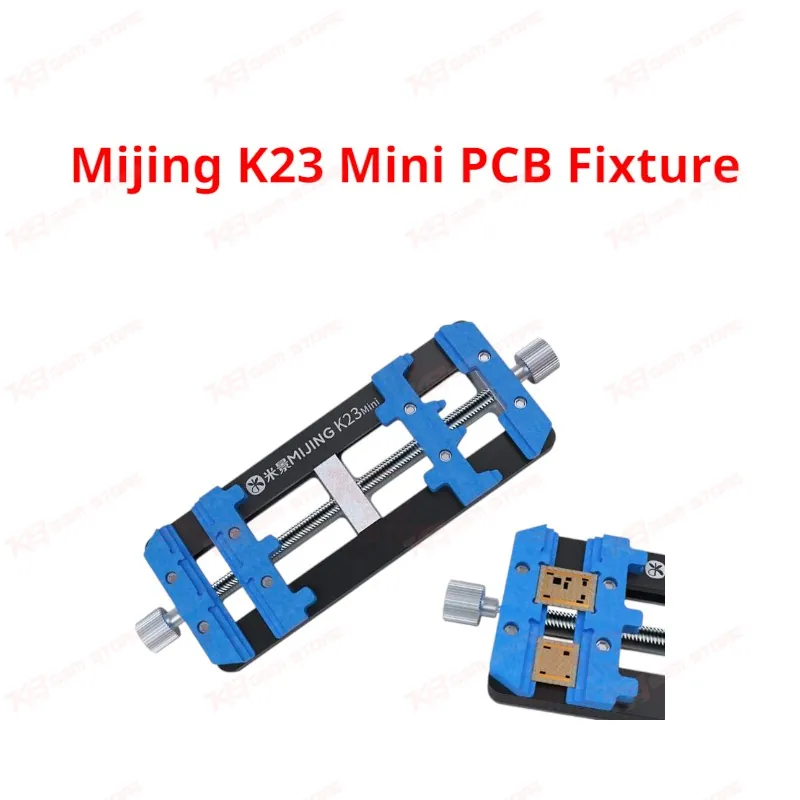
Every GSM technician working on a dead phone or a board with a hang on logo fault knows the repair only goes as well as the fixture holding the board. The Mijing K23 Mini solves that problem with a redesigned glue removal slot that sits larger and steadier than older Mijing fixtures, giving you a stable base whether you're clearing old adhesive off a motherboard or repositioning a board mid-repair. You get a dedicated iPhone CPU de-gluing area built into the same panel, so you don't need to swap tools between the glue removal stage and the chip fixing stage of a repair. The deepened V-shaped groove uses a dislocation-fixed angle that grips boards at a precise clamping point, and this matters most when you're running hot air over a board for IC change karna or chip reflow work, because a board that shifts mid-heat ruins the joint you're trying to fix. The panel itself is made from high-temperature resistant synthetic stone, so repeated exposure to hot air stations and soldering irons doesn't warp or degrade the surface over time the way plastic fixtures do. That same material carries anti-static and anti-corrosion properties, which protects the sensitive ICs and connectors on the board you're clamped onto, particularly relevant when you're handling boards after a charging issue or hardware fault where corrosion may already be present near the charging port or PMIC. Chip storage slots built into the fixture keep small components organized during teardown, so you're not hunting for a screw or an IC pin between disassembly and reassembly on a busy repair bench. The multi-functional chip fixing area extends the fixture's use beyond simple board holding, letting you secure individual chips for reballing or inspection work without a separate holder. Chip heat dissipation is built into the design, which keeps temperatures manageable around the clamped board during longer soldering or rework sessions, reducing the risk of heat damage spreading to nearby components. The fixture works across traditional motherboards and special-shaped or irregular boards alike, with multiple misaligned buckle positions that adapt the clamp to boards that don't sit flush or symmetrical, keeping the hold tight and preventing deformation over repeated use. This makes the K23 Mini a practical fit for repair shops handling a mix of device brands rather than a single motherboard shape. Whether the job is a board moving repair after water damage, a motherboard welding task following a dead after flash situation, or straightforward chip glue removal before reballing, this fixture stays in one place on the bench and does all three without a tool change. For a service center running through multiple boards a day, that consolidation saves real time between jobs. The compact "Mini" footprint also means it doesn't crowd a repair bench the way larger dual-shaft fixtures can, making it a sensible pick for technicians working in tighter workshop spaces or mobile repair setups where bench space is limited.