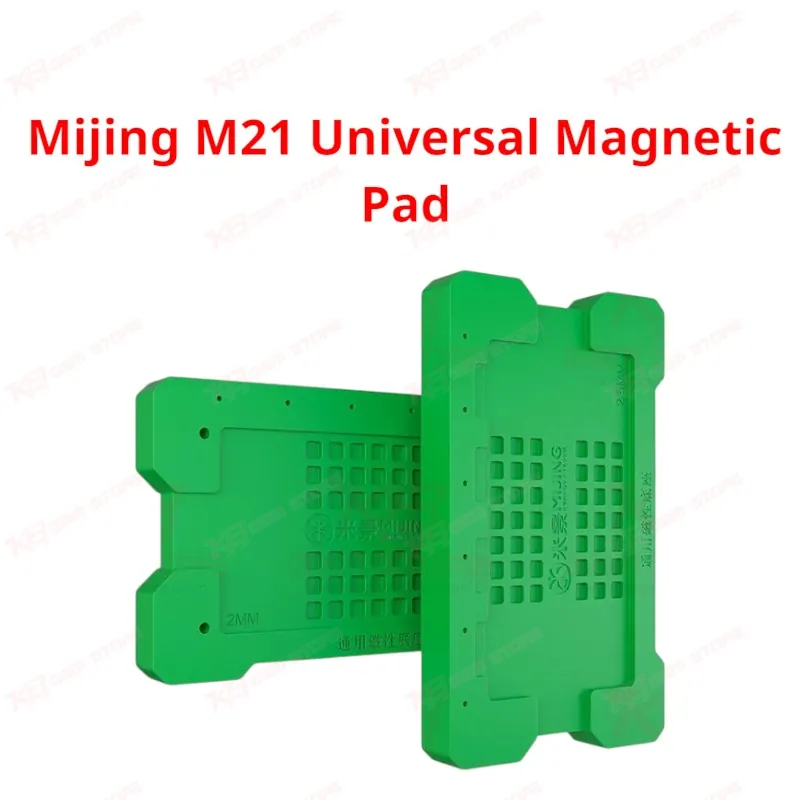
When you're reballing the middle layer of a phone motherboard, the biggest risk isn't the reflow — it's the stencil shifting mid-process and ruining your tin balls. The MIJING M21 solves that problem with a magnetic base that grips the stencil firmly while you work, so the mesh stays exactly where you placed it through the whole tin-planting cycle. The body is molded from temperature-resistant silicone with strong magnetism built directly into the material, which means it holds up to the repeated heat cycles you put it through on a busy repair bench without warping or losing its grip strength over time. What makes the M21 genuinely useful for a Pakistani repair shop is that it's universal — you buy one base and it works with any magnetic middle-layer reballing stencil, instead of locking you into one phone brand. MIJING sells matching stencil sets separately for Samsung (23 pieces covering S10 5G through Z Fold4), Huawei (33 pieces spanning Mate, P-series, and Honor Magic boards), Xiaomi (12 pieces for Mi 9 Pro through 12S Pro), Vivo, Oppo, iQOO, Sony, Asus, and OnePlus. So if your workshop handles a mixed brand of dead phones every day, you add the stencil set for whichever brand walks through the door instead of buying a whole new base each time. The square groove design on the platform keeps the stencil seated evenly across the board, which matters when you're working on small middle-layer components where even a slight tilt throws off your ball placement. The M21 is built to work alongside the Mijing GX01 and GX02 non-magnetic scraper knife set. These knives handle the tin paste application and IC glue removal steps that come before reflow — since the scrapers are non-magnetic, they don't interfere with the base holding the stencil while you scrape. This combination covers the full middle-layer reballing workflow: seat the board, lock the stencil with the M21's magnetism, apply tin paste with the scraper, then move to your hot air station or preheater for reflow. In practical repair shop use, this tool shows up most often when a phone comes in dead after flash or with a hardware fault traced back to the middle-layer board rather than the main CPU or IC package. Board-level technicians pull the middle frame, clean off the old tin, seat a fresh stencil on the M21, and replant the tin balls before putting the board back together. It's also a standard part of the toolkit for shops that do IC change karna work on middle-layer components, since a stable stencil base cuts down on rework caused by shifted or uneven tin balls. At 70 x 48 x 64 mm, the M21 sits comfortably on a crowded workbench next to your hot air station, microscope, and preheater without eating up space. The silicone build resists the heat coming off nearby soldering equipment, and the magnetic grip means you're not holding the stencil in place with one hand while you work with the other — your hands stay free for the actual reballing work. For a repair shop juggling multiple phone brands through the same bench every day, having one universal base instead of brand-specific fixtures cuts down on both cost and clutter, while still giving you accurate, repeatable results on every board that comes through.