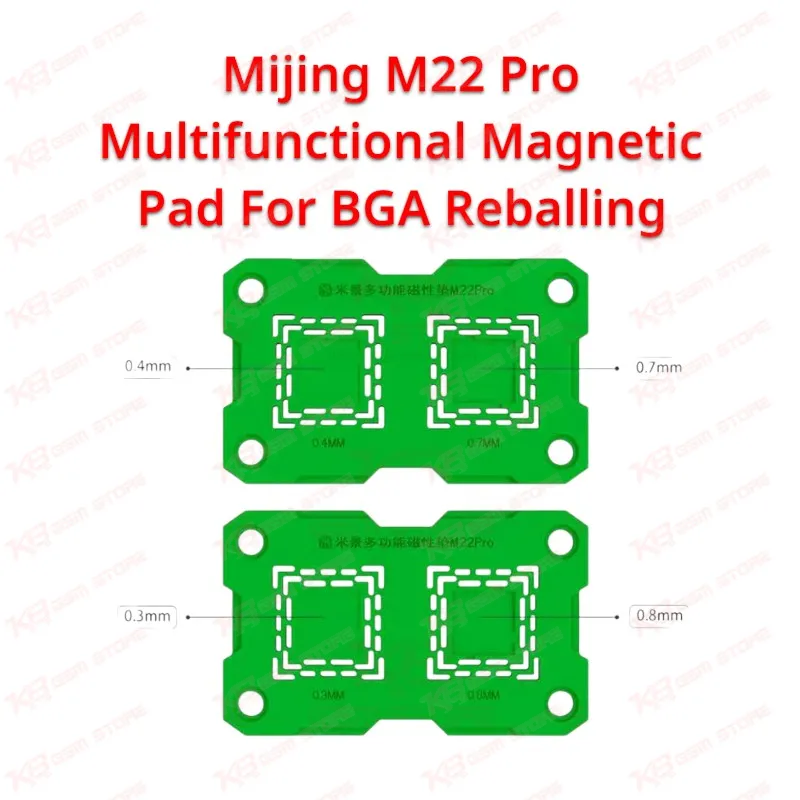
Board-level repair work lives or dies on how steady your chip stays while you're planting balls or reflowing solder, and that's exactly the problem the Mijing M22 Pro magnetic pad solves on a busy repair bench. Instead of carrying separate fixtures for different chip thicknesses, you get one double-sided silicone pad with four distinct depth cavities — 0.3mm, 0.4mm, 0.7mm, and 0.8mm — so a single tool covers small NAND packages right through to thicker CPU and PMIC ICs. The magnetic base pulls the chip flush into the cavity and holds it there through hot air cycles, which matters when you're doing reballing on a motherboard that's already been through a few rounds of rework and can't take rough handling. Technicians doing IC change on CPU, eMMC, UFS, or audio and power ICs deal with a recurring headache: the chip shifts mid-reflow, solder balls scatter unevenly, or the board tilts under the hot air nozzle and the whole job has to restart. The M22 Pro's magnetic hold keeps the chip locked in place through that heat cycle, so your ball placement stays consistent and you're not reworking the same IC twice because of a shifted chip. Built from silicone rather than a rigid plastic or metal base, the pad handles sustained high-temperature exposure from hot air rework stations without warping, cracking, or losing its shape after repeated use — a real concern with cheaper fixtures that soften or deform after a few weeks of daily reflow work. The material also resists the flux residue and mild corrosion that builds up on a workshop bench over time, so the pad keeps performing instead of degrading into a sticky, discolored mess. At 113mm x 70mm x 6mm and only 67g, it's light enough to reposition constantly during a repair session, whether you're working under a microscope, moving between stations, or fitting it into a tight bench layout alongside your soldering iron, hot air gun, and multimeter. Available in green and gray, the pad's flat, low-profile design doesn't add bulk to your workspace, and it sits stable on the bench during precision work where even a small wobble can throw off chip alignment. This fixture fits directly into standard BGA reballing and reflow workflows: place the IC in the matching depth cavity, let the magnetic pull hold it steady, apply flux and solder balls or paste as needed, and run your hot air or reflow process with the chip locked in position throughout. It's equally useful for motherboard-level hardware fault diagnosis where you need to remove, inspect, and reinstall an IC without damaging the pads underneath, since a stable working surface reduces the risk of lifted pads or cold joints that lead to repeat hardware issues after reassembly. For repair shops handling a mix of Android and iOS boards, the four-depth design means you're not stocking multiple single-purpose pads for different chip families — one M22 Pro covers most of the board-level IC sizes you'll encounter across chipset platforms. Whether your workshop focuses on CPU reballing, eMMC and UFS chip replacement, or general PCB rework, this pad functions as a core part of the soldering setup rather than a specialty accessory you reach for occasionally, and its compact footprint means it earns a permanent spot on the bench rather than sitting in a drawer between jobs.