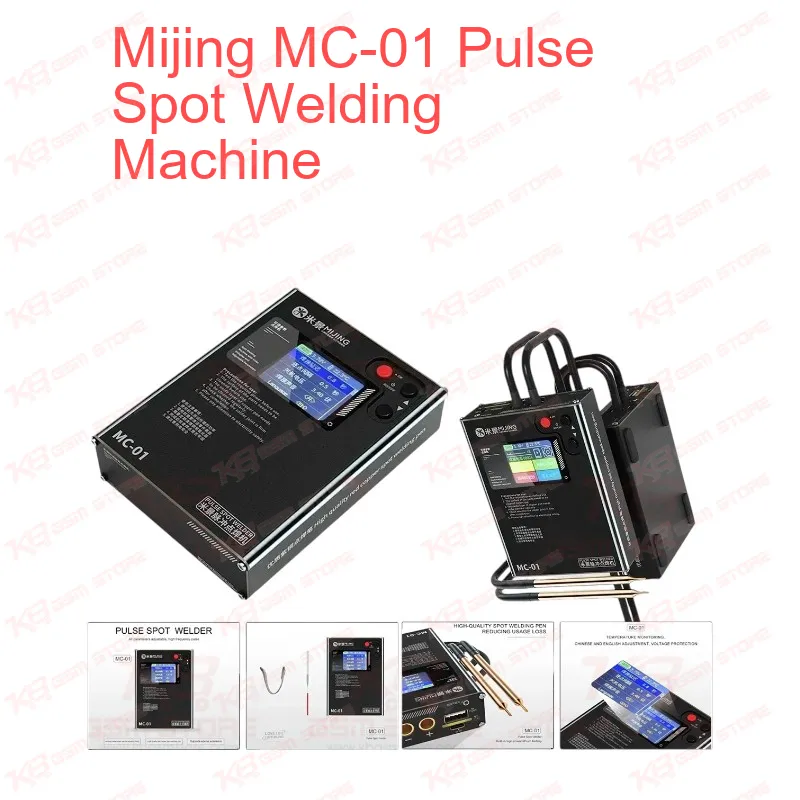
Battery repair is one of the most repeated jobs on any mobile repair bench, and the tool you use for nickel strip welding decides how clean and safe that job turns out. The Mijing MC-01 is a pulse spot welding machine designed around this exact workflow. Instead of running on continuous current like a soldering iron, it stores energy and releases it as a controlled pulse, which keeps heat exposure to the battery cell extremely short. That matters when you're working on lithium-ion phone batteries, where excess heat risks swelling or damaging the cell.You adjust the welding parameters directly on the machine to match the job in front of you. Thin nickel strips on a small phone battery need a different pulse than a thicker connector on a camera module or a steel rim repair, and the MC-01 lets you dial that in rather than forcing one fixed setting on every job. The high-frequency pulse output is built for this kind of precision work, and the unit supports expansion modules if your workshop wants to extend its welding scope later.Handling matters just as much as output on a device you'll be picking up dozens of times a day. The MC-01 stays compact and light, so it sits easily on a crowded repair bench without taking up the space a full-size welder would need. The welding pen uses a copper tip with an insulated rubber sleeve, giving you a steady grip and protecting you from stray current while you're working close to a live board. Automatic trigger welding means you don't have to manually fire each pulse — position the pen, and the machine handles the timing, which speeds up repetitive battery jobs considerably.The LCD screen is where you'll spend most of your attention during a session. It displays welding data in real time, and you can switch the interface between Chinese and English depending on what your technicians are comfortable reading. Built-in temperature monitoring and voltage protection add a layer of safety, cutting down the chances of a bad pulse damaging the battery or the board underneath it. For a workshop doing volume battery replacements — the kind of "charging issue" and "battery swelling" jobs that come in daily — this kind of feedback loop matters more than raw power specs.Power comes from a built-in 5000mAh battery, charged through a Type-C port that accepts 2-5A input for reasonably fast top-ups between jobs. The unit also supports QC and PD output, so it can discharge externally when needed, giving it some flexibility beyond just welding duty. You're not tethered to a wall outlet mid-repair, which matters if your bench setup moves around or if you're doing on-site service work.On the compatibility side, the MC-01 is built to weld lithium-ion phone batteries across major brands — Apple, Huawei, Vivo, Oppo, and Xiaomi are all covered — along with general copper and aluminum welding tasks like camera steel rim repair. It ships with two spot welding pens, nickel strips, and a grinding tool, so you can get straight into battery jobs without sourcing consumables separately on day one.For a Pakistani repair shop handling steady battery replacement volume — whether that's a swollen battery, a dead cell after a drop, or routine nickel strip re-termination — the MC-01 fits into that exact workflow. It's not a general-purpose soldering station; it's a focused tool for one job done often, and it's built to make that job faster and more consistent on the bench.