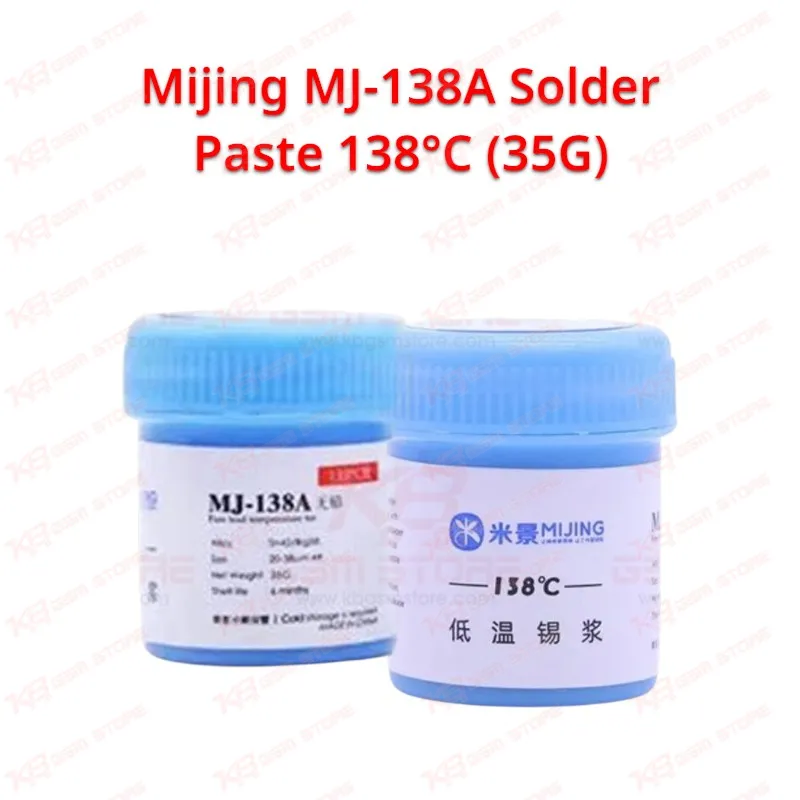
A repair bench that handles daily BGA and SMD work needs a solder paste that reflows without threatening the components sitting next to the target IC, and Mijing MJ-138A solves that problem with a 138°C melting point that sits well below the 183°C to 217°C range most general-purpose pastes demand. That lower threshold matters most when a technician is reballing a CPU, NAND, or PMIC on a dead phone board where three or four other ICs already sit close to the reflow zone, since a hotter paste raises the chance of shifting or damaging a neighboring chip during the same hot air pass. The paste comes in a 35g container, giving a workshop enough material to run multiple reballing jobs, jumper repairs, and cold solder joint fixes before a refill becomes necessary, and the lead-free, halogen-free formulation keeps the workflow aligned with RoHS-style repair practices that many service centers now expect from their tools and consumables. Mijing built the paste with a no-clean flux base, so a technician does not need to run a full isopropyl alcohol wipe after every joint, which saves time on boards where dozens of small solder points need attention in one session, such as a motherboard recovering from a dead-after-flash fault or a board showing a hang on logo symptom traced back to a cold CPU joint. The paste holds its shape under a hot air gun instead of spreading across the board, which keeps solder confined to the intended pad and reduces the risk of bridging adjacent BGA balls during reballing, a common failure point when a lower-quality paste thins out too fast under heat. High wettability lets the solder flow evenly across BGA pads and CPU or NAND contact points, producing consistent joints that hold up under the vibration and heat cycling a phone motherboard experiences during normal use, which directly affects whether a repaired board comes back with a repeat hardware fault. Technicians working reballing stencils benefit from the paste's behavior under a hot air rework station, since the 138°C threshold gives enough working time to align a stencil, apply paste, and reflow the balls before the paste dries out or the flux burns off, a sequence that becomes harder to manage with higher-temperature pastes on boards where every extra second of heat exposure adds risk. The paste also handles jumper repair and general SMD resoldering on PCB traces damaged during a previous repair attempt, since the lower reflow point means a technician can rework a small section of the board without disturbing solder joints on parts that were already reflowed at a higher temperature earlier in the repair. Repair shops in Pakistan running high volumes of motherboard-level jobs, from charging issue diagnosis to network issue troubleshooting that traces back to an RF IC, find that keeping a low-temperature paste like MJ-138A on the bench alongside a standard 183°C or 217°C paste gives more control over which components get exposed to which heat range, letting a technician match the paste to the specific fault rather than running every job at the same aggressive temperature. That flexibility becomes part of a broader board-level repair workflow that includes diagnostics, IC removal, reballing, and reattachment, with MJ-138A serving the lower end of that temperature spectrum where component protection matters more than reflow speed.A repair bench that handles daily BGA and SMD work needs a solder paste that reflows without threatening the components sitting next to the target IC, and Mijing MJ-138A solves that problem with a 138°C melting point that sits well below the 183°C to 217°C range most general-purpose pastes demand. That lower threshold matters most when a technician is reballing a CPU, NAND, or PMIC on a dead phone board where three or four other ICs already sit close to the reflow zone, since a hotter paste raises the chance of shifting or damaging a neighboring chip during the same hot air pass. The paste comes in a 35g container, giving a workshop enough material to run multiple reballing jobs, jumper repairs, and cold solder joint fixes before a refill becomes necessary, and the lead-free, halogen-free formulation keeps the workflow aligned with RoHS-style repair practices that many service centers now expect from their tools and consumables. Mijing built the paste with a no-clean flux base, so a technician does not need to run a full isopropyl alcohol wipe after every joint, which saves time on boards where dozens of small solder points need attention in one session, such as a motherboard recovering from a dead-after-flash fault or a board showing a hang on logo symptom traced back to a cold CPU joint. The paste holds its shape under a hot air gun instead of spreading across the board, which keeps solder confined to the intended pad and reduces the risk of bridging adjacent BGA balls during reballing, a common failure point when a lower-quality paste thins out too fast under heat. High wettability lets the solder flow evenly across BGA pads and CPU or NAND contact points, producing consistent joints that hold up under the vibration and heat cycling a phone motherboard experiences during normal use, which directly affects whether a repaired board comes back with a repeat hardware fault. Technicians working reballing stencils benefit from the paste's behavior under a hot air rework station, since the 138°C threshold gives enough working time to align a stencil, apply paste, and reflow the balls before the paste dries out or the flux burns off, a sequence that becomes harder to manage with higher-temperature pastes on boards where every extra second of heat exposure adds risk. The paste also handles jumper repair and general SMD resoldering on PCB traces damaged during a previous repair attempt, since the lower reflow point means a technician can rework a small section of the board without disturbing solder joints on parts that were already reflowed at a higher temperature earlier in the repair. Repair shops in Pakistan running high volumes of motherboard-level jobs, from charging issue diagnosis to network issue troubleshooting that traces back to an RF IC, find that keeping a low-temperature paste like MJ-138A on the bench alongside a standard 183°C or 217°C paste gives more control over which components get exposed to which heat range, letting a technician match the paste to the specific fault rather than running every job at the same aggressive temperature. That flexibility becomes part of a broader board-level repair workflow that includes diagnostics, IC removal, reballing, and reattachment, with MJ-138A serving the lower end of that temperature spectrum where component protection matters more than reflow speed.