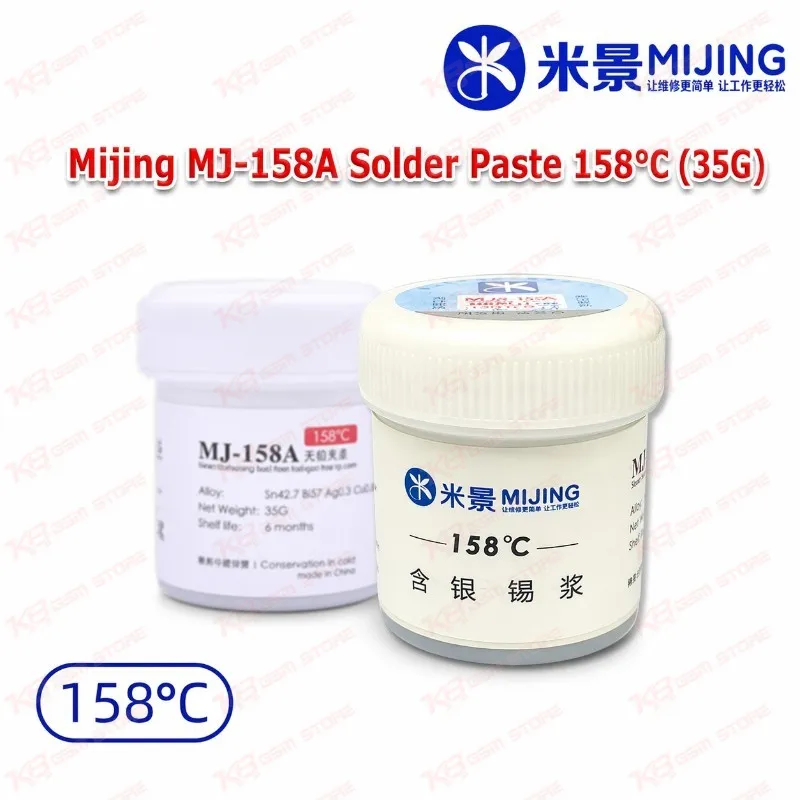
When you reball a CPU or NAND chip on a phone motherboard, the temperature you apply during the process decides whether the board survives the repair or picks up new faults from thermal stress, and that is exactly where the Mijing MJ-158A 158°C solder paste earns its place on a technician's bench. You melt this paste at 158°C, a working point that sits comfortably between standard high-temperature tin pastes and ultra-low-temperature formulas, giving you enough heat to form a clean, reliable joint while keeping the risk of lifted pads, warped boards, or damaged neighboring ICs much lower than a 183°C or 217°C paste would allow. Mobile repair technicians reach for this paste specifically when working on dense, multilayer logic boards where several chips sit close together, since a lower reflow temperature reduces the chance of disturbing solder joints on parts you are not currently working on. You apply the paste directly onto BGA pads or a stencil before reballing a chip, then use your hot air station or reflow setup to bring the board up to the 158°C melt point in a controlled way, watching for even, uniform reflow across the ball grid. This kind of controlled reballing work sits at the center of board-level repair, whether you are fixing a dead phone that shows no display, a board stuck on a hang-on-logo state, or a motherboard that developed a charging issue after a previous repair attempt disturbed a chip's solder joints. Technicians working on boot loop issues traced back to a faulty CPU or PMIC joint also rely on a paste like MJ-158A during the reballing stage, since resoldering the chip with fresh, correctly melted paste often resolves intermittent connection faults that a multimeter alone cannot fully diagnose. The 35g quantity gives a workshop enough material for a steady volume of reballing and rework jobs without needing frequent restocking, which matters for repair shops that handle multiple boards through the day. Because MJ-158A is a general-purpose reballing paste rather than a device-locked component, you can use it across different phone brands and chipset families wherever a BGA chip needs reballing, from PMIC and audio ICs to NAND and RAM packages, as long as your rework station can hold and control the 158°C reflow profile accurately. Consistency in paste texture also plays a direct role in reballing outcomes: an evenly mixed, well-behaved paste spreads across pads without leaving gaps or uneven ball formation, which reduces the number of times you need to reflow the same chip and lowers the cumulative heat exposure on the board. For technicians who regularly perform IC change, jumper lagana work, or pad-level repair on damaged tracks, having a dependable low-temperature paste on hand shortens rework time and improves first-attempt success rates. Workshops that train new technicians also benefit from a mid-range temperature paste like this one, since it gives trainees a wider margin for error compared to higher-temperature alternatives, without sacrificing joint strength on properly executed reballing work. Whether you run a single-bench repair setup or a full-scale service center, keeping MJ-158A stocked alongside your hot air station, reballing stencils, and PCB holder rounds out a dependable board-level repair workflow for the kind of daily reballing and rework tasks that keep a mobile repair business running.