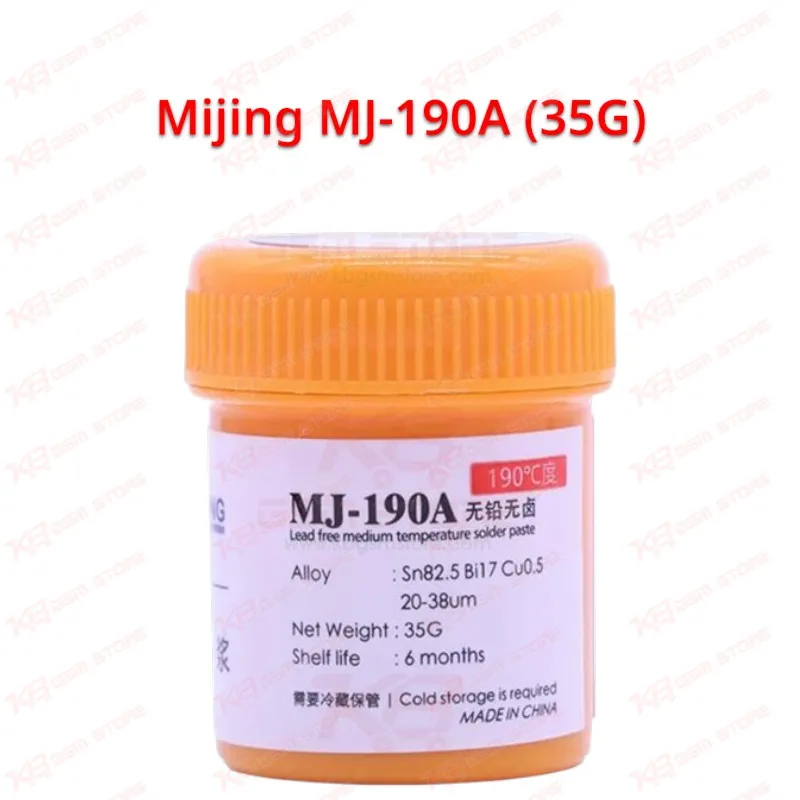
The MiJing MJ-190A solder paste gives mobile repair technicians a reliable medium-temperature option for reballing and chip-level rework on phone, tablet, and laptop motherboards. You get a 35g jar of lead-free, halogen-free tin paste that activates at 190°C, placing it between the low-temperature MJ-138A and the high-temperature MJ-217A in the MiJing lineup, so you can match paste temperature to the specific IC or board you're working on without overheating sensitive components nearby. The paste carries added silver content, which strengthens conductivity across the solder joint and helps the finished connection resist stress during normal device use, something that matters when you're reballing a PMIC or CPU that will go straight back into daily operation. Flux quality drives most of the real-world performance difference between reballing pastes, and this one uses a high-viscosity, no-clean formula that holds its printed shape on the stencil instead of slumping before reflow, which keeps ball spacing even on fine-pitch BGA packages. You avoid the extra step of scrubbing flux residue off the board after soldering, since the no-clean chemistry leaves only a light film that doesn't interfere with continued testing or reassembly. On the workbench, this translates into fewer solder bridges, cleaner wetting across the pads, and solder balls that sit uniformly across the reballing stencil rather than pooling unevenly. Technicians use MJ-190A across the full reballing workflow: applying paste to a stencil for CPU or PMIC reballing, tinning pads during board-level component replacement, reflowing NAND or eMMC chips during data recovery work, and touching up SMD joints during general PCB rework. It fits naturally into dead phone diagnosis, where a board shows no power or gets stuck on the hang on logo screen because of a failed IC connection rather than a software fault, and reballing the suspect chip with fresh paste often restores a stable connection where reflow alone falls short. The medium 190°C activation point makes it a practical default for general motherboard repair, since it sits low enough to protect nearby components rated for standard reflow profiles while still reaching a temperature that produces a proper metallurgical bond on lead-free BGA balls. Repair shops running high daily volumes value the 35g size because it lasts through many reballing jobs before needing replacement, and the sealed jar format keeps the paste protected from air exposure between uses, which matters for maintaining consistent viscosity over time. Because the paste is lead-free and halogen-free, it aligns with RoHS-style environmental handling expectations that many repair businesses now follow, without sacrificing the wetting performance technicians expect from older leaded pastes. You'll find this paste useful whether you're running a full reballing station with a preheater and hot air rework system, or doing a smaller manual repair with a soldering iron and stencil on a single IC. Its compatibility with copper, gold-plated, and standard PCB pad surfaces means you don't need a separate paste for different board types, and the consistent silver-content formula behaves predictably across Qualcomm, MediaTek, Samsung, and Apple motherboard layouts, which keeps your reballing process the same regardless of the device brand sitting on your bench. For technicians who handle charging issues, network issues, or display problems that trace back to a failed motherboard IC rather than a software fault, MJ-190A becomes part of the standard toolkit alongside your hot air station, preheater, and BGA stencils, giving you a dependable middle-temperature option for the majority of reballing and chip resoldering jobs that come through the shop.