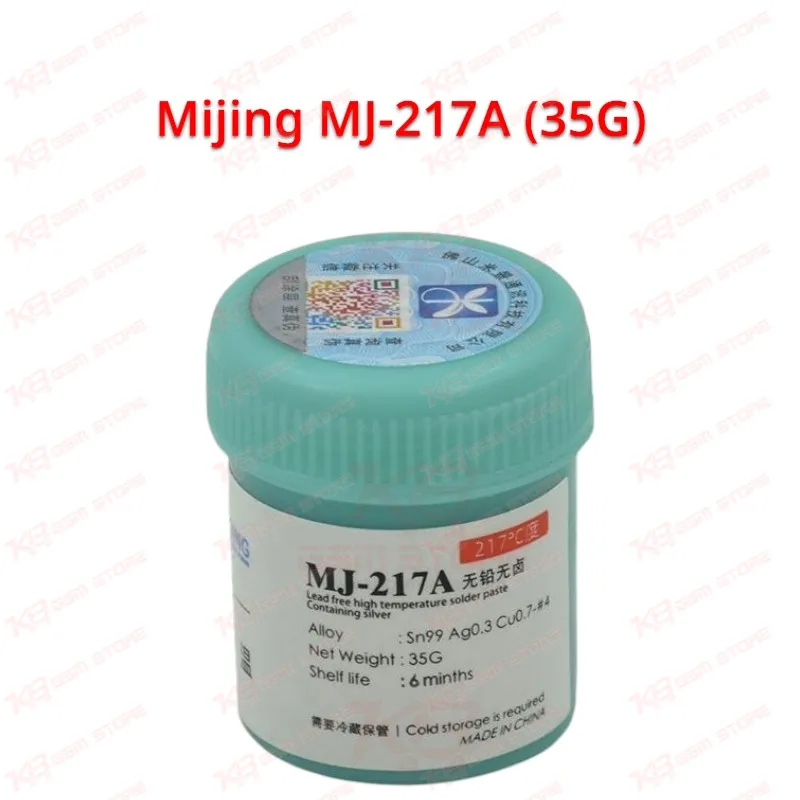
When you work on a dead phone or a board stuck in a boot loop, you need a solder paste that holds up under real repair bench conditions, and MiJing MJ-217A gives you exactly that with its 217°C high-temperature formula built for CPU IC change, BGA reballing, and SMD rework on mobile phone motherboards. This 35g tube mixes lead-free, halogen-free tin with added silver particles, so you get bright, uniform solder joints with strong conductivity every time you reflow a CPU IC, NAND flash chip, or PMIC on a Qualcomm or MediaTek board. MiJing engineers the paste with a fine 1-10μm particle size, which keeps the mixture smooth and viscous while you apply it under a microscope or hot air station, letting you place tiny BGA balls with precision instead of fighting clumps or uneven spread. You'll notice the no-clean flux formula cuts your workflow time down, because you don't need to scrub the board after reflow — the paste resists foaming and oxidation on its own, so your joints stay clean and your board stays free of corrosion risk long after the repair. Pakistani GSM technicians reach for the 217A option specifically when they handle high-temperature reflow jobs that the 138A, 158A, or 190A variants in the same MiJing lineup can't match, since those lower-temperature options suit different chip types and different stages of the same reballing and IC change workflow. On a typical repair bench, you'd use MJ-217A after removing a faulty CPU IC or charging IC with your hot air rework station, applying the paste directly onto the pads before placing a new chip or running a reballing job with a BGA stencil, and the 217°C threshold gives you enough working time to align the chip properly before the solder sets. This paste fits naturally into board-level repair work across dead after flash cases, hang on logo issues, network problems tied to a faulty baseband IC, and charging issues traced back to a damaged PMIC, since all of these repairs eventually require you to remove, reball, or reattach an IC using a paste that can survive the heat without breaking down. Repair shop owners running a busy workshop appreciate that a single 35g tube covers a good number of jobs before you need a refill, and the small, lightweight tube travels well if you move between service center locations or handle house-call repairs. Because MJ-217A contains silver, it also gives you better conductivity than a plain tin-only mix, which matters when you're reballing CPU or NAND chips where solder joint reliability directly affects whether the phone boots cleanly after your repair. Technical training institutes and hardware engineers working with PCB repair equipment often keep multiple MiJing paste variants on their bench, and MJ-217A covers the high end of that range for chips that demand a hotter reflow temperature, such as certain CPU packages and NAND flash components on newer Android boards. Store the tube sealed when you're not using it, since exposure to air over time affects flux performance and paste consistency, and test a small dab on a scrap board when you open a new batch to check reflow behavior before you commit to a client's motherboard. Whether you're running a solo repair bench in Lahore, Karachi, or Islamabad, or managing a full-service mobile repair shop, MJ-217A gives you a dependable, verified-spec tin paste that fits directly into your CPU IC change, BGA reballing, and board-level soldering workflow without guesswork.