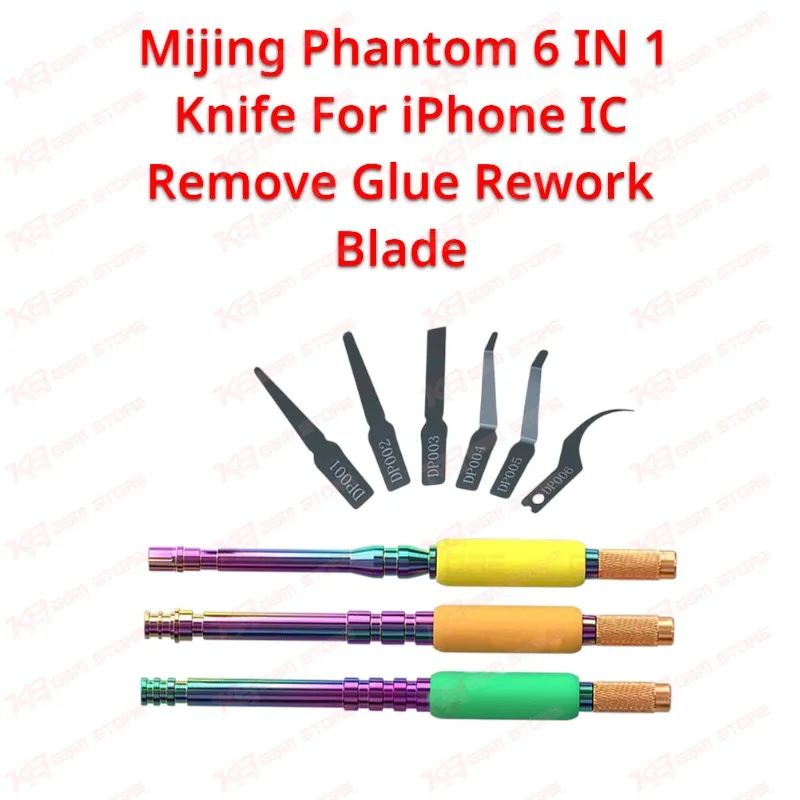
The Mijing Phantom 6 in 1 Maintenance Knife Set gives mobile repair technicians a dedicated blade-and-handle system for lifting black glue, IC packages, and NAND or CPU chips off iPhone motherboards without damaging surrounding pads. Every kit ships with three aluminum alloy handles and six interchangeable blades, secured through a brass collet that locks each blade in place so it does not shift while you apply pressure at the edge of a chip. On a repair bench you use this knife after preheating the board section under a hot air rework station, then slide the blade under the glue line or chip edge to break the bond gradually instead of forcing a lift in one motion, which keeps pads and solder balls intact for reballing or replacement. Repair shops running high volumes of dead phone diagnostics, boot loop cases, or hang on logo boards rely on this kind of knife because CPU and NAND removal is one of the first steps before reballing, chip swapping, or board level component testing, and a blade that flexes or dulls quickly slows down the whole workflow. Aluminum alloy construction on the handle keeps the tool light enough for extended use during a full day of board work, while the brass collet resists wear from repeated blade changes better than plastic clips found on cheaper knife sets. Because the kit includes six blades across three handles, you keep dedicated blades for different tasks, one profile for wide IC packages and another for narrower connector or lattice glue points, without constantly swapping a single blade back and forth and risking damage to the cutting edge. Dot projector lattice glue removal on Face ID modules is another common use for this style of Phantom knife, where a thin, controlled blade edge matters more than raw cutting force, since the lattice sits close to fragile flex connectors on the board. Technicians working through a typical iPhone motherboard repair sequence use this knife at the disassembly stage, after visual inspection and diagnostic testing identify a faulty CPU, NAND, or power IC, the board goes under hot air, and the Phantom knife handles the physical separation before the technician moves to reballing stencils, flux paste, and a replacement chip. This positions the tool inside PCB repair and BGA rework processes rather than general phone disassembly, and it complements ISP pinout tools, UFS programmers, and eMMC test boxes already sitting on a typical GSM repair bench, since chip level data recovery and IC replacement work often start with the same physical removal step this knife performs. The set gives shop owners a lower per repair cost compared to buying single fixed blades repeatedly, since a damaged or dulled blade gets replaced on its own while the three handles stay in service for the life of the kit. For service centers processing multiple boards a day, having three ready handles means less downtime waiting for a single blade to cool down or get repositioned between jobs. Build quality on the collet and handle matters here because a knife that flexes under load transfers less controlled force to the blade tip, raising the risk of gouging a pad or lifting a trace during CPU or NAND removal, so the rigid aluminum body on this Phantom set gives more predictable results across repeated use. Whether the board in front of you shows a charging issue traced back to a power IC, a display problem linked to a display driver chip, or a straightforward hardware fault requiring chip level replacement, the Phantom knife handles the mechanical separation stage consistently, leaving pad condition intact for whatever repair step follows. New technicians building a first toolkit often start with a fixed fibre spudger, which bends and loses its edge within weeks of daily glue removal work, and upgrading to a metal handle and blade system like this one extends usable tool life across hundreds of board jobs rather than dozens. Keeping the blade set clean and free of hardened flux residue between jobs also preserves the sharp edge needed for clean pad separation, so most shops wipe blades with isopropyl alcohol after each glue removal task before storing the handles back in the kit case.