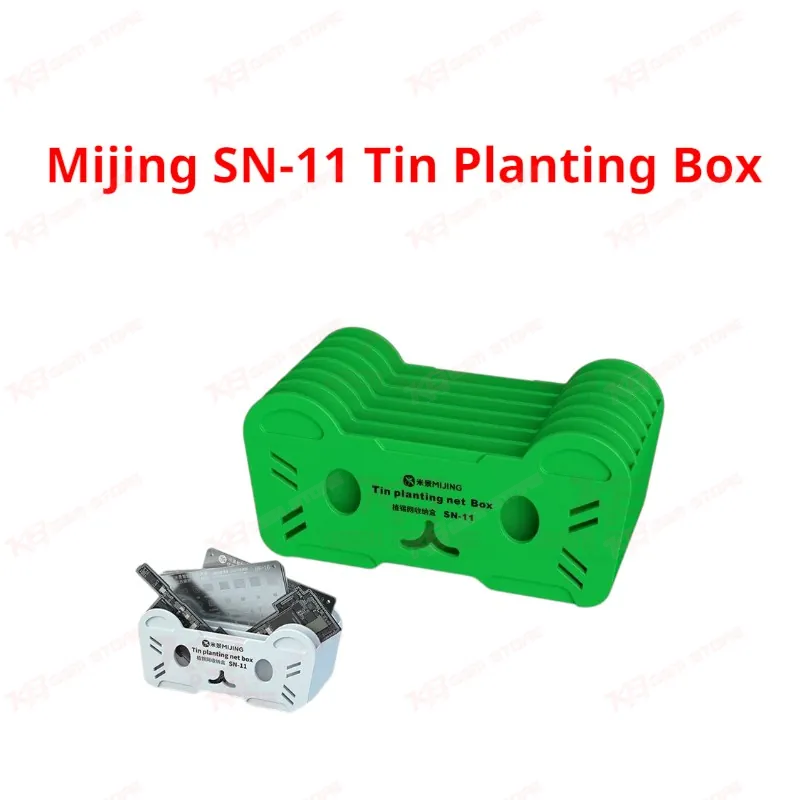
Every technician who does regular BGA reballing knows the problem — stencils pile up, mix sizes get bent, and finding the right one mid-repair wastes time you don't have on a busy bench. The Mijing SN-11 Tin Planting Box solves that by giving each stencil its own slot in a cross-placed layout, so mesh sheets stay flat and separated instead of stacking on top of each other and warping. The slot spacing sits around 9.5mm apart, and a single slot comfortably holds close to 60 pieces of BGA stencil, which means one box can carry a full working set of tin planting nets for different chip footprints without needing a second container. On a mobile repair bench where space next to the hot air station or reballing platform is already tight, this compact 12 x 6 x 5.6cm size matters — it sits flush without eating into your workspace, and the open-slot design lets you grab a stencil with two fingers instead of fishing it out with tweezers. You get two color options, green and gray, so shops running multiple stations can color-code boxes by technician or by chipset family if that fits your workflow. The build stays lightweight at roughly 110 grams, so it's not adding real weight to a bench that's already loaded with a microscope, hot air rework station, and a stack of ICs. Where this box actually earns its place is in the day-to-day reballing routine. When you're doing a CPU reball on a board with a dead-after-flash symptom, or replacing an IC after a hardware fault, the last thing you want is to spend five minutes hunting for the right stencil size while the board sits exposed on the platform. With stencils sorted and visible in the SN-11, you pull the mesh, align it on the chip pads, apply your solder paste or balls, and move straight into reflow — no interruption to the process. Shops that train new technicians also benefit here, since a labeled, organized stencil box makes it obvious which mesh corresponds to which chip package, cutting down on trial-and-error during CPU or IC repair work. It's a small tool, but it sits right in the middle of the reballing workflow — between your desoldering step and your reflow step — and keeps that stage from becoming the bottleneck it often is when stencils are scattered across the bench. For a repair shop running multiple boards a day, whether it's iPhone CPU reballs, Android IC changes, or laptop chip repair, having stencils organized this way shaves real minutes off every job. It's not a flashy machine, but it's the kind of accessory that separates an organized bench from a cluttered one, and for professional service centers where turnaround time matters, that organization translates directly into more jobs completed per day.