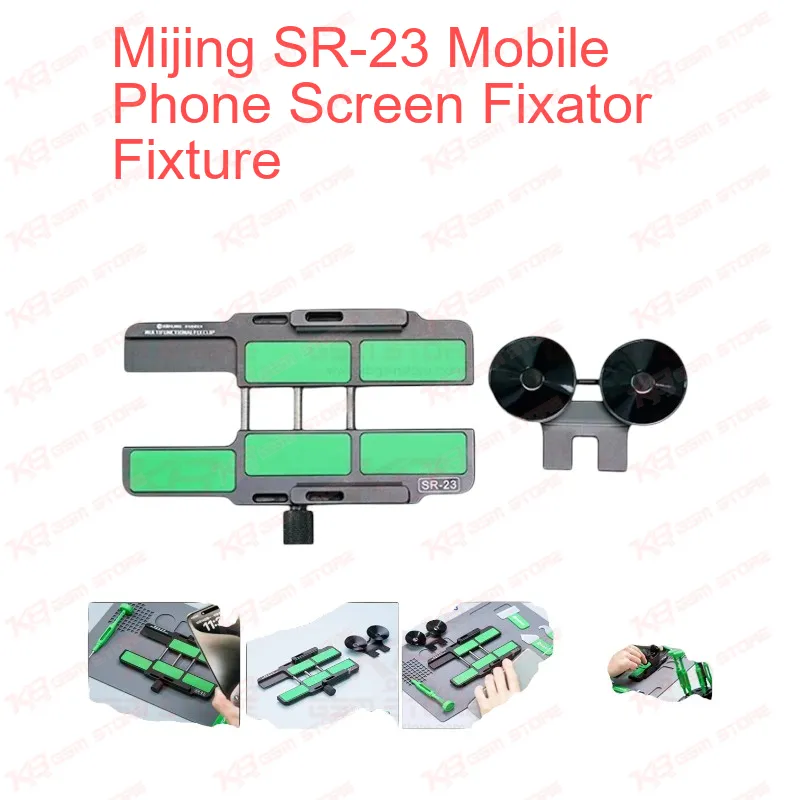
Every technician who has tried to hold a phone screen with one hand while soldering with the other knows how fast that setup goes wrong. The Mijing SR-23 solves that specific problem by giving the display its own support arm. You tilt the screen toward the built-in suction cup, let it lock the display in place at an angle, and get both hands free to work on the motherboard, connector, or charging port underneath. This matters most during dead phone repairs, charging issue diagnosis, and board-level jumper work, where the screen has to stay connected to test the display while you probe the PCB. Instead of propping the screen against a stand or resting it on the desk edge, the SR-23 keeps it suspended safely off to the side. The suction cup itself is made from high-quality PVC that's designed to be reused without losing its grip or warping after repeated attachment cycles, so it holds up through daily workshop use rather than needing replacement every few jobs. When a job doesn't need the screen held separately, the suction cup detaches from the base frame, and the fixture switches roles to become a straightforward phone-holding clamp. That flexibility means one tool covers two common bench tasks, cutting down on how much hardware you need within reach during a repair. The center of the fixture is hollow by design, which keeps the camera module completely clear of pressure or contact while the phone sits in the holder. Camera housings on modern phones are thin and easy to crack under uneven clamping force, so this detail matters more than it looks on a spec sheet. Around the base and contact points, silicone padding cushions the phone frame itself, preventing the scuffing and scratching that metal or bare plastic clamps tend to leave behind. That's a small thing until a customer notices a new scratch on their frame after a screen replacement, at which point it becomes the difference between a clean repair and a comeback complaint. The fixture's width adjusts to accommodate different phone sizes, which is what lets it work across roughly 99% of models currently on the market rather than being locked to one screen size or one brand's chassis dimensions. On top of that, the entire unit rotates freely once the phone is secured, so you can turn the device to a better angle mid-repair without unclamping it and starting over. For a shop doing high repair volume, that rotation saves real time across a full day of screen jobs, frame work, and hang-on-logo troubleshooting where you need to view the board from more than one side. It's not a tool tied to any single chipset or software workflow. It sits in the physical handling side of the repair process, alongside teardown rods, suction plates, and PCB holders, doing the job of keeping the phone stable and the screen protected while the actual diagnostic or soldering work happens. For a repair shop or service center running multiple screen jobs a day, having a dedicated fixator like the SR-23 on the bench removes a lot of the improvisation that leads to cracked screens, scratched frames, or dropped phones mid-repair.