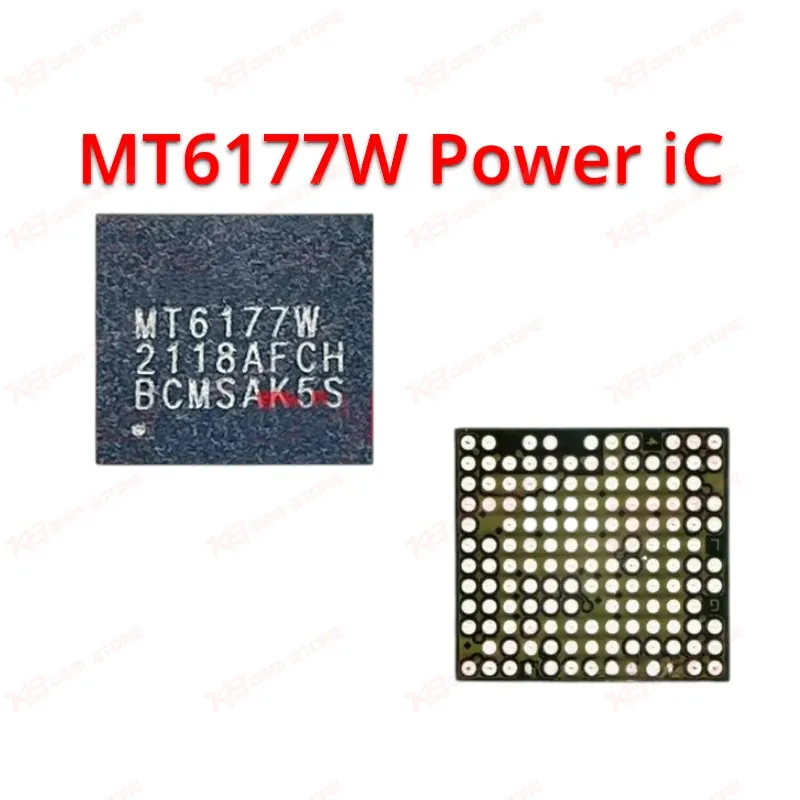
Open any Pakistani repair shop's IC drawer and you'll find the MT6177W sitting under "Power IC" — that's the market name, and it's the one you'll search for. Functionally, though, this chip sits in the RF signal chain as MediaTek's intermediate-frequency transceiver, bridging the baseband processor and the RF front-end module. When a phone loses network, drops calls randomly, or shows a weak or fluctuating signal bar that doesn't clear up after a software flash, this IC is one of the first hardware suspects on MediaTek-based boards. You'll run into the MT6177W most often on Redmi and Oppo boards, though it shows up across several other MediaTek device families too. On the Xiaomi side, it's common on Redmi 6, Redmi 6A, Redmi 9, Redmi 9A, Redmi 9C, Redmi Note 9, and Redmi Note 11 4G boards, plus POCO M2. On Oppo boards you'll find it on A1K, A3, A7Y, A73s, A15, A15s, A16, F3 Plus, F5, F7 Youth, and F9 Pro. It also turns up on Vivo Y12s, Y81, Y83, and Y91c, Infinix Hot 8, Motorola E6 Plus, E6 Play, G8 Play, and One Macro, Huawei Y6 2019 and Honor 8A, several Samsung A-series boards, and multiple Tecno Camon and Spark models. If you're servicing a mixed MediaTek repair queue, this is a chip worth keeping stocked rather than sourcing per job. Diagnosing a bad MT6177W follows the same logic you'd apply to any RF-chain fault. Start by ruling out SIM tray, antenna connector, and coax cable damage, then reflash the network/NV or IMEI partition if the board supports it. If the network issue persists after a clean flash and the RF front-end and antenna switch test fine, reflow the IC first — dry joints under a BGA package cause a large share of these failures, especially on boards that have been through a previous repair or drop. If reflow doesn't resolve it, a full reball or chip replacement using a matched MT6177W is the next step. Board cleaning before and after rework matters here more than most technicians expect, since flux residue near the RF section causes callback issues even when the reballing itself is clean. For the actual replacement job, you're working with a small-pitch BGA package, so a stencil-matched reballing setup, a controlled hot air station, and a microscope for post-reflow inspection are worth having on the bench before you start. Rushing the reflow profile on RF/IF ICs tends to produce intermittent signal faults that only show up after the customer has left the shop — cold joints here don't always fail immediately, which makes careful thermal control during installation more important than on simpler power ICs. Every MT6177W we stock is new and tested before it ships, so you're not gambling on a pulled part with unknown thermal history. Given how often this specific fault pattern shows up on MediaTek Redmi and Oppo boards passing through a Pakistani repair workshop, having a few of these on hand saves a same-day turnaround from turning into a two-day wait on parts.