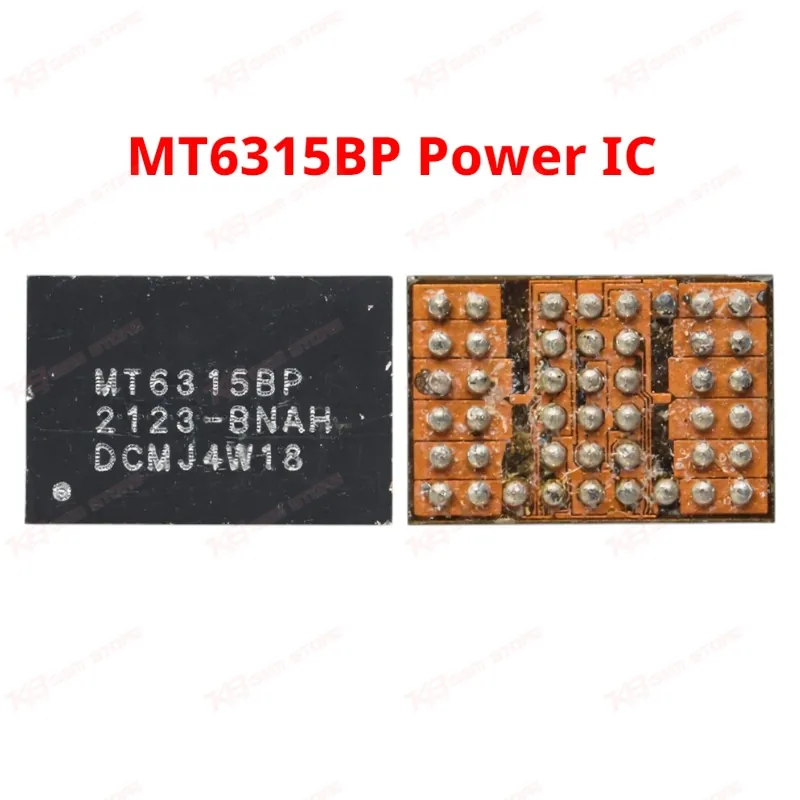
Mobile repair technicians working on MediaTek-powered devices run into this chip constantly, usually stamped "MT6315BP," "MT6315GP," or "MT6315FP" depending on the supplier lot. These markings are repair-trade naming conventions for MediaTek's MT6315 4-Phase Buck Converter, officially ordered from MediaTek as MT6315GP/B or MT6315LP/B. The underlying silicon and pinout are the same across these market-labeled variants — what differs between GP and LP versions is the default voltage configuration and which processor rail each buck phase drives. Functionally, the MT6315 is a dedicated CPU power IC, not a full PMIC. It sits between the main power management chip and the application processor, providing four independent step-down buck converters bundled into a 4-phase configuration. Each phase can deliver up to 5A, and the output voltage range runs from 0.4V to 1.19375V in 6.25 mV steps — fine enough resolution for dynamic voltage scaling on modern SoCs. On the GP/B variant, the four phases split across GPU, Processor-Little, and SOC_SRAM/audio rails. On the LP/B variant, all four phases combine to feed the Processor-Big core, which needs a heavier current load. For a repair bench, this chip becomes relevant during dead phone diagnosis. When a board shows no display, no charging response, or stays stuck at the logo despite a healthy main PMIC, checking the VCORE and VGPU output pins on the MT6315 is a standard next step. Since the IC pulls directly from VSYS through its PVDD pins, a shorted or dead MT6315 often drags down the whole battery rail, which shows up as a hardware fault with abnormal current draw at bench-supply testing. A boot loop issue that persists after a clean flash frequently traces back to one of these buck phases failing to reach its target voltage, since the processor won't complete its power sequencing without all rails present. The chip is fully controlled over SPMI or I2C, selectable by eFuse, with a dedicated EN pin for on/off control and a FAULTB output that reports alarms back to the main PMIC. Built-in protections include output short-circuit detection, input over-voltage lockout, and thermal shutdown at 150°C — features that matter on a repair bench because a failing downstream component (a shorted capacitor or a damaged CPU) can trip these protections and mimic a bad power IC when the real fault lies elsewhere. Technicians should verify surrounding passives and continuity on the VBUCK lines before condemning the chip itself. Physically, the MT6315 comes in a 45-pin WLCSP package measuring just 2.35 × 3.44 mm, which demands a hot air station with tight temperature control, fine-tip tweezers, and a stable microscope setup for reballing and placement. Reflow work on a package this small leaves little margin for pad damage, so preheating the board evenly and using proper flux discipline matters more here than on larger PMICs. Stock this IC alongside your ISP pinout tools, reballing stencils, and PCB holders — it's a recurring need on any bench that services MediaTek Helio and Dimensity-based handsets, where CPU power rail failure is one of the more common causes of a dead or non-booting board.