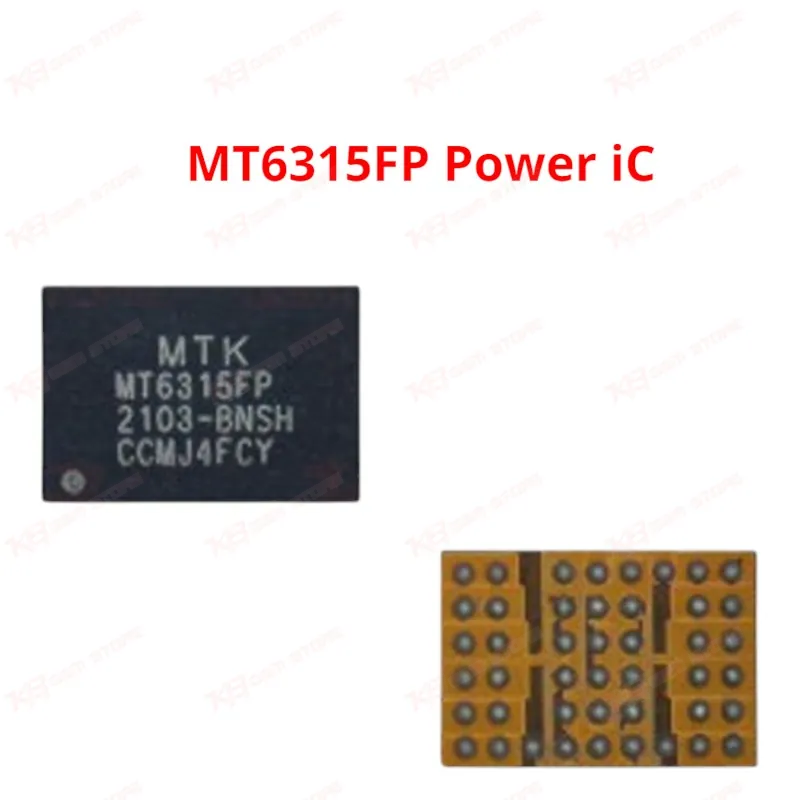
Mobile repair technicians dealing with dead phones, hang-on-logo faults, or boot loop issues on MediaTek-platform smartphones eventually run into the CPU power rail — and that's where the MT6315FP earns its place on the bench. This chip belongs to MediaTek's MT6315 4-phase buck converter family, a dedicated power management IC built specifically to feed voltage into the application processor rather than manage the phone's overall power tree the way a main PMIC does. At its core, the MT6315FP houses four independent high-efficiency step-down DC/DC converters. These four phases bundle together into a 4-phase buck configuration, letting the chip supply current to the CPU, GPU, and SoC SRAM rails simultaneously, each with its own switching node and feedback loop. Output current tops out at 5A per phase, giving the combined regulator enough headroom to handle the load swings of a modern application processor under heavy use — gaming, camera processing, or multitasking. Output voltage is programmable from 0.4V to 1.19375V in 6.25mV steps, with dynamic voltage scaling handled through the control interface or the SRCLKEN pin, so the processor can request voltage changes on the fly as workload shifts. Communication with the host processor runs through either an SPMI interface or an I2C-compatible serial interface, selectable via eFuse configuration at the factory. This flexibility is part of why you'll find MT6315-family chips across such a wide spread of device brands — OEMs configure the same silicon platform differently depending on their processor's control bus. On the protection side, the chip includes output short-circuit protection, input over-voltage protection, under-voltage lockout, and over-temperature shutdown, along with a dedicated FAULTB pin that reports fault conditions back to the main PMIC. That fault-reporting line matters on the bench: a board that won't power on can sometimes be traced back to this IC pulling the FAULTB line low and holding the whole power sequence hostage. For board-level repair, this is the IC you're chasing when a device shows dead-after-flash symptoms, random reboots tied to CPU load, or a board that draws current but never gets past the logo. Since the MT6315FP sits directly in the CPU/GPU power path, a damaged phase or shorted output pin often presents as a phone that powers on briefly, spikes current, then cuts out — a classic short-on-VBUCK pattern technicians test for with a multimeter in diode mode before committing to a reflow or replacement. Physically, the MT6315 family ships in a compact WLCSP package (45-pin, 2.35 × 3.44mm per MediaTek's official specification), which means reballing and hot air rework demand a steady hand, a fine-pitch stencil, and good thermal control — overheating adjacent components on a densely packed board is the real risk here, not the reflow of the IC itself. Operating temperature range is rated from -30°C to +85°C, and the input battery rail accepts 2.5V to 5V, matching typical Li-ion battery voltage swings from full charge down to cutoff. Stocking the MT6315FP makes sense for any workshop regularly servicing MediaTek Dimensity or Helio-based boards from Oppo, Realme, Infinix, Tecno, Xiaomi, Vivo, Samsung, and OnePlus. It's a recurring board-repair part precisely because CPU power ICs take the brunt of load-related stress and are one of the more common points of hardware failure on boards that have already been through a rough flash cycle or liquid exposure. Keep it alongside your reballing stencils and a working microscope, since confirming pad condition before reflow is what separates a clean repair from a repeat comeback.