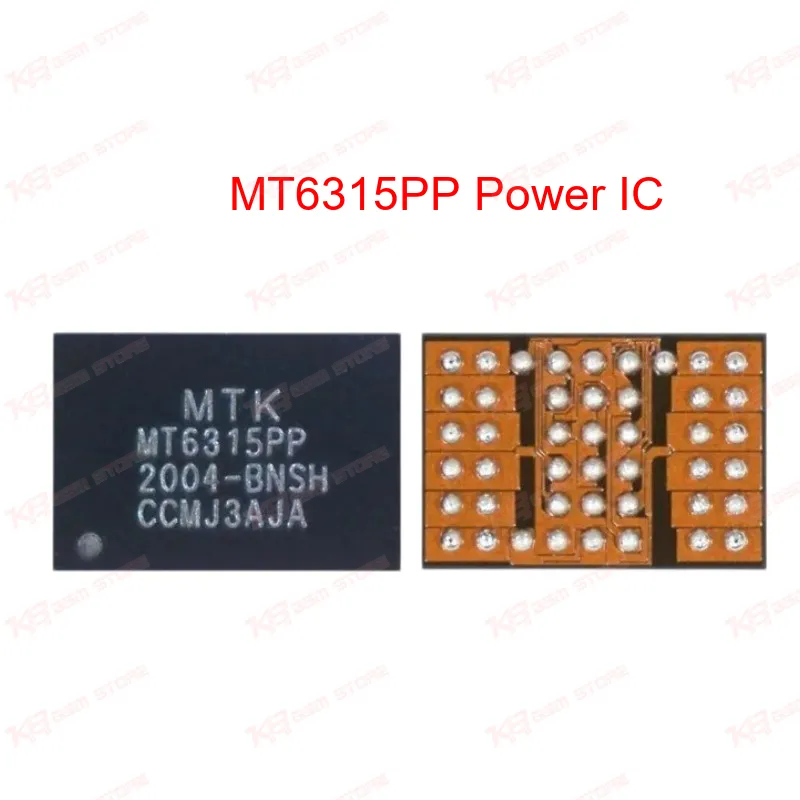
The MT6315PP belongs to MediaTek's MT6315 family of dedicated CPU core buck converters, built specifically to complement the MT6359 series PMIC in MediaTek's 5G smartphone power architecture. Rather than handling general system power like a main PMIC, the MT6315PP has one focused job: converting the battery-derived system voltage into the precise, tightly regulated voltage rails the CPU cores need to operate. In multi-core MediaTek SoCs, separate MT6315 devices are typically assigned to different core clusters, and MediaTek's own platform documentation confirms the PP variant is allocated to specific CPU core rails within this multi-phase arrangement. This distributed approach lets each core cluster get independently regulated power instead of sharing a single noisy rail, which improves efficiency and reduces the voltage droop that happens under heavy CPU load. Electrically, the MT6315 series operates as a 4-phase buck converter, splitting the current load across four internal phases to keep switching losses and heat generation low even under sustained high-current draw. During startup, the IC actively controls output slew rate, a design detail that limits voltage overshoot and inrush current when the phone powers on, protecting downstream CPU circuitry from transient stress. The IC also reports fault status flags back to the PMIC and SoC, which is part of why a failing MT6315PP so often produces board-level symptoms rather than a clean, isolated fault: the system can shut down protectively rather than run on unstable core voltage. For technicians, this IC becomes relevant in a specific failure pattern: a board that was working, then went completely dead, boot loops repeatedly, or hangs on the logo screen after physical stress like a drop, bend, or moisture exposure. Because the MT6315PP sits in the CPU power path, a short or open fault here can pull down the entire CPU rail, and on a multimeter this often reads as an abnormal short at the CPU core supply test point rather than at the battery or charging circuit. This is different from a charging IC fault, where the phone charges but won't power on, or a display IC fault, where the board boots but the screen stays black. Before reballing a suspected MT6315PP, it's worth confirming with a thermal camera or current-limited bench supply that the short traces back specifically to the CPU core rail and not a neighboring component, since misdiagnosis on a densely packed 45-pin WLCSP package wastes both the IC and the board's remaining pad integrity. Physically, the MT6315PP ships in a 45-pin WLCSP package measuring 2.35 x 3.44 mm, small enough that reballing requires a proper stencil, flux control, and a stable hot air profile to avoid pad lift or tombstoning during reflow. The IC is rated for operation across a -30°C to 85°C range, consistent with mobile-grade component standards. Given how tightly this component is tied to CPU boot behavior, technicians handling Dimensity-platform boards should treat MT6315PP replacement as a precision reballing job rather than a routine swap, and should verify the original part number and revision marking on the board before ordering a replacement, since MediaTek issues multiple lettered variants (NP, PP, QP, RP, SP, TP) assigned to different core positions across different chipset generations.