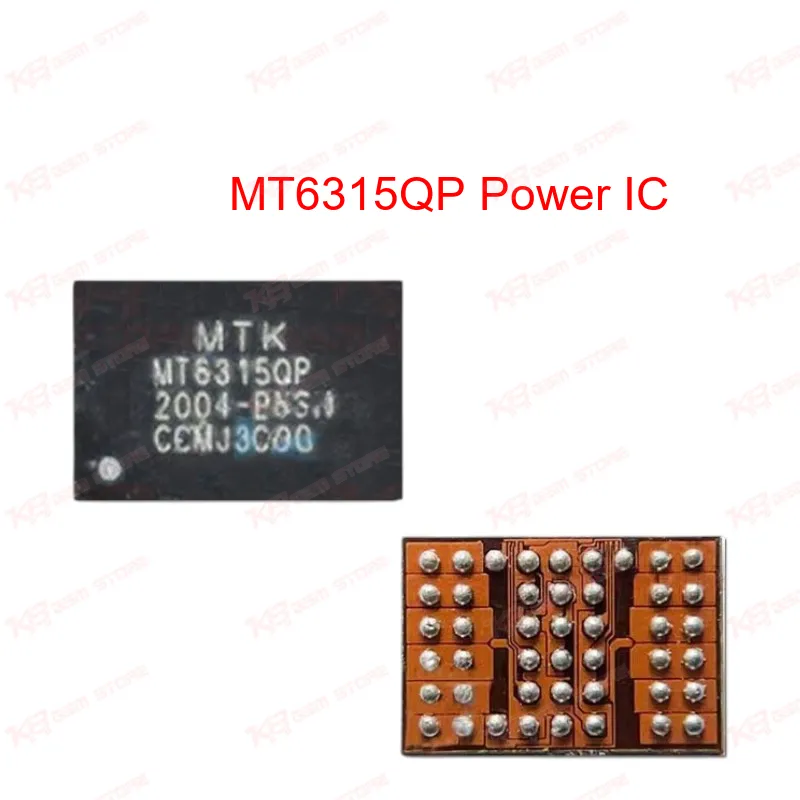
Board repair technicians dealing with a MediaTek-based Android phone that won't power on often trace the fault back to the CPU power management IC. The MT6315QP fits that exact repair scenario. It belongs to MediaTek's MT6315 family of 4-phase buck converters, a PMIC class built specifically to regulate voltage for application processors in smartphones, tablets, and similar portable devices. Inside the chip sit four independent step-down DC/DC converters. These get bundled into a 4-phase buck configuration through eFuse programming, letting the same silicon platform serve different phase arrangements depending on the host device's power design. Each phase handles up to 5A, and the output voltage range runs from 0.4V to 1.19375V in 6.25mV steps, with dynamic voltage scaling available through the SPMI or I2C interface or the SRCLKEN pin. That fine voltage granularity matters for CPU cores, where even small rail deviations cause instability, boot loops, or complete dead phone symptoms. The IC ships in a 45-pin WLCSP package measuring just 2.35×3.44mm, small enough to sit directly under the CPU on tightly packed mainboards. This size makes precision reballing mandatory during replacement — a misaligned ball or bridged pad on a package this dense will reintroduce the same fault you're trying to fix. Use a proper stencil, controlled hot air profile, and microscope inspection before and after reflow. Protection circuitry built into the MT6315QP includes output short-circuit protection, input over-voltage protection, under-voltage lockout (UVLO), and over-temperature shutdown. A dedicated FAULTB pin reports fault conditions back to the main PMIC, and a chip enable pin allows on/off control from the host system. During startup, the device manages output slew rate to limit voltage overshoot and inrush current, which reduces stress on downstream components during power-up sequencing. On the repair bench, this IC comes into play for several common fault patterns. A phone that's completely dead after a fall, liquid exposure, or a shorted component nearby often has damage on the buck converter feeding the CPU. Hang on logo issues, where the phone powers on but never completes boot, sometimes trace back to one of the four buck outputs failing to reach its target voltage. No display problems paired with warm or hot IC readings near the processor area also point toward a faulty power stage. Before condemning the IC itself, always check for shorts on the VBUCK and PVDD lines, confirm PGND continuity, and rule out a cracked CPU or damaged PCB trace — swapping the power IC won't fix a fault sitting elsewhere on the board. Since MediaTek sells this family under several top markings — QP, NP, RP, TP, SP, PP, FP, and OP among them — each tied to a different phase configuration and default voltage table for a specific chipset platform, matching the exact top marking to the board you're repairing is critical. Installing the wrong variant can leave a core rail under-powered or force incorrect default voltages, producing a boot loop instead of a fix. This part suits repair shops, GSM technicians, and mobile service centers running board-level IC replacement services on MediaTek Dimensity and Helio-based devices. Pair it with a hot air rework station capable of tight temperature control, a compatible reballing stencil, and continuity testing tools to confirm a clean replacement before reassembly.