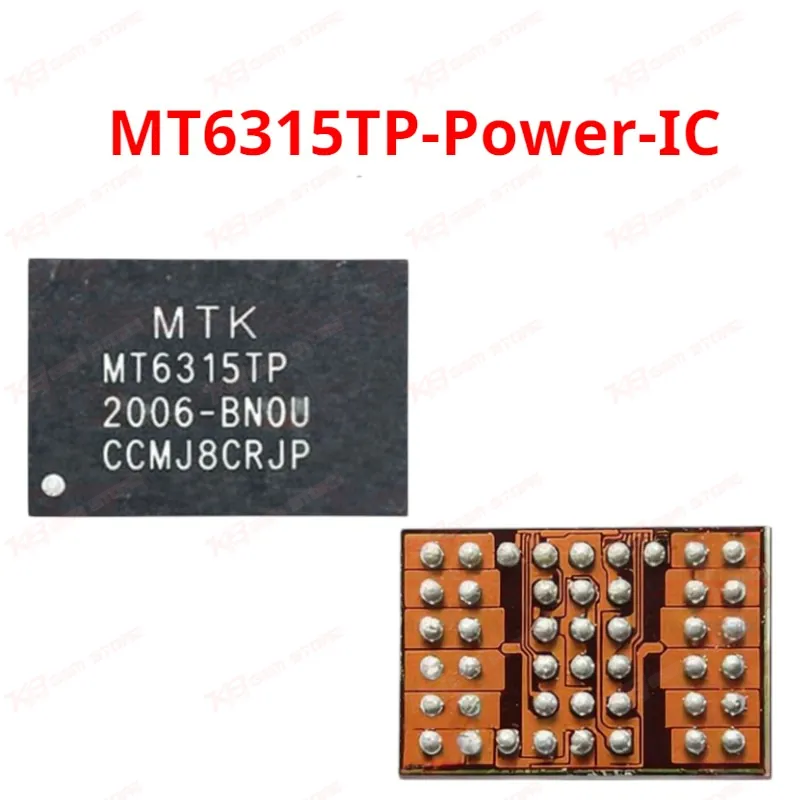
The MT6315TP/B belongs to MediaTek's MT6315 family of 4-phase buck converters, a chip you will run into constantly once you start opening up Dimensity 5G boards. Instead of one big regulator doing everything, MediaTek splits the job across four separate step-down DC/DC converters inside a single package, and those four phases get bundled together based on how much current a particular rail needs. On the TP/B variant specifically, this bundling supplies VSRAM_OTHERS, VSRAM_MD, and additional CPU-side buck rails as part of a coordinated power plan that also includes the MT6315PP/B and MT6315SP/B chips, all controlled by the main MT6359 PMIC. For a repair technician, understanding this three-chip relationship matters. When a Dimensity board comes in dead or stuck on logo, you are not just checking one IC — you are checking a small cluster of MT6315 variants that share responsibility for CPU-Little, CPU-Big, SRAM, and modem power. A short on any single VBUCK output can pull down the whole rail and trigger the main PMIC's protection circuit, which shuts the phone off before it even reaches the boot logo. That is why dead-after-drop or dead-after-liquid-damage boards so often trace back to one of these buck converter ICs rather than the PMIC itself. Electrically, the MT6315TP/B is built for tight, low-voltage precision work. Its output range of 0.4V to 1.19375V is exactly the kind of narrow, low-voltage window that modern ARM CPU cores need, and the 6.25 mV step size allows the system to fine-tune voltage on the fly through dynamic voltage scaling, dropping power when the CPU is idle and ramping it back up under load. Each of the four phases can push up to 5A, and the chip includes programmable over-current protection, output short circuit protection, input over-voltage protection, over-temperature shutdown, and input under-voltage lockout, so a lot of its own protective logic is baked in rather than left to the main PMIC. It also carries a dedicated FAULTB pin, which reports back to the system PMIC the moment something goes wrong on any of its rails — useful context if you are trying to figure out why a board is entering a fault loop. On the bench, this chip shows up in a 45-ball WLCSP package measuring roughly 2.35 by 3.44 mm — small enough that hot air rework and a steady hand under magnification are non-negotiable. Reflow work on packages this size calls for a proper preheat, controlled airflow, and flux that will not bridge the tightly spaced balls during reballing. Given the size, a microscope and fine-tip tools are standard equipment for anyone attempting removal or replacement rather than just diagnosis. In terms of where it fits in your repair workflow, the MT6315TP/B typically comes into play during CPU-side short circuit diagnosis, dead board triage, and power rail fault isolation on Dimensity 5G handsets. Technicians usually get to this chip after confirming with a current meter or thermal camera that one of the CPU or SRAM rails is drawing excess current, then isolate the fault down to this specific buck converter before committing to removal. Because it operates purely as a slave device controlled over SPMI or I2C by the main PMIC, a faulty MT6315TP/B rarely causes symptoms on its own — it is almost always diagnosed as part of a broader dead-phone or boot-loop investigation rather than in isolation.