


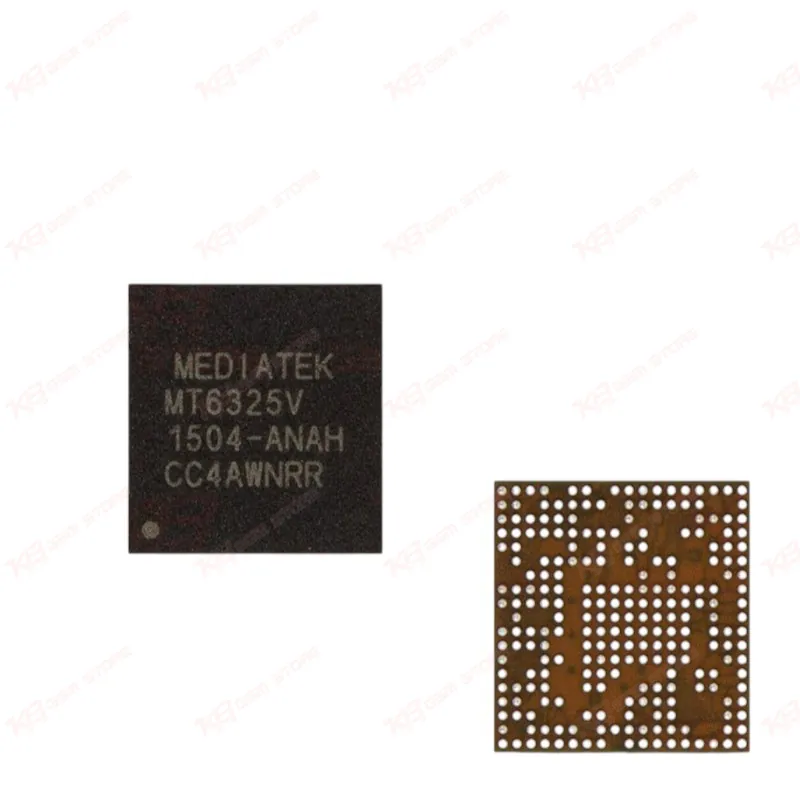
MT6325V Power IC
MT6325V Power IC
Regular price
Rs.350.00 PKR
Regular price
Sale price
Rs.350.00 PKR
Shipping calculated at checkout.
Quantity
Couldn't load pickup availability
The MediaTek MT6325V is a BGA-packaged power management IC built to regulate and distribute power across the mainboard of supported MediaTek-platform devices. Technicians reach for this chip when a board shows dead-after-flash symptoms, random shutdown, or a complete no-power fault traced back to the power rail rather than the battery or charging port. Rated for a 1.0V–6V supply range with 0.6W power dissipation, it fits directly into board-level rework where reballing and precision soldering are part of the daily workflow. This IC ships new and is meant for bench-level replacement, not end-user handling.
⚖️ Weight: 0.01 kg
SKU:MST-IC-74
- Safe & Secure Payment
- Fast Delivery
- WhatsApp Support


Description
FAQ
What is the product name?
The product name is the MediaTek MT6325V Power Management IC.
What is the brand of this product?
The brand of this product is MediaTek (MTK).
What is the model of this product?
The model of this product is MT6325V.
What is this product used for?
This product regulates and distributes power across the mainboard, and technicians use it to repair no-power and dead-after-flash faults.
Which devices are compatible with this product?
This product is compatible with the Lenovo IdeaTab A10-70 (A7600), Tab 2 A10-70F, Tab 2 A10-70L, A7000, P70, and Vibe S1.
Who should use this product?
This product is suitable for mobile repair technicians, repair shops, service centers, and professional users.
Does the MT6325V support both charging and power sequencing functions?
The MT6325V functions as a power management IC handling voltage regulation and power sequencing rather than charging IC functions, which sit on a separate chip in most MediaTek boards.
Can the MT6325V be reballed with a standard hot air rework station?
Yes, technicians reball the MT6325V using a standard hot air station with controlled, even preheat and microscope-assisted ball alignment before reflow.