Skip to product information
1 of 5

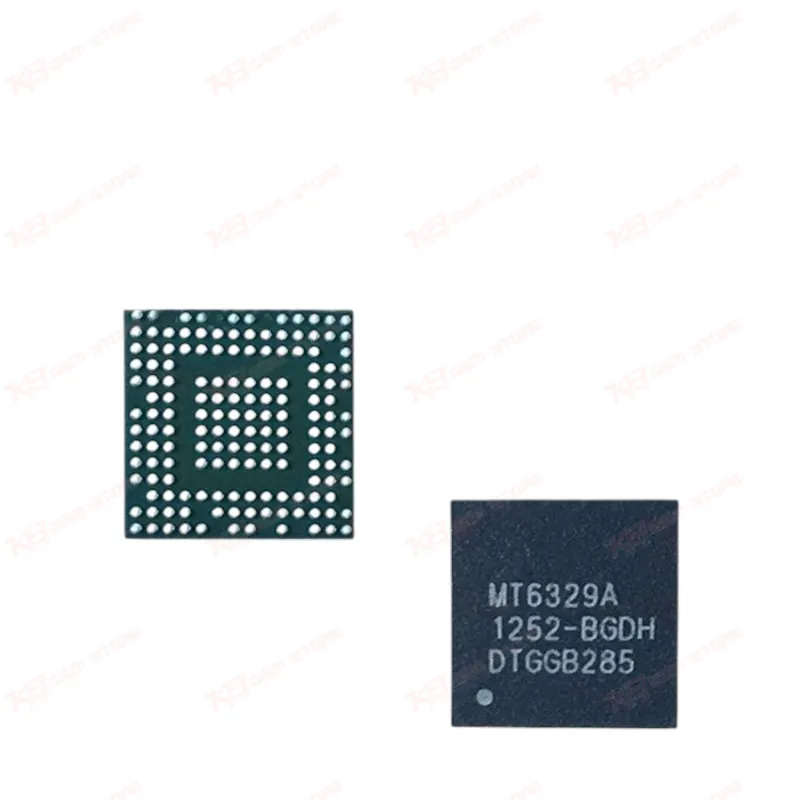
MT6329A Power IC

MT6329A Power IC

Regular price Rs.200.00 PKR
Regular price Sale price Rs.200.00 PKR
Sale Sold out
Shipping calculated at checkout.
Quantity

The MediaTek MT6329A is a power management IC built for MT6575-based 2G/3G handset boards. It runs 5 buck converters and 21 LDOs to feed every voltage rail on the board, from the baseband core to the display backlight. A GSM technician reaches for this IC when a board shows dead phone symptoms, hang on logo, or no charging response after a drop or short. The chip also drives dual-channel Class AB/D audio and controls WLED backlight strings through I2C. Use it for board-level reballing, IC change, or full power-section replacement on affected boards.

⚖️ Weight: 0.01 kg

SKU:MST-IC-35

  • Safe & Secure Payment
  • Fast Delivery
  • WhatsApp Support
View full details

Description

When a board comes into your workshop dead after flash, or the screen sticks at the logo with no further boot, the MT6329A is one of the first ICs you check on MT6575-based hardware. MediaTek designed this PMIC to run the entire power backbone of a 2G/3G handset — 5 buck converters and 21 LDOs sit inside a single BGA package, each one feeding a specific rail: baseband core, RF front end, memory, and peripheral blocks.You control every rail through I2C, so the IC talks to the baseband processor rather than running fixed voltages. This matters on your bench because a corrupted I2C line or a shorted rail inside the MT6329A often mimics a software fault. A phone stuck on hang on logo, or one that shows charging issue symptoms without actual battery damage, frequently traces back to a bad rail on this chip rather than a flash-related problem. Before you reach for the box to reflash, check continuity on the rails this IC drives — it saves you a wasted flashing cycle.The chip accepts a battery input between 3.4V and 4.3V, matching standard single-cell Li-ion packs used across MT6575 boards, and takes charger input up to 10V. That wide charger tolerance means the MT6329A also handles surge protection duties during charging. When a board arrives with charging issue after a cheap charger or a bad cable, the PMIC absorbs the abnormal input first — so it's a common failure point in charging-related dead boards.Beyond core power delivery, the MT6329A drives dual-channel Class AB/D audio amplifiers rated at 0.7W into 8Ω. If a board has a display problem paired with no audio output, don't assume two separate faults — both paths run through this same IC, so a single bad solder joint or internal short can present as multiple symptoms at once. The same chip controls WLED backlight strings, supporting up to 6 LEDs in parallel or a 10-LED series configuration, which covers most backlight architectures found on MT6575 panels.For technicians doing board-level repair, the MT6329A also manages RTC alarm timing and battery charging logic, with a selectable 1-step or 2-step RTC LDO design. This lets the RTC circuit hold time without a battery connected for several hours — useful to know when you're diagnosing a board that loses time settings after every power cycle; that's a strong sign the RTC LDO path on this IC needs attention, not a software reset.Reballing this IC calls for the same discipline as any BGA power chip: clean pad prep, correct paste volume per pad, and a controlled reflow profile to avoid bridging between the dense pin rows. Since the MT6329A carries multiple independent rails on one package, a single misaligned ball can take down power to more than one subsystem — so verify continuity on all major rails after reflow, not just the rail tied to your original symptom.Stock this IC if your workshop handles MT6575 platform repairs regularly. It's a recurring point of failure on boards that see charging abuse, liquid exposure, or drop damage, and having it on hand cuts your turnaround time on dead-board jobs considerably.

Key Features

  • 5 buck converters and 21 LDOs on a single BGA package
  • I2C interface for rail-by-rail voltage control
  • 3.4V–4.3V battery input range for standard Li-ion packs
  • Charger input tolerance up to 10V
  • Dual-channel Class AB/D audio amplifier, 0.7W into 8Ω
  • WLED backlight driver support up to 6 parallel or 10 series LEDs
  • Selectable 1-step/2-step RTC LDO for extended timekeeping without battery
  • Extended temperature rating from -40°C to 105°C

Specifications

Brand Entity MediaTek
Product Entity MT6329A Power Management IC
Technology Entity I2C multi-rail power management, PMIC
Compatible Device Entities MediaTek MT6575 platform boards
Repair Process Entity BGA reballing, IC reflow, board-level power repair
Industry Entity Mobile Repair Industry, PCB Repair, GSM Technician Workflow

Compatible Devices

MediaTek MT6575 chipset-platform 2G/3G smartphone boards — chipset-family scope, not device-brand-specific.

Common Repair Uses

Dead phone / no-power diagnosis, IC change for boards with hang on logo or boot loop, charging issue troubleshooting, power rail continuity testing, BGA reballing and reflow on MT6575 power sections.

FAQ

What is the product name?
The product name is MediaTek MT6329A Power Management IC.
What is the brand of this product?
The brand of this product is MediaTek.
What is the model of this product?
The model of this product is MT6329A.
What is this product used for?
This IC manages battery input, charger regulation, audio amplification, and backlight power on MT6575-based handset boards.
Which devices are compatible with this product?
This IC is compatible with boards built on the MediaTek MT6575 chipset platform.
Who should use this product?
This product suits mobile repair technicians, repair shops, service centers, and professional GSM technicians.
Does the MT6329A support both charging and audio functions on the same board?
Yes, it handles battery charging regulation and drives dual-channel Class AB/D audio on the same chip, so a fault here can affect both functions together.
Can a bad MT6329A cause a board to hang on logo without any software fault?
Yes, a shorted or corrupted power rail from this IC frequently causes hang on logo symptoms that look like a flash fault but are actually hardware-level.

Ask any Query