


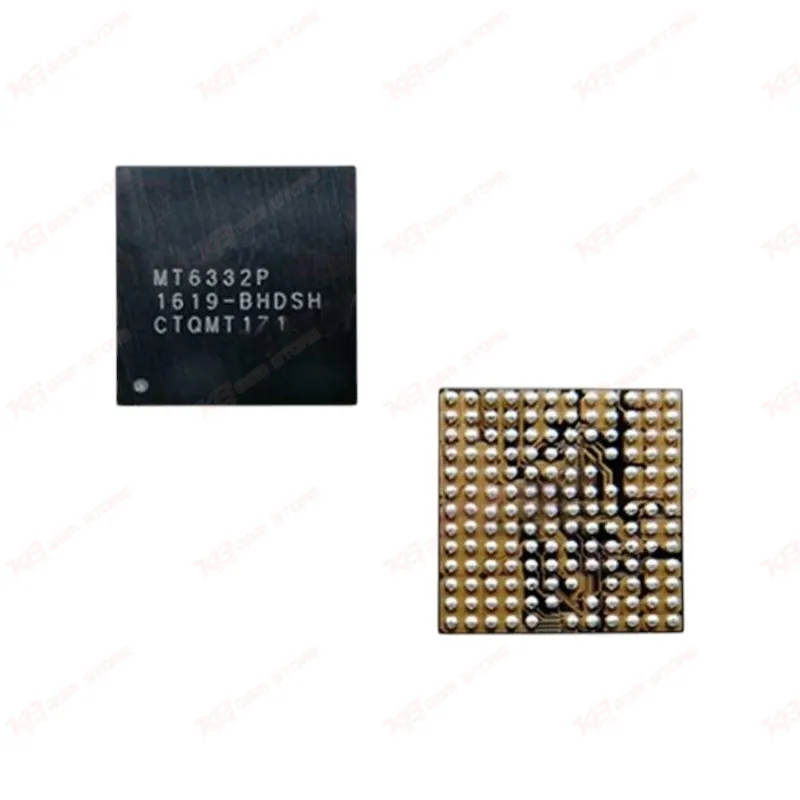
MT6332P Power IC
MT6332P Power IC
Regular price
Rs.300.00 PKR
Regular price
Sale price
Rs.300.00 PKR
Shipping calculated at checkout.
Quantity
Couldn't load pickup availability
The MT6332P/B is a MediaTek power management IC built for MTK-based smartphone motherboards, mainly found on Xiaomi and Meizu boards. This BGA chip handles DC-DC power conversion, battery charging regulation, and thermal protection at the board level. Technicians reach for this IC when a phone won't power on, stays dead after a flash attempt, or shows unstable charging tied to the power rail. This is a direct replacement part for board-level repair work, not a diagnostic tool. Handle it with hot air reballing equipment and proper BGA soldering skill, since misalignment on this chip creates new dead-board faults instead of fixing the original one.
⚖️ Weight: 0.01 kg
SKU:MST-IC-45
- Safe & Secure Payment
- Fast Delivery
- WhatsApp Support


Description
FAQ
What is the product name?
The product name is MT6332P/B MediaTek Power Management IC.
What is the brand of this product?
The brand of this product is MediaTek.
What is the model of this product?
The model of this product is MT6332P/B.
What is this product used for?
This product is used for board-level power management, battery charging control, and thermal protection on MediaTek-based smartphone motherboards.
Which devices are compatible with this product?
This product is compatible with MediaTek chipset-based Xiaomi and Meizu smartphones using the MT6332P/B power architecture, verified by matching the chip marking on your board.
Who should use this product?
This product is suitable for mobile repair technicians, repair shops, service centers, and professional users.
Does the MT6332P/B handle both battery charging and power regulation on the same chip?
Yes, it combines DC-DC power conversion, LDO regulation, and Li-ion/Li-polymer battery charging management in a single PMIC, so one chip failure can affect both power delivery and charging behavior.
Can a dead after flash fault be linked to this power IC?
Yes, a dead after flash state often points to a power sequencing fault between the MT6332P/B and the main chipset, since the PMIC controls the boot voltage sequence the SoC depends on to start up.