


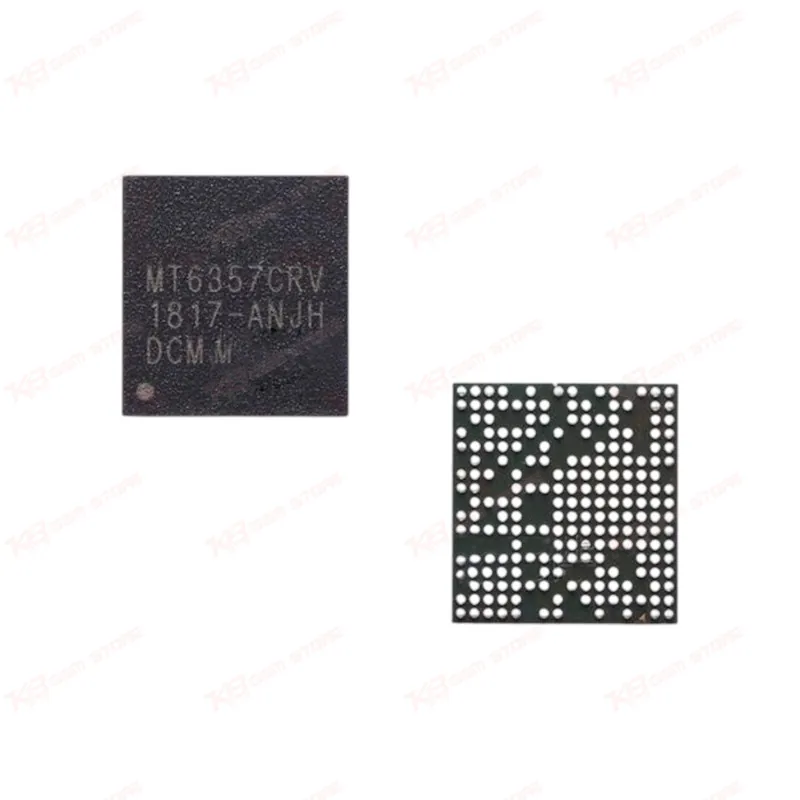
MT6357CRV Power IC
MT6357CRV Power IC
Regular price
Rs.350.00 PKR
Regular price
Sale price
Rs.350.00 PKR
Shipping calculated at checkout.
Quantity
Couldn't load pickup availability
The MT6357CRV is a MediaTek power management IC built for MTK-based smartphones running on Helio-series chipsets. It handles voltage regulation, battery charging control, and power distribution to the CPU, modem, camera, and display sections. Technicians use this IC to fix dead phone faults, charging issues, and hang on logo problems linked to power sequencing failure. The chip runs on 5 buck converters and 29 LDOs inside a compact VFBGA package, giving your repair bench a direct replacement part for common OPPO, Realme, Redmi, and Samsung PMIC faults without guessing on pinout or voltage rails.
⚖️ Weight: 0.01 kg
SKU:MST-IC-34
- Safe & Secure Payment
- Fast Delivery
- WhatsApp Support


Description
FAQ
What is the product name?
The product name is MT6357CRV MediaTek Power Management IC.
What is the brand of this product?
The brand of this product is MediaTek.
What is the model of this product?
The model of this product is MT6357CRV.
What is this product used for?
This IC regulates power distribution, battery charging, and voltage delivery across the CPU, modem, camera, and display sections of MediaTek-based smartphones.
Which devices are compatible with this product?
This IC is verified on OPPO A1K, OPPO A5S, OPPO A12, Realme C2, Redmi 6A, and Samsung A107F, with wider compatibility across Xiaomi, Redmi, Vivo, Infinix, and Honor devices built on MediaTek Helio-series platforms.
Who should use this product?
This product is suitable for mobile repair technicians, repair shops, service centers, and professional users.
Does this IC support ISP mode or SPI-based diagnostics for dead phones?
Yes, the MT6357CRV communicates with the baseband over an SPI interface, which technicians use during board-level diagnostics on dead phone cases before deciding on IC replacement.
What package type does this IC use, and does it affect reballing difficulty?
It uses a 209-pin VFBGA package at 7.0 x 6.6mm, which requires a stencil-matched hot air reflow process rather than manual jumper work due to the dense ball pitch.